CPQ software automates the configure, price, quote process for sales teams, reducing quote generation time from hours to minutes while eliminating pricing errors. These platforms handle complex product configurations, apply pricing rules automatically, and generate professional quotes that accelerate deal closure.
Modern CPQ platforms integrate with CRM systems, enforce approval workflows, and provide real-time pricing updates. Sales organizations using CPQ software report 30% faster quote generation and 25% reduction in pricing errors compared to manual processes.
What is CPQ Software
Configure, Price, Quote (CPQ) software streamlines the sales quoting process by automating product configuration, pricing calculations, and quote generation. The system guides sales representatives through complex product selections, applies business rules for valid configurations, and calculates accurate pricing based on predefined rules and discount structures.
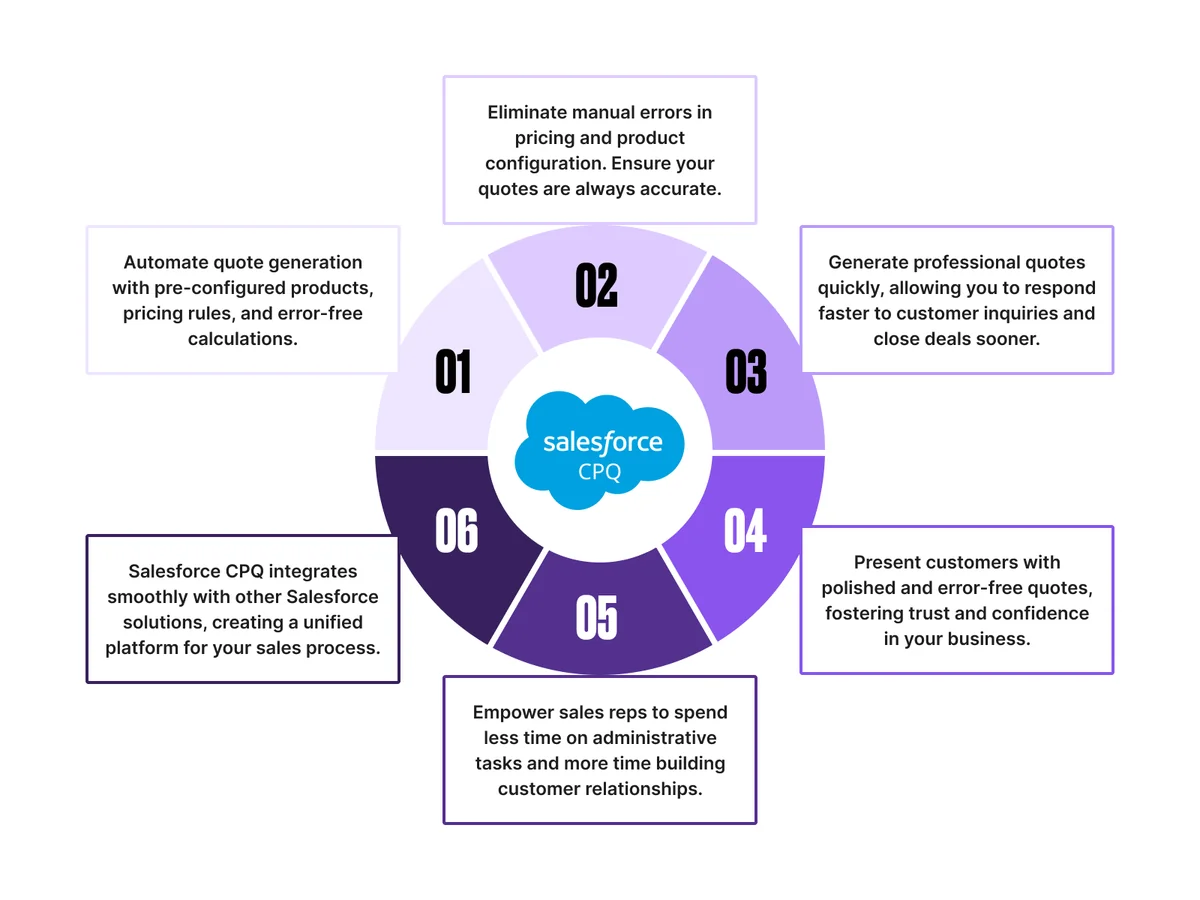
CPQ platforms handle three core functions:
- Configure: Product selection and bundling with validation rules
- Price: Automated pricing calculations with discounts and promotions
- Quote: Professional document generation with approval workflows
Enterprise organizations benefit most from CPQ implementation due to complex product catalogs, multiple pricing tiers, and lengthy approval processes. Manufacturing, technology, and professional services industries commonly deploy CPQ solutions to manage intricate product configurations and pricing models.
Top CPQ Vendors and Platforms
The CPQ market includes established enterprise vendors and specialized solutions targeting specific industries. Each platform offers distinct capabilities for configuration management, pricing automation, and quote generation.
Salesforce CPQ
Salesforce CPQ operates natively within Sales Cloud, providing seamless integration with existing Salesforce data and workflows. The platform handles complex product hierarchies, subscription billing, and multi-dimensional pricing models.
Key capabilities include:
- Product and price rules for automated configuration validation
- Quote line groups for organizing complex quotes by location or product type
- Contracted pricing for customer-specific discount structures
- Automated renewal processing for subscription products
- Twin fields for synchronized data entry across quote objects
Salesforce CPQ requires Sales Cloud licenses and additional CPQ user licenses. Implementation complexity varies based on product catalog size and pricing rule requirements.
Oracle CPQ Cloud
Oracle CPQ provides guided selling workflows and visual product configuration for complex manufacturing scenarios. The platform integrates with Oracle ERP systems and supports multi-currency, multi-language quote generation.
Core features include:
- Visual product configurator with 3D modeling capabilities
- Dynamic pricing with real-time cost calculations
- Subscription order management for recurring revenue models
- Contract lifecycle management with automated renewals
- AI-powered deal insights for pricing optimization
SAP CPQ
SAP CPQ integrates with SAP ERP and CRM systems, leveraging existing master data for product configuration and pricing. The platform supports variant configuration for highly customizable products.
Notable capabilities:
- Advanced configuration management with constraint-based rules
- Margin protection with automated approval workflows
- Real-time data synchronization across SAP landscape
- Multi-channel support for e-commerce and partner portals
- Comprehensive analytics for sales performance tracking
Salesforce CPQ Competitors Analysis
Organizations evaluating Salesforce CPQ alternatives consider factors including integration requirements, pricing models, and industry-specific functionality. Each competitor offers unique strengths for different use cases.
Conga CPQ (Revenue Lifecycle Cloud)
Conga CPQ focuses on revenue optimization through intelligent pricing and contract management. The platform provides open architecture for custom integrations and supports complex subscription models.
Competitive advantages:
- Revenue intelligence with AI-powered pricing recommendations
- Contract lifecycle automation from quote to renewal
- Document generation with advanced template management
- Asset-based ordering for existing customer expansions
- Multi-CRM support including Salesforce and Microsoft Dynamics
ConnectWise Sell
ConnectWise Sell targets managed service providers and IT solution providers with industry-specific templates and PSA integration. The platform streamlines technology product quoting with automated vendor data sourcing.
Key differentiators:
- IT-focused product catalog with vendor integrations
- Procurement automation for approved quotes
- Native mobile application for field sales teams
- Renewal reminder automation for service contracts
- Integration with ConnectWise Manage PSA platform
PandaDoc CPQ
PandaDoc combines CPQ functionality with document automation and e-signature capabilities. The platform serves small to mid-market organizations requiring simple configuration and pricing workflows.
Primary features:
- Drag-and-drop quote builder with product catalog integration
- Electronic signature workflow for quote approvals
- Payment processing integration for immediate deal closure
- Template library for standardized quote formats
- CRM integration with popular platforms including HubSpot and Pipedrive
CPQ Platforms Feature Comparison
CPQ platform selection depends on specific business requirements including product complexity, pricing models, and integration needs. The following comparison highlights key capabilities across major vendors.
| Feature | Salesforce CPQ | Oracle CPQ | SAP CPQ | Conga CPQ |
|---|---|---|---|---|
| Visual Configuration | Advanced | 3D Modeling | Variant Config | Rule-Based |
| Subscription Billing | Native | Advanced | Integrated | Comprehensive |
| Mobile Access | Salesforce Mobile | Responsive Web | Native App | Separate App |
| API Capabilities | REST/SOAP | REST | REST/OData | REST/GraphQL |
| Deployment Options | Cloud Only | Cloud/On-Premise | Cloud/Hybrid | Cloud/On-Premise |
Integration Capabilities
CPQ platforms require integration with existing business systems including CRM, ERP, and billing platforms. Native integrations reduce implementation complexity and ongoing maintenance requirements.
Salesforce CPQ provides seamless integration within the Salesforce ecosystem but requires custom development for non-Salesforce systems. Oracle and SAP CPQ leverage existing enterprise system investments through pre-built connectors.
Third-party integration platforms like MuleSoft, Zapier, and Microsoft Power Automate enable connections between CPQ systems and business applications. API quality and documentation impact integration success and long-term maintainability.
Top CPQ Solutions to Reduce Quoting Errors
Quoting errors cost organizations revenue through incorrect pricing, invalid product configurations, and delayed deal closure. CPQ solutions address these challenges through automated validation, approval workflows, and real-time pricing updates.
Error Prevention Mechanisms
Modern CPQ platforms implement multiple error prevention strategies:
- Configuration Rules: Prevent invalid product combinations through constraint-based logic
- Pricing Validation: Automated margin checks and discount limit enforcement
- Approval Workflows: Multi-level review processes for high-value or high-discount quotes
- Data Synchronization: Real-time updates from product and pricing master data
- Template Standardization: Consistent quote formats with automated field population
Quality Assurance Features
Enterprise CPQ platforms provide quality assurance capabilities that reduce manual review requirements:
- Automated testing of pricing rules and product configurations
- Version control for quote templates and business rules
- Audit trails for quote modifications and approvals
- Integration testing tools for connected systems
- Performance monitoring for quote generation processes
CPQ Implementation Best Practices
Successful CPQ implementation requires careful planning, stakeholder alignment, and phased deployment. Organizations should prioritize data quality, user training, and change management throughout the implementation process.
Pre-Implementation Planning
Before selecting a CPQ platform, organizations should:
- Document current quoting processes and pain points
- Catalog product hierarchy and configuration rules
- Map pricing structures and discount policies
- Identify integration requirements with existing systems
- Define success metrics and ROI expectations
Data Migration Strategy
CPQ success depends on accurate product, pricing, and customer data. Migration planning should include:
- Data cleansing and standardization procedures
- Mapping between legacy and CPQ data models
- Validation rules for imported data quality
- Rollback procedures for migration issues
- Testing protocols for data accuracy verification
CPQ ROI and Performance Metrics
Organizations measure CPQ success through operational efficiency gains, revenue impact, and user adoption metrics. Typical ROI realization occurs within 6-12 months of full deployment.
Key Performance Indicators
CPQ performance tracking includes:
- Quote Generation Time: Average time from request to delivery
- Quote Accuracy: Percentage of quotes requiring revision
- Win Rate: Percentage of quotes converting to orders
- Deal Size: Average quote value and upselling success
- User Adoption: Platform usage rates across sales teams
Leading organizations report 40-60% reduction in quote generation time and 15-25% improvement in win rates following CPQ implementation. Revenue per quote typically increases through better upselling and cross-selling capabilities.
Future of CPQ Technology
CPQ platforms continue evolving with artificial intelligence, machine learning, and advanced analytics capabilities. These technologies enable predictive pricing, automated product recommendations, and intelligent deal insights.
Emerging Capabilities
Next-generation CPQ features include:
- AI-powered pricing optimization based on market conditions and competitor analysis
- Predictive analytics for deal probability and revenue forecasting
- Natural language processing for automated quote generation from customer requirements
- Augmented reality visualization for complex product configurations
- Blockchain integration for contract verification and compliance tracking
Cloud-native architectures enable faster deployment, automatic updates, and improved scalability. API-first designs support ecosystem integration and custom application development.
Frequently Asked Questions
What is the difference between CPQ software and CRM?
CPQ software focuses specifically on configure, price, quote processes while CRM manages the entire customer relationship lifecycle. CPQ platforms integrate with CRM systems to access customer data and opportunity information but provide specialized functionality for product configuration, pricing calculations, and quote generation that CRM systems lack.
How long does CPQ implementation typically take?
CPQ implementation duration varies from 3-6 months for simple deployments to 12-18 months for complex enterprise implementations. Factors affecting timeline include product catalog size, pricing rule complexity, integration requirements, and customization needs. Phased rollouts often reduce risk and accelerate time-to-value.
Which CPQ vendors offer the best integration capabilities?
Salesforce CPQ provides seamless integration within the Salesforce ecosystem, while Oracle and SAP CPQ excel at integrating with their respective enterprise software suites. Conga CPQ offers multi-CRM support and open architecture for custom integrations. Integration quality depends on your existing technology stack and specific requirements.
What are the main benefits of using CPQ platforms?
CPQ platforms deliver faster quote generation, improved pricing accuracy, reduced manual errors, and enhanced sales productivity. Organizations typically see 30-50% reduction in quote creation time, 20-30% fewer pricing errors, and 15-25% improvement in win rates. Additional benefits include standardized processes, better compliance, and improved customer experience.
How do CPQ solutions help reduce quoting errors?
CPQ solutions reduce quoting errors through automated validation rules, real-time pricing updates, configuration constraints, and approval workflows. The systems prevent invalid product combinations, enforce pricing policies, validate discount limits, and maintain synchronized data across systems. Template standardization and automated calculations eliminate manual entry errors.