Anypoint Platform is MuleSoft’s environment for designing APIs, building integrations, deploying Mule applications, applying runtime policies, publishing reusable assets, and monitoring production traffic. Salesforce teams use it when business processes must exchange data with ERP, billing, identity, data warehouse, partner, or legacy systems without placing every integration inside Apex.
This Anypoint Platform guide explains the product as an API lifecycle rather than a list of screens. It also shows where Salesforce responsibilities end, where MuleSoft responsibilities begin, and how teams can build maintainable integrations using reusable System, Process, and Experience APIs.
What Is Anypoint Platform?
Anypoint Platform combines integration development and full-lifecycle API management. Teams can define an API contract, discover reusable assets, implement Mule flows, transform payloads, deploy runtimes, enforce policies, and observe API traffic through one product family.
MuleSoft documentation separates the control plane, where configuration and management occur, from the runtime plane, where Mule applications and gateways process traffic. This distinction matters when selecting hosting locations, network routes, data residency controls, and operational responsibilities.
Anypoint Platform is not a replacement for Salesforce configuration, Flow, Apex, or event-driven features. It becomes useful when a process crosses application boundaries, needs protocol mediation, requires centralized API governance, or must support several consumers without duplicating point-to-point code.
MuleSoft: What Is It and Where Does Anypoint Fit?
For searches phrased as mulesoft what is it, the practical answer is that MuleSoft is Salesforce’s integration and automation product family. Anypoint Platform is its main environment for integration development and API management. Mule runtime components execute integration logic, while platform services support design, reuse, access control, deployment, policies, governance, and operations.
Not every connection requires MuleSoft. A same-org record update may belong in Salesforce Flow. A multi-system order process with retries, canonical data models, API consumers, credentials, monitoring, and recovery requirements is a better candidate for Anypoint Platform.
Any Point Versus Anypoint
Any point is a normal English phrase. Anypoint is the MuleSoft product name and is written as one word. Search results sometimes mix the terms, but architecture documents, API specifications, asset names, and internal standards should use the official spelling.
Which MuleSoft Features Are Included in Anypoint Platform?
The available products and limits depend on the organization’s subscription and entitlements. The following MuleSoft features cover the common API and integration lifecycle. Access to a screen does not mean that every deployment target, connector, policy, or monitoring function is licensed.
| Capability | Primary use | Typical owner |
|---|---|---|
| API Designer and Design Center | Define RAML or OpenAPI contracts and reusable specification fragments | API designer or integration developer |
| Anypoint Exchange | Publish and discover APIs, templates, examples, connectors, and other assets | Platform team and developers |
| Anypoint Code Builder or Anypoint Studio | Implement, test, debug, and package Mule applications | MuleSoft developer |
| Runtime Manager | Deploy and operate Mule applications across supported runtime targets | Operations or platform engineer |
| API Manager | Manage API instances, contracts, gateway policies, and client access | API product owner or platform engineer |
| API Governance | Apply governance rulesets to API and service specifications | Architecture or governance team |
| API Visualizer | View discoverable APIs and Mule applications as an application network | Architect or product owner |
| Anypoint Monitoring | Inspect supported logs, dashboards, telemetry, and alerts | Support or site reliability team |
Anypoint MuleSoft API Visualizer
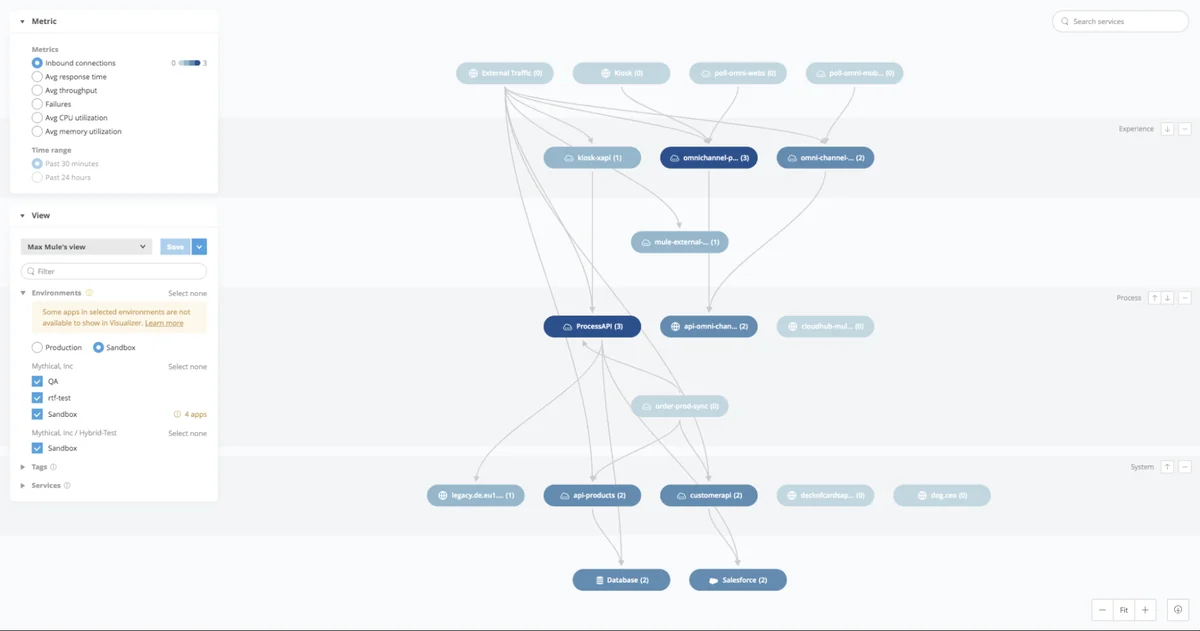
API Visualizer provides a graphical view of discoverable APIs and Mule applications. Architects can use it to inspect runtime relationships, identify connected services, and determine whether a proposed integration can reuse an existing interface.
The visualization does not replace a reviewed architecture model, data classification, dependency register, or disaster-recovery design. It should support architecture decisions rather than become the only source of system documentation.
Anypoint Exchange for Reusable Assets
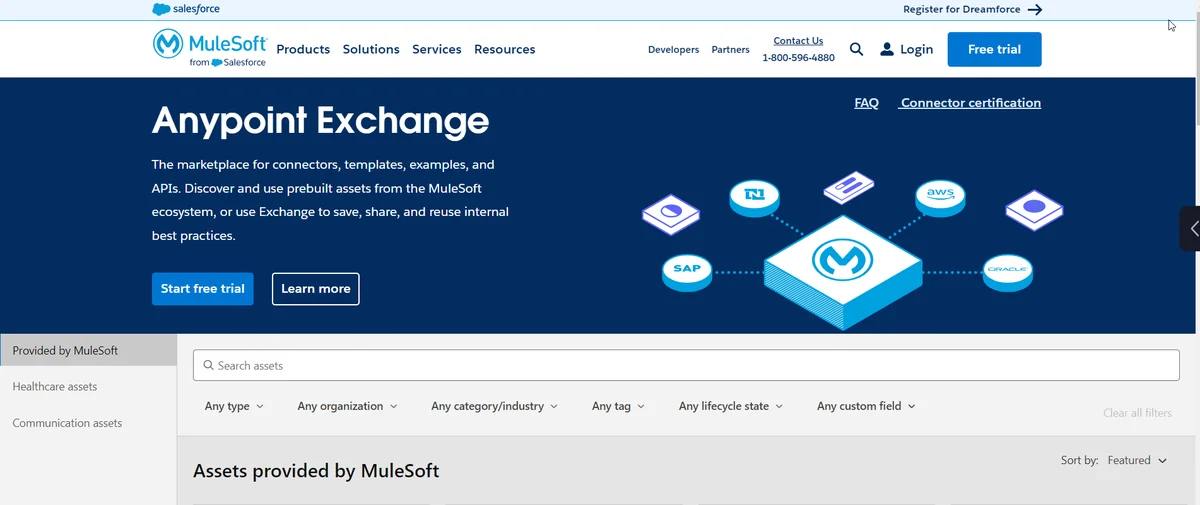
Anypoint Exchange is the catalog for reusable assets. A platform team can publish API specifications, examples, templates, custom connectors, policies, and documentation for internal consumers.
Reuse works only when assets have owners, semantic versions, lifecycle states, support expectations, and usable documentation. Publishing an unsupported connector or an undocumented API does not make it reusable.
API Designer and Contract-First Development
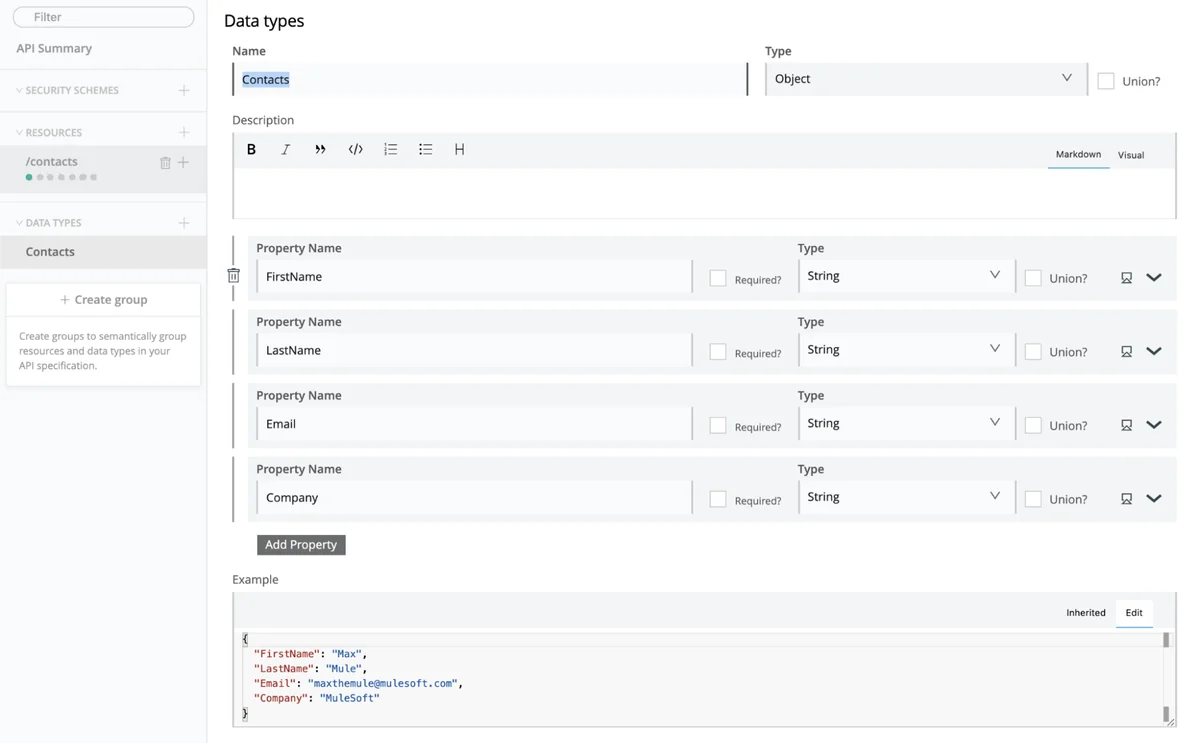
API Designer supports contract-first work with RAML and OpenAPI specifications. Define resources, methods, schemas, examples, errors, and security schemes before implementation. A reviewed contract allows Salesforce, web, mobile, and partner teams to build against the same interface while the Mule implementation is still being developed.
Runtime Manager
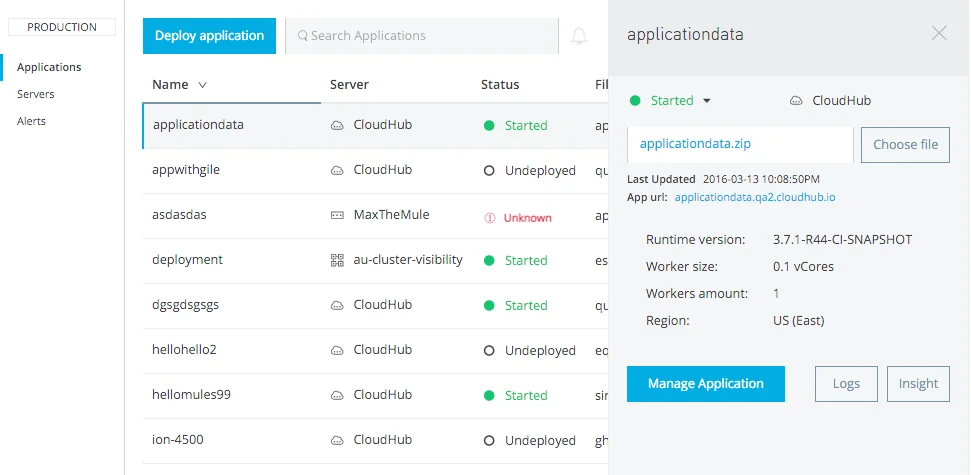
Runtime Manager gives operators a central view of supported Mule applications, servers, APIs, and environments. Teams use it for deployment, configuration, status review, and operational management across supported cloud and customer-managed runtime targets.
Keep environment-specific values in secure configuration. Do not embed client secrets, passwords, certificates, hostnames, or production endpoint URLs in application source.
Anypoint Code Builder and Anypoint Studio
MuleSoft currently documents both Anypoint Code Builder and Anypoint Studio for development workflows. Studio is the desktop IDE used to create Mule projects, configure connectors, debug flows, run tests, and deploy supported applications. Code Builder provides browser and desktop development experiences for supported API and integration tasks.
Choose a standard toolchain for the team, then keep project source, tests, dependency versions, and deployment configuration in version control. Do not rely on an exported deployment package as the only copy of an integration.
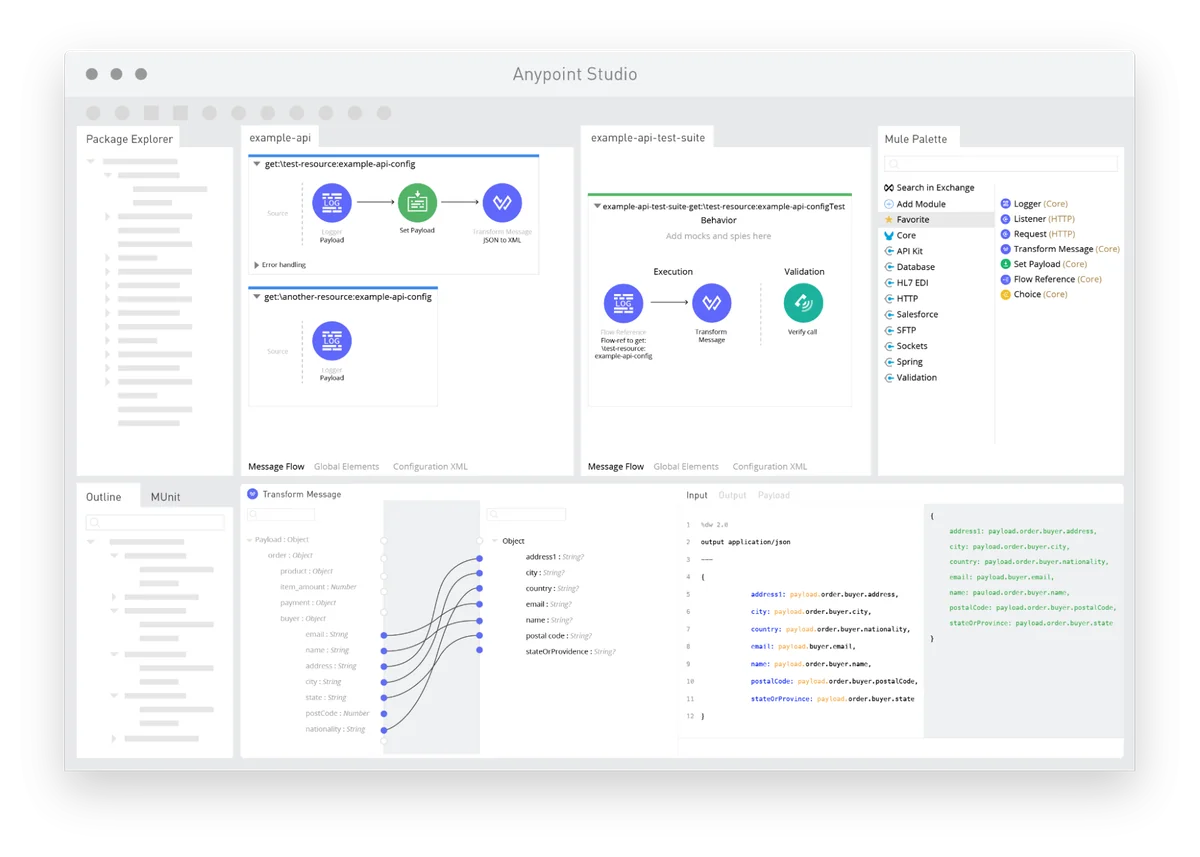
Monitoring and API Analytics
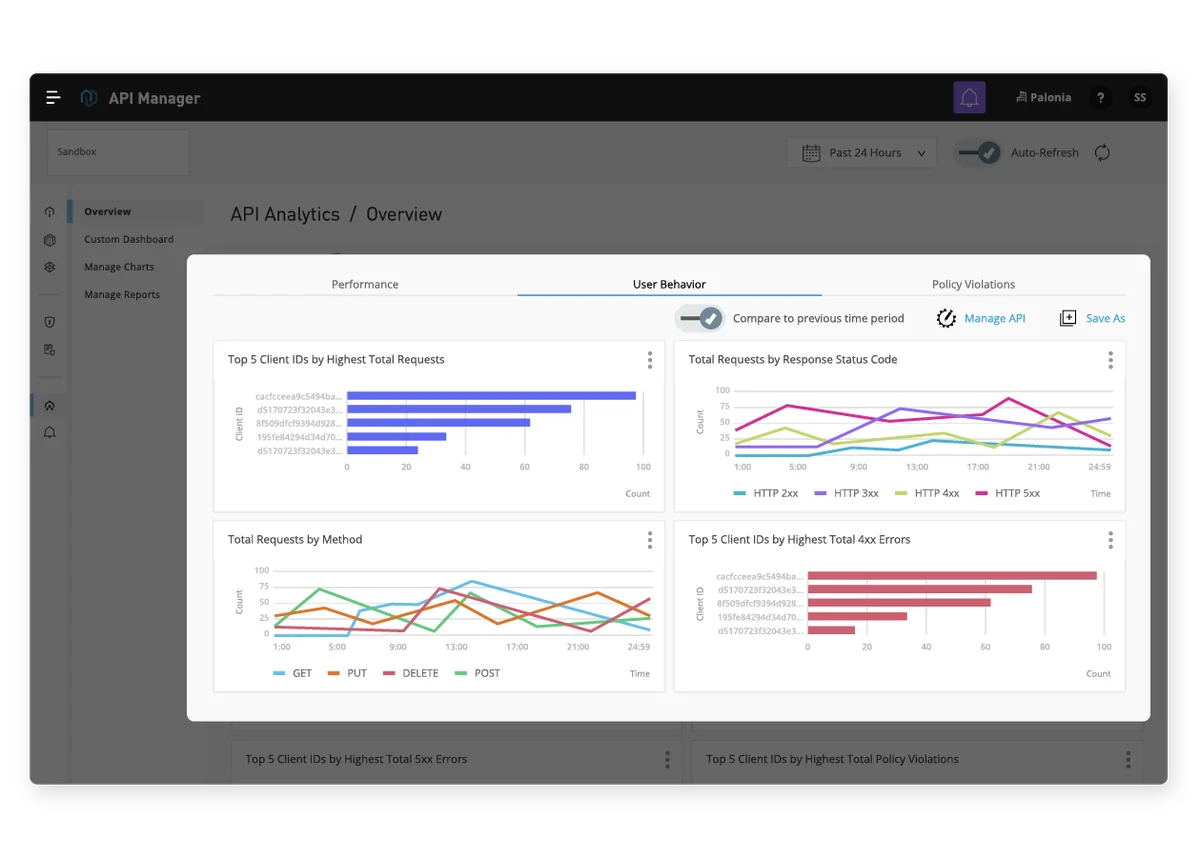
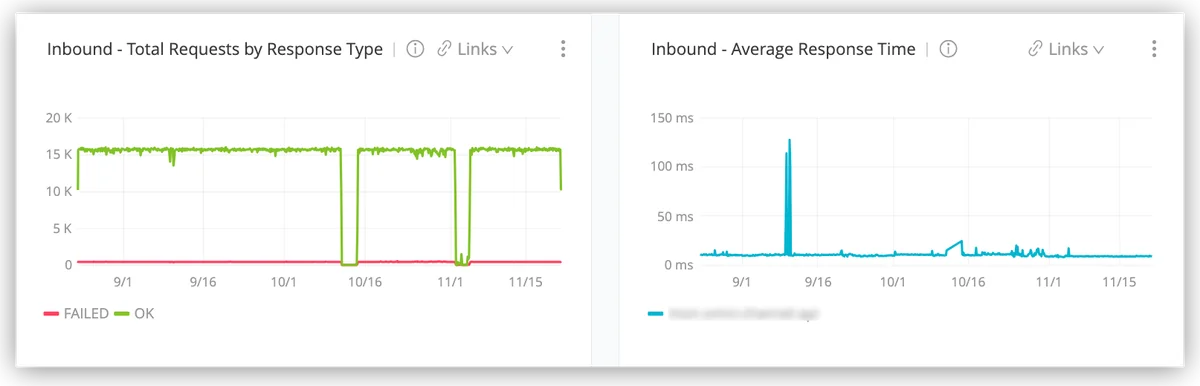
Operational teams need more than a successful deployment status. Track request volume, latency, error rate, dependency failures, queue depth where applicable, and business outcomes such as orders rejected or accounts not synchronized.
Monitoring retention, available dashboards, and telemetry differ by product entitlement and runtime target. Confirm logging, alerting, escalation, and retention requirements before production cutover.
API Manager and Gateway Policies
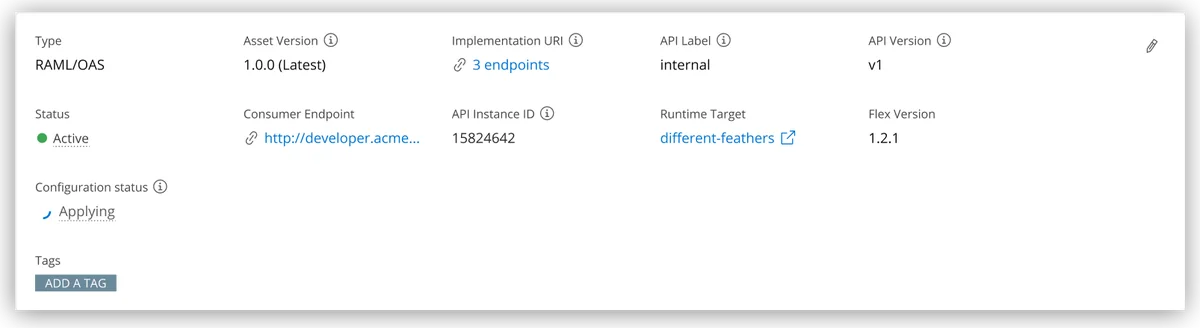
API Manager manages API instances, client contracts, and gateway controls. Depending on the gateway and entitlement, teams can apply policies for authentication, client enforcement, rate limiting, and traffic management without implementing the same controls in every Mule flow.
A gateway policy is not a complete security model. Backend authorization, object-level access, record filtering, data masking, secret management, and consumer entitlements still require explicit design.
How Does the Anypoint Platform API Lifecycle Work?
- Discover: Search Exchange and the existing application network before creating another interface.
- Design: Define the API contract, examples, errors, security scheme, ownership, and versioning policy.
- Validate: Review naming, compatibility, data classification, governance rules, and consumer requirements.
- Implement: Build Mule flows, routing, connectors, transformations, and error handlers.
- Test: Add unit, contract, negative, performance, and dependency-failure tests.
- Deploy: Promote the same tested artifact while injecting environment-specific configuration.
- Manage: Register the API instance, apply policies, approve contracts, and control client access.
- Observe: Monitor availability, latency, errors, saturation, and business processing outcomes.
- Retire: Announce deprecation, identify remaining consumers, provide a migration window, and remove the old version.
The Anypoint Platform lifecycle avoids a common failure mode: building a working Mule flow first and deciding later how consumers authenticate, which errors they receive, or how the API will be versioned.
Example RAML Contract
The following RAML 1.0 fragment defines a Salesforce account lookup API. It uses a path parameter, a typed JSON response, and explicit error responses. Production specifications can place shared data types, traits, and security schemes in reusable fragments when several APIs use them.
#%RAML 1.0
title: Customer Account API
version: v1
baseUri: https://api.example.com/customer/{version}
mediaType: application/json

types:
  AccountSummary:
    type: object
    properties:
      id: string
      name: string
      industry?: string
      lastModifiedDate: datetime

/accounts/{accountId}:
  uriParameters:
    accountId:
      type: string
      minLength: 15
      maxLength: 18
  get:
    responses:
      200:
        body:
          application/json:
            type: AccountSummary
      404:
        body:
          application/json:
            example:
              code: ACCOUNT_NOT_FOUND
              message: No account was found for the supplied identifier.
      502:
        body:
          application/json:
            example:
              code: SALESFORCE_UNAVAILABLE
              message: The upstream Salesforce service could not be reached.
How Do You Integrate Salesforce with Anypoint Platform?
Consider an order process in which Salesforce captures the customer request, an ERP owns inventory and invoicing, and a logistics provider owns shipment status. A point-to-point design places ERP and carrier details inside Salesforce automation. An API-led design isolates those systems behind reusable interfaces.
| API layer | Responsibility | Example |
|---|---|---|
| System API | Expose a stable interface to one system of record | Salesforce Customer System API or ERP Order System API |
| Process API | Orchestrate rules and data across systems | Order Fulfilment Process API |
| Experience API | Shape data for a channel or consumer | Partner Order Status API |
A Salesforce automation can publish a platform event or call an authenticated API, depending on latency, transaction, and recovery requirements. MuleSoft can validate the request, transform the payload with DataWeave, call the ERP, handle retryable failures, and return or publish a normalized result.
For asynchronous processing, include an idempotency key so a replay does not create the same order twice. The key can be a stable external order number or a generated request identifier persisted by the receiving system.
Sample DataWeave Transformation
%dw 2.0
output application/json
var account = payload.account
---
{
  correlationId: attributes.headers.'x-correlation-id' default uuid(),
  customer: {
    salesforceId: account.Id,
    name: account.Name,
    billingCountry: account.BillingCountry default "UNKNOWN"
  },
  order: {
    externalOrderNumber: payload.orderNumber,
    requestedDate: payload.requestedDate as Date
  }
}
DataWeave transformations should not silently coerce every invalid value. Define required fields in the API contract, reject malformed input with a stable error code, and log a correlation ID rather than the complete payload when records may contain personal or regulated data.
Salesforce Security Responsibilities
- Use a dedicated integration user or another approved machine-identity pattern. Do not share a human administrator account.
- Grant object and field access through least-privilege permission sets.
- Use OAuth-based authentication and store secrets in supported secure configuration.
- Confirm whether the integration must enforce Salesforce record sharing or operate with broader system access.
- Keep bulk data movement out of synchronous per-record transactions. Select Bulk API or another asynchronous pattern when volume requires it.
- Design for Salesforce API limits, Mule runtime capacity, downstream limits, and retry amplification.
For related Salesforce concepts, review the Salesforce integration patterns tutorial, Salesforce REST API guide, Salesforce Platform Events tutorial, and Salesforce security model guide.
Where Can Anypoint MuleSoft Applications Run?
Anypoint MuleSoft deployments separate platform management from runtime location. MuleSoft documents managed cloud and customer-managed choices, including CloudHub 2.0, Runtime Fabric, hybrid runtime management, and Private Cloud Edition for qualifying requirements.
The correct deployment option depends on network boundaries, operations ownership, data residency, Kubernetes capability, availability targets, workload characteristics, and licensing.
| Deployment approach | Use when | Operational concern |
|---|---|---|
| CloudHub 2.0 | You want a MuleSoft-managed cloud runtime experience | Private networking, region availability, sizing, and egress |
| Runtime Fabric | You need Mule workloads on customer-managed Kubernetes infrastructure | Cluster operations, upgrades, capacity, and network policy |
| Hybrid deployment | You run Mule runtime engines on customer-managed servers with supported cloud management | Host lifecycle, control-plane connectivity, and patching |
| Private Cloud Edition | You require Anypoint control-plane services in a customer-managed environment | Platform installation, Kubernetes operations, scaling, backup, and upgrades |
Do not select a deployment model only from a product diagram. Run a nonfunctional review covering peak throughput, payload size, connection pools, failure domains, recovery time, recovery point, certificates, DNS, firewall routes, logs, backup, and support ownership.
How Do Security and Governance Work in Anypoint Platform?
Anypoint Platform security is divided across identities, business groups, environments, connected applications, gateways, Mule applications, and backend systems. Anypoint access management provides permissions by product. Connected apps provide OAuth 2.0 and OpenID Connect-based access for external applications with restricted platform permissions.
API Manager applies runtime policies, while application code and backend services remain responsible for business authorization, data filtering, and safe data handling.
Least-Privilege Checklist
- Create business groups and environments that reflect ownership and separation requirements.
- Grant only the product permissions required for each role.
- Use connected apps for automation instead of personal credentials.
- Separate deployment permission from policy administration and production support where practical.
- Rotate secrets and certificates through a documented process.
- Mask tokens, credentials, and sensitive fields in logs.
- Review client applications and API contracts periodically.
API Governance
Anypoint API Governance applies rulesets to API or service specifications during the lifecycle. Governance can check standards such as required metadata, naming, documentation, security declarations, and design conventions.
Rules should be versioned, tested against representative specifications, and introduced with an exception process. A rule that blocks delivery without an owner or remediation path is likely to be bypassed rather than adopted.
Best Practices for Anypoint Platform Implementations
- Start with ownership. Assign an owner, consumers, service objective, support path, and retirement policy to each API.
- Reuse deliberately. Search Exchange first, but verify the asset version, support status, licensing, security, and compatibility.
- Keep contracts stable. Prefer additive, backward-compatible changes. Create a new major version for breaking changes.
- Externalize configuration. Keep endpoints, credentials, certificates, and environment values out of source code.
- Design idempotency. Retries must not duplicate payments, orders, cases, or inventory reservations.
- Use bounded retries. Retry only transient failures, apply backoff, and stop before overloading a failing dependency.
- Standardize errors. Return a stable error code, safe message, correlation ID, and appropriate HTTP status.
- Test failure paths. Simulate timeouts, invalid tokens, partial responses, throttling, and malformed data.
- Measure business outcomes. An HTTP 200 response does not prove that an order was accepted or a customer record was synchronized.
- Automate promotion. Build once, test the artifact, and promote it through environments with controlled configuration.
Common Anypoint Platform Errors
| Problem | Why it happens | Correction |
|---|---|---|
| Duplicate transactions after retry | The consumer repeats a timed-out request without an idempotency key | Persist and enforce a unique business or request key |
| API works in test but fails in production | Certificates, allowlists, DNS, secrets, or network routes differ | Validate production connectivity before release and externalize configuration |
| Payloads expose sensitive data in logs | Debug logging captures complete messages | Use structured logs, field masking, access controls, and restricted retention |
| Breaking change affects several consumers | The contract changed without versioning or consumer analysis | Use compatibility checks, deprecation notices, and a migration window |
| Salesforce API consumption rises unexpectedly | Chatty per-record requests replace bulk or composite processing | Aggregate work, cache stable reference data, and select the correct Salesforce API |
| Retries overload a dependency | Several Mule workers retry the same failing service without backoff | Limit attempts, use exponential backoff, and add circuit-breaking or queue-based recovery where appropriate |
What Should Salesforce Professionals Learn First?
Before using Anypoint Platform, admins and architects should understand API contracts, synchronous versus asynchronous processing, authentication, error handling, idempotency, and API-led connectivity. Developers should then learn Mule event structure, connectors, DataWeave, testing, deployment, and operations.
The official Anypoint Platform Basics Trailhead module provides a current starting point. The MuleSoft documentation index links to product-specific references.
MuleSoft product releases do not map directly to Salesforce core API versions such as v60.0. Record the Mule runtime version, connector version, gateway type, and feature status in implementation documents instead of assigning a Salesforce API version to an Anypoint capability.
Frequently Asked Questions
Is Anypoint Platform the same as MuleSoft?
No. MuleSoft is the broader integration and automation product family. Anypoint Platform is the environment used to design, build, deploy, manage, govern, and monitor many MuleSoft APIs and integrations.
Does Anypoint Platform replace Salesforce Apex integrations?
No. Apex remains appropriate for Salesforce-owned transaction logic and some outbound or inbound integrations. Anypoint Platform is a better fit when orchestration spans several systems, APIs need centralized governance, transformations are substantial, or multiple consumers should reuse the same interface.
What is the difference between API Manager and Runtime Manager?
API Manager controls managed API instances, gateway policies, contracts, and API access. Runtime Manager deploys and operates Mule applications and supported runtime targets. A production API commonly uses both.
Can Anypoint Platform run on premises?
Yes. Supported customer-managed options include hybrid runtime management, Runtime Fabric on customer-managed infrastructure, and Anypoint Platform Private Cloud Edition. Availability and architecture requirements depend on the subscription and current MuleSoft documentation.
What are the main MuleSoft features for Salesforce teams?
The main MuleSoft features for Salesforce integration teams are API design, Exchange asset reuse, Mule application development, DataWeave transformation, runtime deployment, API policies, governance, access management, and production monitoring.
Conclusion
Anypoint Platform gives Salesforce and integration teams a shared lifecycle for APIs and Mule applications. Its value comes from contract-first design, reusable assets, controlled deployment, gateway policies, governance, and production operations—not from moving every integration into one tool.
Start with one bounded business process. Define ownership, consumers, security, error handling, recovery, and monitoring before implementation. Reuse existing interfaces where they fit, and measure both API health and the resulting business outcome.
Official References