A salesforce developer resume should show what you built, the Salesforce products and languages you used, and the measurable result of the work. Hiring teams need evidence that you can design maintainable automation, write bulk-safe Apex, build Lightning Web Components, protect data, test changes, and deploy them through a controlled release process.
Do not treat the resume as a list of Salesforce terms. Connect each technical skill to a project, implementation decision, production constraint, or business outcome. A developer who writes “Apex, LWC, integrations” gives the reviewer keywords; a developer who explains how those tools reduced processing failures or replaced manual work gives the reviewer evidence.
What should a Salesforce developer resume include?
A practical salesforce developer resume usually contains the sections below. The order can change based on experience, but the first half of the document should establish your target role, core platform skills, and recent results.
| Section | What to include | Common mistake |
|---|---|---|
| Header | Name, target title, city, phone, email, LinkedIn, Trailblazer profile, and portfolio or repository when relevant | Placing contact details only inside a decorative header or image |
| Professional summary | Experience level, platform focus, industries, implementation scope, and one or two measured results | Using generic claims such as “results-driven professional” |
| Technical skills | Apex, SOQL, LWC, Flow, integrations, testing, security, DevOps, data tools, and relevant clouds | Listing every Salesforce product without project evidence |
| Experience | Role, employer, dates, implementation context, technical decisions, and outcomes | Copying routine responsibilities from a job description |
| Projects | Problem, architecture, contribution, technology, constraints, testing, deployment, and result | Describing only what the application does |
| Certifications | Current Salesforce credential names and a verification link | Listing expired or incomplete credentials as active |
| Education | Degree, institution, relevant specialization, and graduation details when useful | Giving more space to education than recent technical work |

Recommended order for an experienced developer
- Header and target job title
- Professional summary
- Technical skills
- Professional experience
- Selected Salesforce projects
- Certifications
- Education and community contributions
Recommended order for an entry-level developer
- Header and target job title
- Professional summary
- Technical skills
- Projects, internships, or volunteer implementations
- Certifications and Trailhead work
- Education
- Other work experience with transferable results
How do you write a Salesforce developer resume summary?
The summary should state your level, technical focus, implementation context, and evidence of impact. Keep it to three or four lines. Recruiters should be able to identify the target position without interpreting broad career language.
Experienced developer summary example
Salesforce developer with six years of experience delivering Sales Cloud and Service Cloud solutions for financial-services teams. Builds bulk-safe Apex, Lightning Web Components, record-triggered flows, and REST integrations. Led the replacement of synchronous account processing with Queueable Apex, reducing transaction failures during peak data loads and improving support visibility through structured logging.
Entry-level developer summary example
Junior Salesforce developer with hands-on experience building Apex services, Lightning Web Components, flows, validation rules, and permission-set-based access in scratch and training orgs. Completed a case-management portfolio project with Apex tests, CRUD and field-level security checks, Git-based source tracking, and documented deployment steps. Preparing for roles that combine development, testing, and production support.
Avoid claims that cannot be demonstrated during an interview. For example, replace “expert in Salesforce architecture” with the specific architecture decisions you made, such as choosing Queueable Apex for callout orchestration or using Platform Events to decouple a downstream process.
Which skills belong on a Salesforce developer resume?
Group skills so the reader can distinguish platform development, declarative automation, integration, security, testing, and release management. The following skill matrix can be adapted to the vacancy.
| Skill group | Examples to include when supported by experience |
|---|---|
| Server-side development | Apex classes, triggers, interfaces, exception handling, Queueable Apex, Batch Apex, Schedulable Apex, platform events |
| Data access | SOQL, SOSL, relationship queries, selective filtering, aggregate queries, DML, Database methods |
| User interface | Lightning Web Components, Lightning Data Service, wire adapters, imperative Apex, Lightning Message Service |
| Automation | Record-triggered Flow, screen flows, scheduled paths, subflows, invocable Apex, approval processes where still applicable |
| Integration | REST API, SOAP API, Bulk API 2.0, Named Credentials, External Credentials, OAuth, webhooks, callouts |
| Security | Organization-wide defaults, role hierarchy, sharing rules, permission sets, restriction rules, Apex sharing, CRUD and field-level security enforcement |
| Testing | Apex tests, test data factories, callout mocks, positive and negative tests, bulk tests, Jest tests for LWC |
| DevOps | Salesforce CLI, source format, scratch orgs, sandboxes, DevOps Center, Git, CI pipelines, package-based deployment |
| Data operations | Data Loader, import planning, external IDs, duplicate management, data mapping, reconciliation |
| Products | Sales Cloud, Service Cloud, Experience Cloud, Revenue Cloud, Data Cloud, or other products used in completed work |
Do not place a product in the salesforce developer resume merely because you completed an introductory module. Separate production experience from training knowledge when the distinction matters.
Show governor-limit awareness
Apex experience should demonstrate bulk processing rather than single-record examples. Salesforce execution contexts enforce governor limits, so resume bullets should mention patterns such as collection-based processing, queries outside loops, consolidated DML, asynchronous work, or selective queries when those patterns affected the implementation.
public with sharing class OpportunityAmountService {
    public static Map<Id, Decimal> calculateTotals(Set<Id> accountIds) {
        Map<Id, Decimal> totalsByAccount = new Map<Id, Decimal>();

        if (accountIds == null || accountIds.isEmpty()) {
            return totalsByAccount;
        }

        for (AggregateResult result : [
            SELECT AccountId accountId, SUM(Amount) totalAmount
            FROM Opportunity
            WHERE AccountId IN :accountIds
              AND IsClosed = false
            GROUP BY AccountId
        ]) {
            totalsByAccount.put(
                (Id) result.get('accountId'),
                (Decimal) result.get('totalAmount')
            );
        }

        return totalsByAccount;
    }
}
Governor-limit note: This example uses one aggregate SOQL query for the complete account set. It avoids querying once per account. Resume statements should describe the same design behavior without pasting code into the document.
Show security implementation, not only security terminology
Declaring a class with sharing helps enforce record-level sharing, but it does not by itself enforce object permissions or field-level security. A strong project description explains how the implementation enforced the required access model, such as user-mode data operations, Security.stripInaccessible(), permission sets, sharing rules, or Apex managed sharing.
Review the official Salesforce guidance for securing Apex classes before describing a security pattern. Use only the mechanisms implemented in your project.
How should Salesforce experience bullets be written?
Each bullet should answer four questions: What problem existed? What did you implement? Which constraint or design decision mattered? What changed after deployment?
Use this achievement formula
Action + Salesforce component + implementation detail + measured result.
| Weak statement | Stronger statement |
|---|---|
| Developed Apex triggers. | Consolidated three overlapping Case triggers into a handler-based service, removed SOQL from loops, and added bulk tests covering 200-record transactions. |
| Built Lightning components. | Built an LWC service console panel that retrieves entitlement data through Lightning Data Service and reduced the number of screens agents opened during case review. |
| Worked on integrations. | Implemented an OAuth-based REST integration using Named Credentials, Queueable Apex, callout mocks, retry controls, and persistent error logging. |
| Created Salesforce flows. | Replaced field-update automation with a before-save record-triggered flow and documented entry criteria to prevent unnecessary executions. |
| Performed deployments. | Introduced validation and test stages in the deployment pipeline, reducing failed production releases caused by missing dependencies. |
Use defensible measurements
Useful measurements include transaction volume, number of users, records migrated, test execution time, support cases reduced, manual steps removed, integration failure rate, deployment frequency, and processing duration. Do not invent a percentage because it sounds persuasive. Use counts or before-and-after observations when exact financial impact is unavailable.
State your contribution in team projects
Enterprise implementations involve admins, developers, architects, analysts, testers, security teams, and release managers. Explain the part you owned. “Delivered a Service Cloud implementation” is unclear when a large team delivered it. “Owned the Apex case-routing service, its tests, and production monitoring” is specific.
What Salesforce projects should appear on the resume?
Selected projects help a reviewer understand your work beyond job titles. A project entry should contain enough detail to support an architecture or coding discussion during the interview.
Project entry template
- Project: Name and business process
- Environment: Cloud or product, user scale, data scale, and connected systems
- Problem: The operational or technical issue
- Contribution: Components you designed, developed, tested, or deployed
- Controls: Security, error handling, governor-limit, data-quality, and release considerations
- Result: Verified change after release
Example: Service Cloud integration project
Customer entitlement synchronization: Implemented a scheduled integration between Service Cloud and an external subscription system. Used Named Credentials for authentication, Queueable Apex for chained callouts, external IDs for idempotent upserts, custom logging for failed requests, and
HttpCalloutMocktests for success, timeout, and invalid-payload paths. The process replaced a daily spreadsheet import and gave support agents current entitlement status on the Case record.
Example: LWC portfolio project
Opportunity review workspace: Built an LWC that displays opportunity products, open activities, approval status, and account-level risk indicators. Used Lightning Data Service for record access, Apex only for the aggregate query, permission checks for restricted fields, Jest tests for component behavior, and Apex tests for the server-side service.
Developers with limited production experience can use a personal developer org, scratch org, internship, nonprofit contribution, or structured portfolio project. Label the context accurately. Do not present a tutorial exercise as a customer deployment.
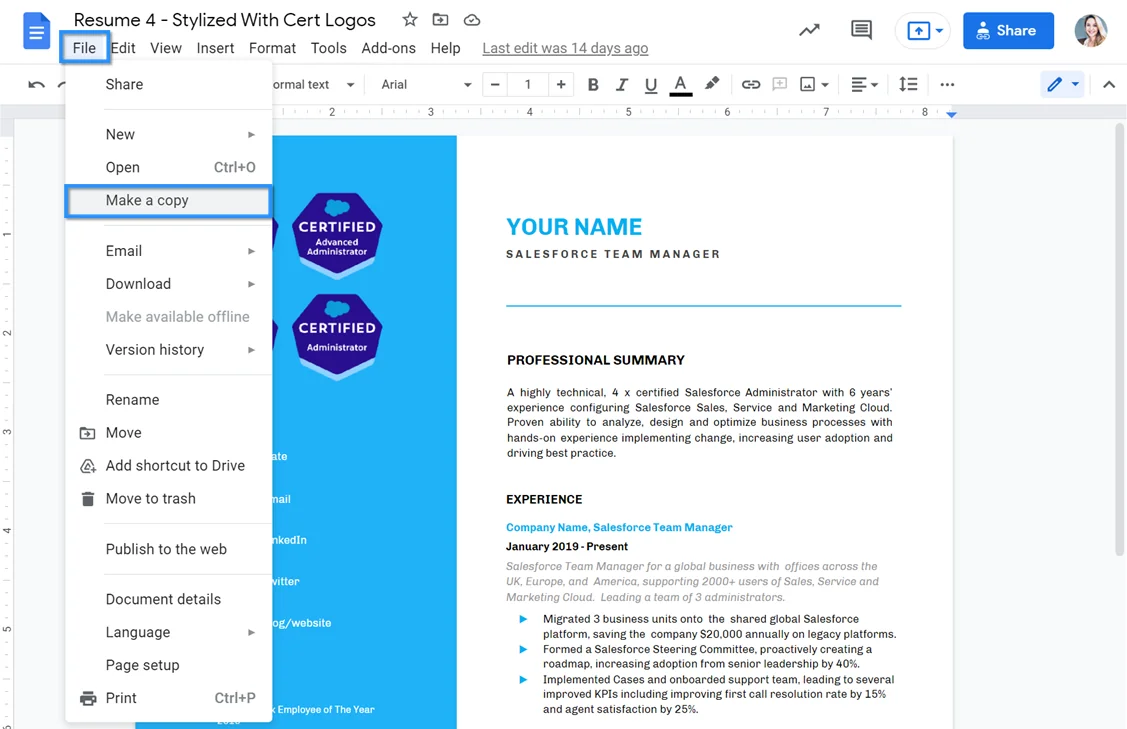
How should Salesforce certifications appear on a resume?
List the official credential name, current status, and verification path. The Salesforce Certified Platform Developer credential page describes the developer credential, while the Salesforce credential verification service lets employers verify credentials that are publicly available.
A certification entry can use this format:
- Salesforce Certified Platform Developer — Active — Trailblazer verification link
- Salesforce Certified Administrator — Active — Trailblazer verification link
Use current credential names from Trailhead rather than relying on an old certificate file or an outdated resume. Salesforce can revise credential names, maintenance requirements, and exam experiences. Check your Trailblazer profile before publishing the application.
Certifications support a salesforce developer resume, but they do not replace implementation evidence. Pair a credential with projects that demonstrate Apex, LWC, data modeling, automation, testing, deployment, and security.
How is a resume Salesforce analyst profile different?
A search for resume Salesforce analyst usually reflects a candidate targeting business analyst, systems analyst, CRM analyst, or hybrid administrator-analyst positions. That document should focus less on code implementation and more on requirements, process analysis, data quality, stakeholder decisions, testing, adoption, and measurable business changes.
Resume Salesforce analyst skills to include
- Requirements discovery and stakeholder interviews
- Process mapping and gap analysis
- User stories, acceptance criteria, and backlog refinement
- Salesforce object and field mapping
- Reports, dashboards, and data-quality analysis
- Flow requirements and automation testing
- User acceptance testing and defect triage
- Release notes, training, and adoption support
- Permission requirements and access reviews
- Integration and migration mapping
Resume Salesforce analyst summary example
Salesforce analyst with four years of experience translating sales and service processes into user stories, data requirements, automation rules, reports, and acceptance criteria. Facilitated discovery across operations and engineering teams, supported UAT, and redesigned lead-quality reporting so managers could identify incomplete records before assignment.
Resume Salesforce analyst achievement examples
- Mapped the existing lead handoff process, identified duplicate decision points, and defined acceptance criteria for a consolidated assignment flow.
- Created a data dictionary covering 80 account and opportunity fields, including ownership, source, validation, sensitivity, and reporting use.
- Designed UAT scenarios for case escalation, entitlement validation, and queue assignment across four support personas.
- Replaced manually assembled pipeline spreadsheets with role-based reports and dashboards using documented filter definitions.
A hybrid candidate can maintain two documents: one salesforce developer resume for engineering positions and one resume Salesforce analyst version for requirements or operations roles. Do not submit the same skills order and summary to both vacancies.
How do you make a Salesforce developer resume ATS-friendly?
An applicant tracking system extracts text into structured fields and may rank an application against the vacancy. You do not need to repeat every job-description phrase. You do need consistent headings, readable text, relevant terminology, and a file format accepted by the employer.
Use standard section headings
Prefer headings such as Professional Summary, Technical Skills, Professional Experience, Projects, Certifications, and Education. Creative labels can make the document harder for both software and reviewers to scan.
Match exact technical terminology where accurate
Use the wording from the vacancy when it describes your real experience. Examples include Lightning Web Components rather than only “front-end development,” Queueable Apex rather than only “asynchronous processing,” and Named Credentials rather than only “API authentication.”
Avoid formatting that hides information
- Keep the name and contact details in the document body.
- Avoid placing skill names inside images.
- Use a common font and consistent heading hierarchy.
- Limit tables and columns when the application system parses them incorrectly.
- Do not use skill-rating bars; they do not explain proficiency.
- Follow the employer’s requested file format. Do not assume DOCX or PDF is universally preferred.
Create a vacancy-specific keyword checklist
Before submitting the salesforce developer resume, compare it with the vacancy in these categories:
- Salesforce products and clouds
- Apex and asynchronous processing
- LWC or other user-interface technology
- Flow and declarative automation
- Integration protocols and authentication
- Security and sharing
- Testing and code quality
- Deployment and source control
- Industry requirements
- Team responsibilities and seniority
What common Salesforce resume mistakes should you avoid?
- Listing tools without context: Connect Apex, LWC, Flow, or APIs to a project and result.
- Calling configuration development: Distinguish code, declarative automation, administration, and analysis accurately.
- Ignoring security: Mention sharing, permissions, CRUD and field-level security, or data classification when relevant.
- Claiming ownership of team output: State your contribution and the components you owned.
- Using unsupported metrics: Include numbers that can be explained and defended.
- Submitting one resume for every role: Adjust the summary, skill order, and project selection for each vacancy.
- Overstating certifications: Verify the status and use the official credential name.
- Confusing test coverage with test quality: Salesforce requires at least 75% Apex code coverage for deployment, but a resume should also show assertions, negative paths, bulk tests, and callout mocks.
- Ignoring production support: Include monitoring, logging, incident analysis, and defect prevention when these were part of the role.
For related technical preparation, review the Salesforce developer tutorial, Apex programming guide, Lightning Web Components tutorial, and Salesforce administrator guide.
Salesforce developer resume final checklist
- The target job title appears near the candidate’s name.
- The summary names the platform focus and one verified result.
- Technical skills match completed work.
- Recent experience uses achievement-focused bullets.
- Apex bullets demonstrate bulk and governor-limit awareness.
- Security work distinguishes record sharing from object and field access.
- Projects explain contribution, constraints, testing, and deployment.
- Credentials use current names and a verification link.
- Keywords reflect the vacancy without unsupported claims.
- The document remains readable when converted to plain text.
- Spelling, dates, links, and contact information have been checked.
- The file type follows the employer’s application instructions.
Frequently Asked Questions
How long should a Salesforce developer resume be?
A Salesforce developer resume is commonly one or two pages, but relevance matters more than a fixed page count. An entry-level candidate can often use one page. An experienced developer may need two pages to document recent implementations, architecture decisions, technical skills, certifications, and measurable results without reducing readability.
Should Trailhead badges be included on a Salesforce resume?
Include relevant Trailhead modules, projects, superbadges, or ranks when they strengthen an entry-level application or demonstrate recent learning. Keep them separate from Salesforce certifications. As professional experience grows, give more space to production projects, technical decisions, and results.
Which Salesforce certifications should a developer list?
List active credentials that relate to the target role, such as the current Salesforce Platform Developer credential and other credentials supported by your work. Use the official credential name and provide a public Trailblazer verification link when available. Do not list an exam as completed until Salesforce has awarded the credential.
Can I write a Salesforce developer resume without job experience?
Yes. Use original portfolio projects, internships, volunteer implementations, supervised work, and relevant training. Explain the data model, automation, Apex, LWC, security, tests, source control, and deployment process you implemented. Label personal or training projects accurately instead of presenting them as production customer work.
What is the difference between a developer resume and resume Salesforce analyst content?
A developer resume emphasizes Apex, LWC, integrations, automation, testing, security, performance, and deployment. Resume Salesforce analyst content emphasizes requirements discovery, process mapping, user stories, data analysis, UAT, reporting, stakeholder decisions, and adoption. Hybrid candidates should adjust the summary, skills, and examples for the position.
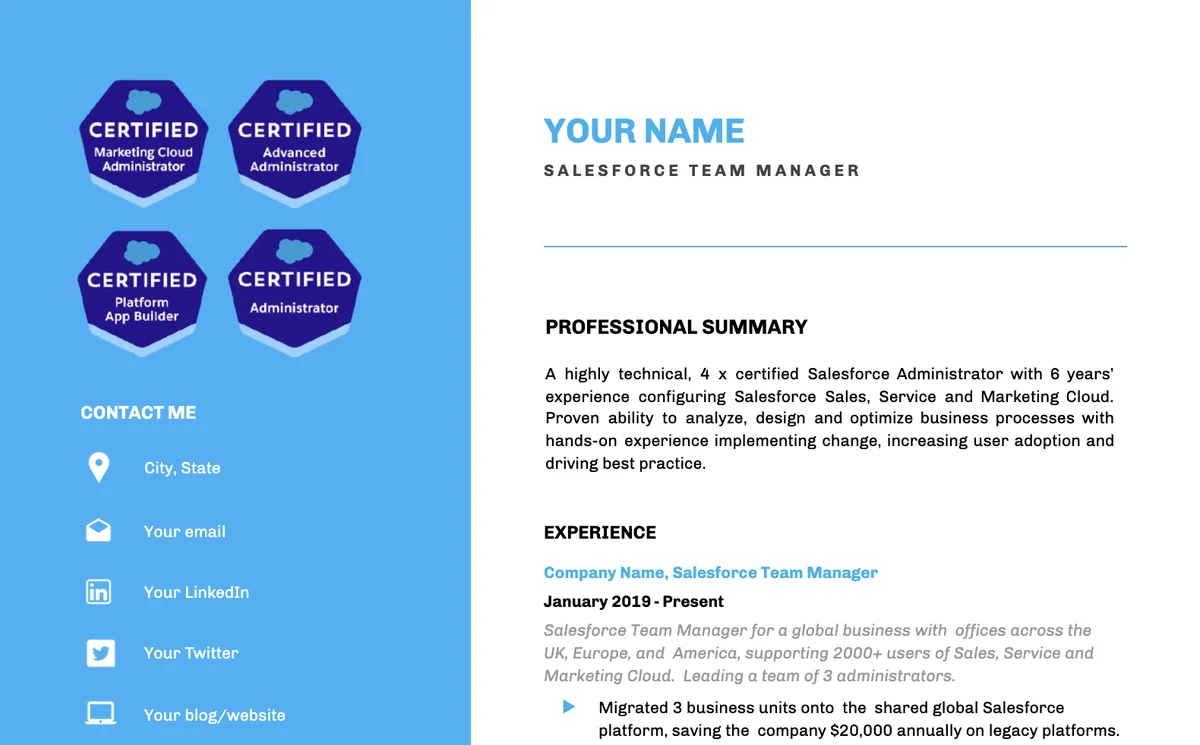
Should a Salesforce resume include certification logos?
Certification names and verification links provide the important information. Logos are optional and should not replace text because an ATS may not interpret an image. Follow Salesforce brand and credential-use requirements, and confirm that the document remains readable without images.