Salesforce Marketing Cloud experts design, configure, extend, and operate Marketing Cloud Engagement so that customer data, consent, content, journeys, and integrations work as one system. The title can refer to several different jobs, so the first step is to separate platform administration, consulting, development, and architecture responsibilities.
What do Salesforce Marketing Cloud experts do?
Salesforce Marketing Cloud experts turn campaign requirements into controlled, testable platform changes. Their work normally spans data extensions, Contact Builder, Automation Studio, Journey Builder, Content Builder, Email Studio, MobileConnect or MobilePush where licensed, CloudPages, identity and access, and integrations with Salesforce or external systems.
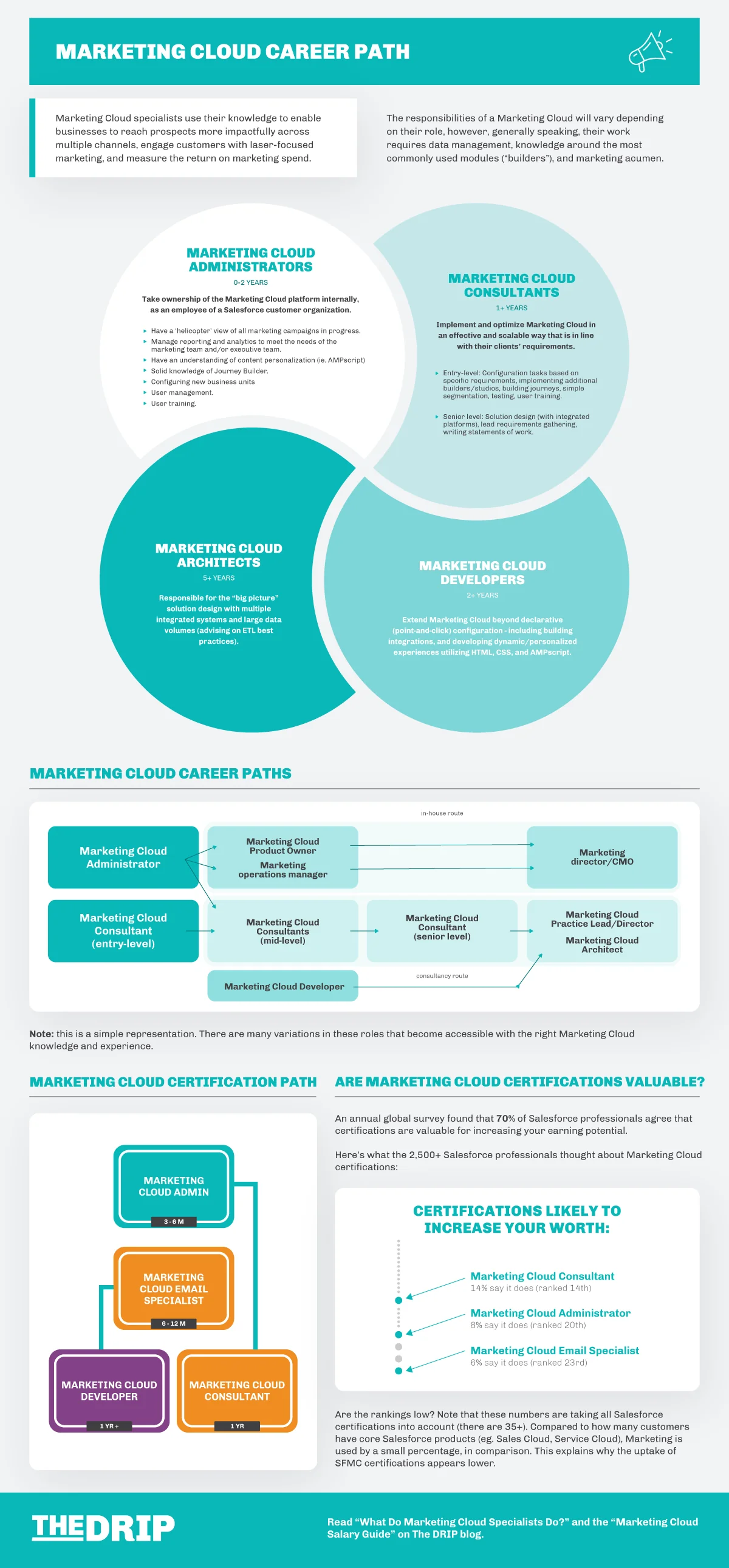
The exact role depends on who owns the decision. An administrator owns day-to-day platform health. A marketing cloud consultant translates business requirements into a delivery plan. A developer writes AMPscript, SQL, Server-Side JavaScript, HTML, and API integrations. An architect sets the data, identity, security, integration, and deployment design across systems.

How do Marketing Cloud roles differ?
| Role | Primary responsibility | Typical deliverables | Skills that matter most |
|---|---|---|---|
| Administrator | Operate the tenant and keep it usable | User access, business units, sender setup, data retention, monitoring, runbooks | Setup, subscriber management, permissions, troubleshooting |
| Consultant | Convert business requirements into a working solution | Discovery notes, solution design, journey configuration, test plans, training | Requirements, channel design, data mapping, stakeholder communication |
| Developer | Build behavior that configuration alone cannot provide | AMPscript, SQL queries, CloudPages, SSJS, REST or SOAP integrations | Programmatic languages, APIs, secure coding, testing |
| Architect | Control cross-system design and nonfunctional requirements | Identity model, contact-key strategy, integration architecture, environment and release standards | Data architecture, security, scale, governance, trade-off analysis |
Marketing cloud consultant responsibilities
A marketing cloud consultant should be able to run discovery, identify gaps in the source data, define audience and suppression logic, map channels to customer consent, configure journeys, and create an acceptance-test plan. The consultant is accountable for explaining why a design fits the requirement, not only for building screens in the user interface.
In an enterprise implementation, the consultant also coordinates with CRM administrators, data engineers, privacy teams, campaign operations, and release managers. A consultant who cannot explain contact identity, send classification, data retention, or failure handling is not ready to lead a production rollout.
SFMC consultant delivery scope
An SFMC consultant may work across discovery, implementation, optimization, or remediation. During discovery, the consultant documents source systems, data latency, consent sources, expected message volume, business-unit boundaries, and reporting needs. During implementation, the consultant converts those decisions into data extensions, automations, journeys, content rules, and operating procedures.
The abbreviation SFMC remains common in job descriptions, although Salesforce documentation uses Marketing Cloud Engagement. A good statement of work should therefore name the product and the licensed capabilities instead of relying on the abbreviation alone.
Cloud specialist operational scope
A cloud specialist title is less precise. In one company it may mean a Marketing Cloud administrator; in another it may include Data Cloud, Account Engagement, Personalization, or core Salesforce platform work. Confirm the products, channels, and systems in scope before using the title in a hiring request.
SFMC expert technical scope
An SFMC expert should understand both configuration and system behavior. That includes contact-key selection, subscriber status, sendable data extensions, publication lists, journey entry rules, SQL query activities, automation schedules, triggered or transactional messaging, API authentication, and personalization code. Seniority should be measured by decisions handled in production, not by the number of builders listed on a résumé.
What skills should Salesforce Marketing Cloud experts have?
Data model and contact identity
The data model is the first design checkpoint. Salesforce Marketing Cloud experts must distinguish a business identifier from an email address and choose a stable contact key that can survive address changes. They should understand how data extensions relate to Contact Builder, which data is sendable, how retention settings affect storage, and how duplicate or abandoned contacts increase operational cost and risk.
A production design should document:
- the system of record for each attribute;
- the contact key and subscriber key strategy;
- consent, suppression, and preference fields;
- data refresh frequency and expected latency;
- retention and deletion rules;
- the fields allowed in personalization.
Journey and automation design
A marketing cloud consultant should know when to use Journey Builder for stateful customer orchestration and when Automation Studio is the better fit for scheduled imports, SQL segmentation, file transfer, extraction, or other batch work. The design must include re-entry behavior, exit criteria, holdout or suppression logic, error recovery, and ownership after launch.
Before activation, test with controlled records and verify every branch, wait period, update activity, message, and exit condition. Do not treat an activated journey as the end of the project; add monitoring and a change procedure.
SQL for segmentation
Marketing Cloud SQL uses a query activity to write results to a target data extension. An SFMC consultant should understand joins, deduplication, null handling, and the target update type. Avoid broad SELECT * statements because target schemas are explicit and unnecessary columns make reviews harder.
SELECT
    c.ContactKey,
    c.EmailAddress,
    c.FirstName
FROM Customer_Profile c
LEFT JOIN Global_Suppression s
    ON s.ContactKey = c.ContactKey
WHERE c.EmailOptIn = 1
  AND c.EmailAddress IS NOT NULL
  AND s.ContactKey IS NULL
This example creates an eligible email audience by requiring consent and excluding a suppression table. In production, the reviewer should also confirm data types, primary keys, duplicate behavior, target update mode, and the source refresh schedule.
AMPscript and content personalization
AMPscript is an interpreted language used in Marketing Cloud Engagement messages and landing pages. A developer should provide fallback values, avoid exposing sensitive data, and test every lookup path. Salesforce documents AMPscript syntax and functions in the Marketing Cloud developer documentation.
%%[
VAR @firstName
SET @firstName = AttributeValue("FirstName")

IF Empty(@firstName) THEN
  SET @firstName = "there"
ENDIF
]%%
Hello %%=v(@firstName)=%%,
The fallback prevents a blank greeting. For preference centers or other CloudPages, validate request parameters, use secure links where required, and do not trust values only because they arrived from an email click.
API and integration knowledge
Marketing Cloud Engagement provides REST and SOAP APIs that use OAuth 2.0 authentication. REST covers capabilities such as assets, journeys, messaging, contacts, and data operations; SOAP remains relevant for many email and object operations. Salesforce recommends selecting the API based on the supported resource rather than forcing one protocol across every use case.
Marketing Cloud Engagement APIs do not follow the same version numbering pattern as core Salesforce platform APIs such as v60.0. For that reason, an integration design should cite the exact Marketing Cloud endpoint and current reference documentation instead of assigning a core-platform API version to it.
Use an installed package with the minimum required components and scopes. Keep client secrets outside source code, cache access tokens until expiry, handle HTTP 429 and transient failures with bounded retries, and log request identifiers without storing message content or personal data unnecessarily.
How should a Marketing Cloud consultant run an implementation?
- Confirm scope. Name the Marketing Cloud product, business units, channels, regions, languages, source systems, and licensed features.
- Define identity and consent. Agree on the contact key, subscriber key, consent source, suppression rules, and deletion process before building journeys.
- Map data movement. Document imports, API calls, synchronized data, file drops, transforms, owners, schedules, and failure alerts.
- Design the audience. Specify qualification, exclusion, deduplication, frequency rules, and expected record counts.
- Build reusable content. Use approved content blocks, sender profiles, send classifications, and tested personalization.
- Configure orchestration. Build automations and journeys with explicit re-entry, exit, and recovery behavior.
- Test end to end. Test data, permissions, messages, links, personalization, mobile rendering, unsubscribes, errors, and downstream updates.
- Prepare operations. Provide runbooks, monitoring, ownership, change control, and a rollback or stop-send procedure.
What should an SFMC consultant check before launch?
| Area | Launch check | Failure if omitted |
|---|---|---|
| Identity | One documented contact-key rule across entry sources | Duplicate contacts, split history, failed updates |
| Consent | Suppression and preference logic tested with positive and negative records | Messages sent to ineligible contacts |
| Data | Field types, nulls, primary keys, retention, and row counts verified | Query failures or incorrect audiences |
| Journey | Re-entry, exits, waits, goals, and versioning reviewed | Repeated sends or contacts trapped in old logic |
| Content | Fallbacks, links, sender data, and rendering tested | Broken personalization or unusable messages |
| Integration | Token handling, retries, limits, and alerting tested | Silent data loss or duplicate requests |
| Operations | Named owner and stop-send process available | Slow response during an incident |
How do Salesforce Marketing Cloud experts handle security?
Marketing Cloud Engagement has its own users, roles, permissions, business units, installed packages, and API scopes. Do not assume a core Salesforce profile or permission set automatically controls Marketing Cloud access. Use least privilege, separate human users from integrations, remove inactive access, and review package scopes before deployment.
Personalization code must not expose restricted fields in email HTML, URLs, logs, or CloudPages responses. Store only the data needed for the use case and apply retention policies to temporary audiences, extracts, and staging data extensions. Security review should include consent, data residency, credential storage, file encryption, public-page behavior, and incident ownership.
How do you evaluate a Salesforce Marketing Cloud expert?
Ask for a design walkthrough rather than a list of features. A qualified candidate should be able to explain a production decision, the alternatives considered, the failure modes, and how the result was tested and operated.
- For an administrator: Ask how they investigate a failed automation, control access across business units, and manage subscriber data.
- For a marketing cloud consultant: Ask them to turn a vague campaign request into data, consent, journey, testing, and operating requirements.
- For a developer: Review a SQL query or AMPscript sample for fallbacks, security, and maintainability.
- For an architect: Ask for an identity and integration design covering multiple systems, regions, and failure recovery.
Certifications help confirm product knowledge, but they do not replace delivery evidence. Current role-aligned credentials include Salesforce Certified Marketing Cloud Engagement Administrator, Email Specialist, Developer, and Consultant. Check the official Trailhead credential pages because names, prerequisites, and maintenance requirements can change.
What is the Salesforce Marketing Cloud career path?
There is no single sequence. A practitioner may start in campaign operations or administration, move into consulting or development, and later take architecture responsibility. Another path begins with web development or data engineering and moves directly into Marketing Cloud integrations and personalization.
Progress depends on broader ownership:
- entry-level work focuses on configured tasks with review;
- mid-level work owns a feature or workstream from requirement through testing;
- senior work owns design decisions, risk, stakeholder alignment, and production outcomes;
- architecture work sets standards across teams and connected systems.
Which Salesforce resources should an SFMC expert use?
Use official Salesforce sources as the baseline for implementation decisions:
- Marketing Cloud Engagement APIs and programmatic languages overview
- Marketing Cloud Engagement API authentication and getting started
- AMPscript developer guide
- Salesforce marketing credentials overview
Related SalesforceTutorial references include Salesforce Marketing Cloud concepts, Marketing Cloud Journey Builder, Marketing Cloud Email Studio, and Salesforce certification paths.
Frequently Asked Questions
What does a Salesforce Marketing Cloud expert do?
A Salesforce Marketing Cloud expert designs or operates data, consent, audiences, automations, journeys, content, personalization, and integrations. The exact work depends on whether the role is administrator, consultant, developer, or architect.
What is the difference between an SFMC consultant and developer?
An SFMC consultant owns requirements, configuration, testing, and adoption. A developer owns code and integrations such as AMPscript, SQL, Server-Side JavaScript, CloudPages, and REST or SOAP API work. One person may cover both roles on a small project, but the responsibilities should still be separated in the delivery plan.
Which certification should a Marketing Cloud consultant take?
The role-aligned credential is Salesforce Certified Marketing Cloud Engagement Consultant. Administrators, developers, and email practitioners also have separate credentials. Review the current Trailhead credential pages before registering because Salesforce can change names, prerequisites, and maintenance requirements.
Does an SFMC expert need to know SQL and AMPscript?
An SFMC expert who builds segmentation or personalized content should understand SQL and AMPscript. An administrator may not write complex code every day, but must be able to review how queries and personalization affect data quality, sends, and troubleshooting.
How can I verify a cloud specialist has production experience?
Ask the cloud specialist to explain a real design, including identity, consent, data movement, testing, monitoring, an incident or failure mode, and the trade-offs considered. Production experience appears in operational detail, not only in feature names or certifications.