Agentblazer Guide for Salesforce Agentforce Skills
Agentblazer is Salesforce Trailhead‘s Agentforce learning status for people who want structured AI agent skills, not a loose list of badges. It helps admins, developers, consultants, and architects move from AI basics to Agentforce planning, builder work, testing, deployment, and certification preparation.
For Salesforce teams, the practical value is simple: the Trailhead path gives your team a shared vocabulary for agents before you ask them to design service agents, sales agents, prompt templates, Data 360 grounding, or custom agent actions. In enterprise orgs, that shared baseline reduces rework because business users, admins, developers, and architects can discuss the same risks: data quality, permission boundaries, deterministic logic, human review, and post-launch monitoring.
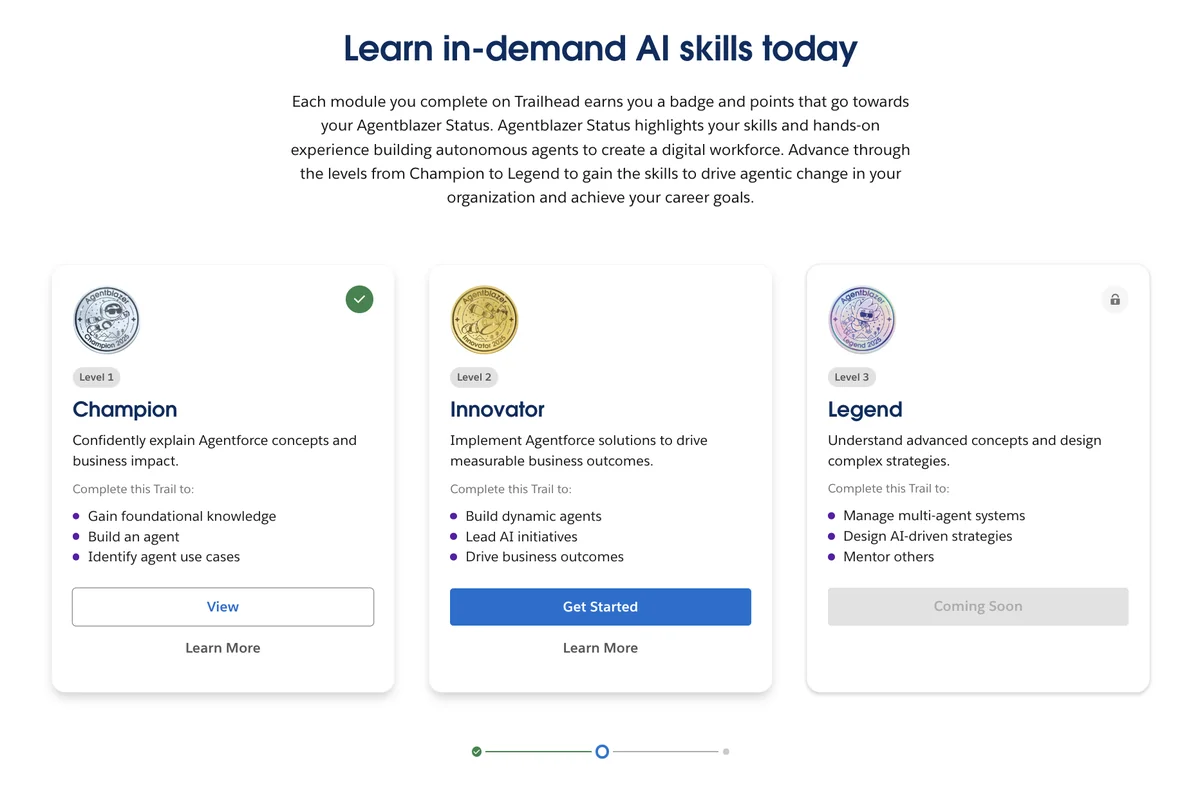
What is the Trailhead Agentforce status?
This is a Trailhead status program for learning Salesforce Agentforce. Salesforce’s official Agentblazer page describes the status as a way to show skills in building autonomous agents and keeping current with updated Agentforce learning content. You can review the official path on Trailhead’s Agentblazer page.
Do not treat the status as a replacement for org-specific implementation experience. It proves that a learner has worked through Salesforce’s AI and Agentforce learning path. It does not prove that the person has designed your data model, passed your security review, built an integration, or deployed an agent into a regulated production org.
A useful way to position this learning track inside a Salesforce Center of Excellence is to make it the baseline before project access. For example, a service transformation team can require Champion for all stakeholders, Innovator for admins and consultants who configure Agentforce, and Legend-level skills for developers and architects who design custom actions, Data 360 grounding, deployment standards, and monitoring.
Status levels in 2026
Salesforce lists three 2026 levels: Champion, Innovator, and Legend. The levels are progressive, so the safest planning assumption is that learners start with Champion, then move into Innovator, then continue toward Legend when they need advanced implementation and lifecycle skills.
| Level | Best fit | What the learner should be able to discuss | Enterprise use |
|---|---|---|---|
| Agentblazer Champion 2026 | Admins, business analysts, product owners, support leads | AI basics, Agentforce concepts, basic agent use cases, prompt fundamentals, responsible AI | Discovery workshops, use case intake, stakeholder education |
| Agentblazer Innovator 2026 | Admins, consultants, solution designers, team leads | Agentforce configuration, sales and service use cases, deployment planning, testing, risk review | Pilot builds, service agent configuration, sales enablement scenarios |
| Agentblazer Legend 2026 | Architects, senior admins, developers, AI governance leads | Full lifecycle management, Data 360 grounding, RAG, customizations, Agentforce development tools | Enterprise operating model, integration patterns, release controls, monitoring |
Agentforce Champion: where most admins should start
People often search for agentforce champion, but the official Trailhead label is Agentblazer Champion 2026. This level is the correct start for most Salesforce admins because it covers AI foundations, Agentforce basics, and the first hands-on agent tasks without assuming that the learner can design a full operating model.
For an admin, the outcome is not “I can build any agent.” The better outcome is “I can explain what an agent should do, where the data comes from, which user permissions matter, and when a human should review the result.” That distinction matters in production because an agent can only be trusted when its scope, data access, and actions are defined.
Agentforce Innovator: what the level proves
Agentforce Innovator maps to the Agentblazer Innovator 2026 level. Salesforce describes the Innovator trail as a path for defining AI goals and customizing and deploying trusted agents across an organization. Trailhead also shows that the Innovator trail is unlocked after the previous trail in the series is complete.
In project terms, Innovator is the level where learners should stop talking only about AI concepts and start writing implementation artifacts: use case definitions, risk notes, prompt acceptance criteria, test conversations, fallback handling, release steps, and user enablement plans.
Trailblazer Innovator vs Agentblazer Innovator
Trailblazer Innovator is a search phrase users type when they connect Salesforce learning with the Trailblazer community. The 2026 AI status track is Agentblazer Innovator. Use the official name in resumes, internal enablement decks, and skills matrices so hiring managers and project leads can verify the status on Trailhead.
Salesforce Agentblazer status on your profile
Salesforce Agentblazer status is most useful when it is paired with evidence from real work. A Trailhead status tells a reviewer that you completed the learning path. A project write-up tells the reviewer what you built, how you handled permissions, what data sources the agent used, and how the team measured quality after launch.
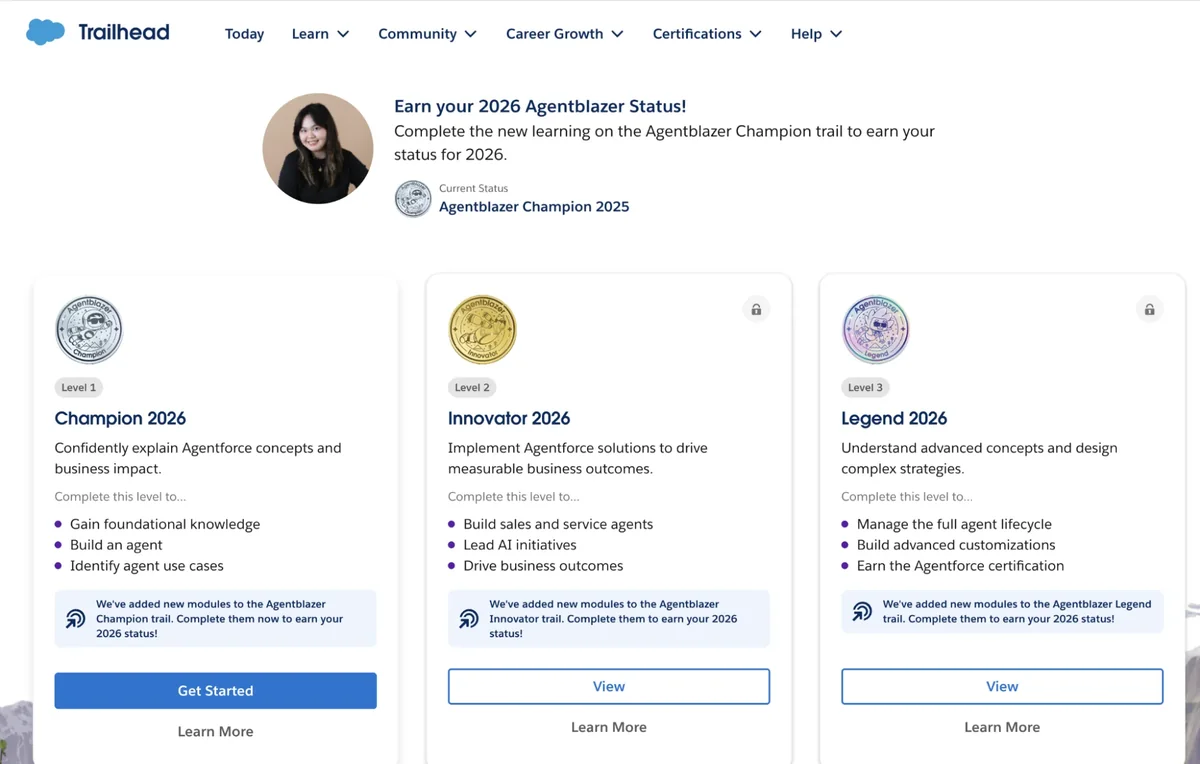
How does Agentblazer relate to Agentforce Specialist certification?
Agentblazer and Salesforce Certified Agentforce Specialist are connected, but they are not the same credential. Salesforce’s credential page says Agentforce Specialists manage and optimize Agentforce and need knowledge of Salesforce platform configuration and Agentforce capabilities. The same page links Agentblazer Status as a study path for the exam. See the official Salesforce Certified Agentforce Specialist credential page before booking or preparing for the exam.
Use this separation in your career plan:
- Agentblazer: learning status, guided Trailhead path, useful for building a baseline.
- Agentforce Specialist: Salesforce credential, exam-based validation, useful when your role requires formal certification.
- Project evidence: design notes, stories, test scripts, monitoring approach, and deployment records from a real org.
If you already maintain Salesforce Administrator, Platform App Builder, or Platform Developer credentials, the path adds Agentforce-specific learning. It does not remove the need to understand the core platform. For related preparation, review our guides on Salesforce Admin Certification, Salesforce Agentforce Certification, and Salesforce AI.
How to use Agentblazer in an enterprise Agentforce rollout
The learning track works best when you connect the learning path to a delivery checklist. In a production Salesforce org, an agent project is not only a builder task. It touches data, permissions, service process design, integration limits, legal review, testing, and release management.
1. Map learning level to project responsibility
Do not give every learner the same responsibility after they complete the same trail. A Champion can support discovery and explain basic Agentforce concepts. An Innovator can help configure and test a pilot. A Legend-level practitioner or architect should review data grounding, custom actions, release controls, and monitoring.
2. Define the agent use case before opening Builder
Write the use case in one sentence: “The service agent answers order-status questions for authenticated customers using approved CRM data and escalates billing disputes to a human queue.” That sentence gives the team boundaries. Without it, the conversation design becomes a collection of prompts with no measurable goal.
3. Treat Data 360 as a governance topic, not only a data source
Salesforce Help states that Data Cloud was rebranded to Data 360 on October 14, 2025, with some transition references still visible in applications and documentation. For Agentforce projects, this means your design documents may use both terms. Standardize your wording for the project and document which data sources ground the agent.
For more background, use our Salesforce Data Cloud and Data 360 guide alongside official Salesforce release notes and Help pages.
4. Build a test set before launch
In enterprise orgs, the test set should include normal requests, ambiguous requests, missing data, permission-denied scenarios, escalation triggers, and unsafe user prompts. Agentforce testing is not complete when the happy path works in a preview window. You need repeatable test conversations that survive release changes.
5. Add a post-launch owner
Every agent needs an owner after deployment. The owner reviews failed conversations, monitors action errors, updates instructions, checks data quality, and coordinates releases. Without ownership, even a well-built agent becomes stale as products, policies, and Salesforce releases change.
Agentforce practice project for Agentforce learners
The Trailhead path is Trailhead-based, but developers and architects should add a small source-controlled project to prove they can connect Agentforce concepts with platform engineering. The example below shows an Apex REST resource that could be used as a practice pattern before creating an Agentforce action from an API catalog entry. Salesforce Developer Docs describe how Apex REST classes can be exposed through generated OpenAPI specifications and activated for Agentforce actions. Review the official Build Custom Agent Actions using Apex REST documentation before applying this pattern.
Use this as a learning pattern, not a drop-in production endpoint. Production endpoints need authentication review, rate limiting strategy, error logging, API gateway decisions where applicable, data classification review, and security testing.
@RestResource(urlMapping='/AgentCaseStatus/*')
global with sharing class AgentCaseStatusResource {
    global class CaseStatusResponse {
        public String caseNumber;
        public String status;
        public String priority;
        public String subject;

        public CaseStatusResponse(Case sourceCase) {
            caseNumber = sourceCase.CaseNumber;
            status = sourceCase.Status;
            priority = sourceCase.Priority;
            subject = sourceCase.Subject;
        }
    }

    @HttpGet
    global static CaseStatusResponse getCaseStatus() {
        RestRequest request = RestContext.request;
        String caseNumber = request.requestURI.substringAfterLast('/');

        if (String.isBlank(caseNumber)) {
            RestContext.response.statusCode = 400;
            return null;
        }

        if (!Schema.sObjectType.Case.isAccessible()) {
            RestContext.response.statusCode = 403;
            return null;
        }

        List<Case> caseRows = [
            SELECT CaseNumber, Status, Priority, Subject
            FROM Case
            WHERE CaseNumber = :caseNumber
            LIMIT 1
        ];

        if (caseRows.isEmpty()) {
            RestContext.response.statusCode = 404;
            return null;
        }

        SObjectAccessDecision decision =
            Security.stripInaccessible(AccessType.READABLE, caseRows);

        Case readableCase = (Case) decision.getRecords()[0];
        return new CaseStatusResponse(readableCase);
    }
}
Governor limit notes for this example:
- The endpoint runs one selective SOQL query with
LIMIT 1. Do not add queries inside loops when extending this pattern. with sharingrespects record sharing, but it does not replace CRUD and field-level security checks. The example checks object access and usesSecurity.stripInaccessiblefor readable fields.- The response returns only the fields an agent needs. Avoid sending full records to an AI workflow when a smaller response is enough.
- Before adding the endpoint as an agent action, define what the agent may do with each response and what it must escalate.
@IsTest
private class AgentCaseStatusResourceTest {
    @IsTest
    static void returnsCaseStatusForKnownCaseNumber() {
        Case testCase = new Case(
            Subject = 'Agentforce practice case',
            Status = 'New',
            Origin = 'Web',
            Priority = 'Medium'
        );
        insert testCase;

        testCase = [
            SELECT CaseNumber
            FROM Case
            WHERE Id = :testCase.Id
            LIMIT 1
        ];

        RestRequest request = new RestRequest();
        request.httpMethod = 'GET';
        request.requestURI =
            '/services/apexrest/AgentCaseStatus/' + testCase.CaseNumber;

        RestContext.request = request;
        RestContext.response = new RestResponse();

        Test.startTest();
        AgentCaseStatusResource.CaseStatusResponse result =
            AgentCaseStatusResource.getCaseStatus();
        Test.stopTest();

        System.assertEquals(testCase.CaseNumber, result.caseNumber);
        System.assertEquals('New', result.status);
    }
}
A developer moving from Innovator toward deeper implementation work should also study Agent Script. Salesforce Developer Docs state that, beginning in April 2026, agent topics are called subagents, with no functional change during the terminology transition. This matters when you read Trailhead, Help, and source files that still contain mixed terms. Developers building Lightning interfaces around Agentforce should also review our Lightning Web Components guide.
Best practices for Agentblazer learners working in Salesforce orgs
- Document the use case before configuration. Include the actor, the customer intent, the data source, the allowed actions, and the escalation rule.
- Separate learning badges from deployment authority. Completing the learning track does not automatically grant permission to change production agents.
- Use sandboxes for build and test. Agent instructions, custom actions, Flows, and Apex should follow the same release discipline as other Salesforce changes.
- Review permissions early. Agents can expose process gaps when a user lacks object access, record access, or field access.
- Keep prompts and instructions versioned. Treat agent behavior as configuration that needs review, rollback, and ownership.
- Plan monitoring before go-live. Capture failed tasks, fallback frequency, escalation rate, and user feedback.
Common errors with Agentblazer and Agentforce learning
| Issue | Likely cause | How to handle it |
|---|---|---|
| Confusing Agentblazer with certification | The Trailhead status and Agentforce Specialist credential appear in the same learning journey | Use Agentblazer for learning status and the official credential page for exam planning |
| Innovator trail appears locked | The prior Agentblazer trail in the sequence is not complete | Complete Champion first, then return to the Innovator trail |
| Agent action is too broad | The action returns more data or performs more work than the agent needs | Limit inputs, outputs, and permissions; add explicit escalation rules |
| Preview behavior differs from production expectations | The team tested only one or two happy-path prompts | Create a regression test set with normal, ambiguous, missing-data, and escalation cases |
| Old terminology appears in docs or source | Salesforce is transitioning Agentforce terminology, including topics and subagents | Use the latest official docs and record the terminology used in your project repository |
Roadmap for admins, developers, and architects
Use the following roadmap when you want Trailhead learning to produce project-ready skills.
Admin roadmap
- Complete Champion.
- Write three agent use cases from your org’s service, sales, or employee support processes.
- For each use case, list the objects, fields, record access rules, and escalation path.
- Build a sandbox proof of concept with one clear task.
- Create a test script with at least 15 user prompts before any production discussion.
Developer roadmap
- Complete Champion and Innovator so the business language is clear.
- Build one Apex REST action and one Flow-based action in a sandbox.
- Generate or maintain the OpenAPI specification according to Salesforce guidance.
- Add Apex tests, negative tests, and CRUD/FLS checks.
- Review Agent Script and Agentforce DX for source-driven agent work.
Architect roadmap
- Define the agent operating model: ownership, release gates, rollback, monitoring, and audit review.
- Decide which data belongs in CRM, Data 360, external systems, or knowledge sources.
- Design least-privilege access for users, integrations, actions, and agent runtime behavior.
- Set acceptance criteria for accuracy, escalation, latency, and data minimization.
- Align Agentblazer learning with certification and internal enablement standards.
Frequently Asked Questions
What is Agentblazer in Salesforce?
Agentblazer is a Salesforce Trailhead status program for learning Agentforce, AI fundamentals, agent use cases, and hands-on agent implementation skills. It is not the same as a paid Salesforce certification, but Salesforce positions it as a learning path that can help prepare learners for Agentforce work.
Is Agentblazer Champion the same as Agentforce Champion?
Salesforce uses Agentblazer Champion as the Level 1 status name. Users often search for agentforce champion because the learning path is tied to Agentforce skills, but the official Trailhead status label is Agentblazer Champion 2026.
What does Agentforce Innovator mean?
Agentforce Innovator usually refers to the Agentblazer Innovator 2026 level. It focuses on defining AI goals, customizing and deploying trusted agents, and applying Agentforce in sales, service, and industry scenarios after the Champion level is complete.
Do Agentblazer statuses renew every year?
Salesforce describes Agentblazer status as an annually renewable learning status. The Trailhead Agentblazer page says new learning content is added during the year and learners complete the latest trails to renew their statuses.
Does Agentblazer replace the Agentforce Specialist certification?
No. Agentblazer is a Trailhead learning status, while Salesforce Certified Agentforce Specialist is a Salesforce credential. The Agentforce Specialist credential page says earning Agentblazer Status can help prepare for the exam.
Should admins or developers start with Agentblazer?
Admins, consultants, and developers can all start with Agentblazer Champion. Admins should focus on use cases, setup, governance, and testing. Developers should add Apex REST actions, Agent Script, Agentforce DX, and integration patterns as they move toward Innovator and Legend work.
Why do people search for Trailblazer Innovator?
Trailblazer Innovator is a common search phrase, but the official 2026 Agentforce learning status is Agentblazer Innovator. Trailblazer is the broader Salesforce learning community; Agentblazer is the AI and Agentforce-specific status track.