Focusonforce Agentforce Learning Guide
Focusonforce is the search term many Salesforce learners use when they need a structured study path, but the safest way to prepare for Agentforce is to anchor your plan in official Salesforce resources, hands-on org work, and scenario-based practice. This guide maps a practical path for Salesforce Admins, Developers, Architects, and education teams who need Agentforce training, an agentforce workshop plan, and Agentforce Specialist exam preparation without relying on copied notes or exam dumps.
The goal is simple: build enough working knowledge to configure an agent, explain how it uses topics and actions, test it with real data boundaries, and know when Apex, Flow, Prompt Builder, Data 360, or Agentforce Education is the right part of the stack. Use this focusonforce page as a checklist, then verify UI labels and release behavior in your own org because Agentforce screens can change across Winter ’26, Spring ’26, and Summer ’26 releases.
What is focusonforce for Agentforce learners?
In this article, focusonforce means a focused Salesforce learning route: official documentation first, Trailhead for guided concepts, developer workshops for build practice, and a realistic practice exam routine after you can explain the product behavior. It is not a shortcut around the official Salesforce exam guide. It is a way to avoid scattered learning and make each study hour traceable to something you can configure or defend in a design review.
For production teams, the study route should mirror delivery work. A Service Cloud team may start with a service agent, case routing, grounding, and escalation rules. A developer may spend more time on Apex actions, external services, and API invocation. An education institution may start with Agentforce for Education, learner data, and consent controls. The focusonforce plan below lets each role choose the same foundation and then branch into its implementation track.
How to build a focusonforce study path with official Salesforce sources
Start with a Salesforce Developer Edition or trial environment that includes the products you want to test. Salesforce lists a free Developer Edition path for hands-on work with Agentforce and Data 360, and Salesforce Developers provides an Agentforce workshop that covers Agentforce Builder, Data 360, Prompt Builder, RAG, and service agent setup. Keep your learning notes tied to the exact org, release, and API version you used; for Summer ’26, Salesforce release notes reference API version 67.0 for platform features.
A practical focusonforce sequence looks like this:
- Set up the org. Use a non-production org. Do not test agents, prompts, or Apex actions directly in production.
- Read the official product flow. Review Agentforce Builder, agent actions, and action instruction guidance before you create custom logic.
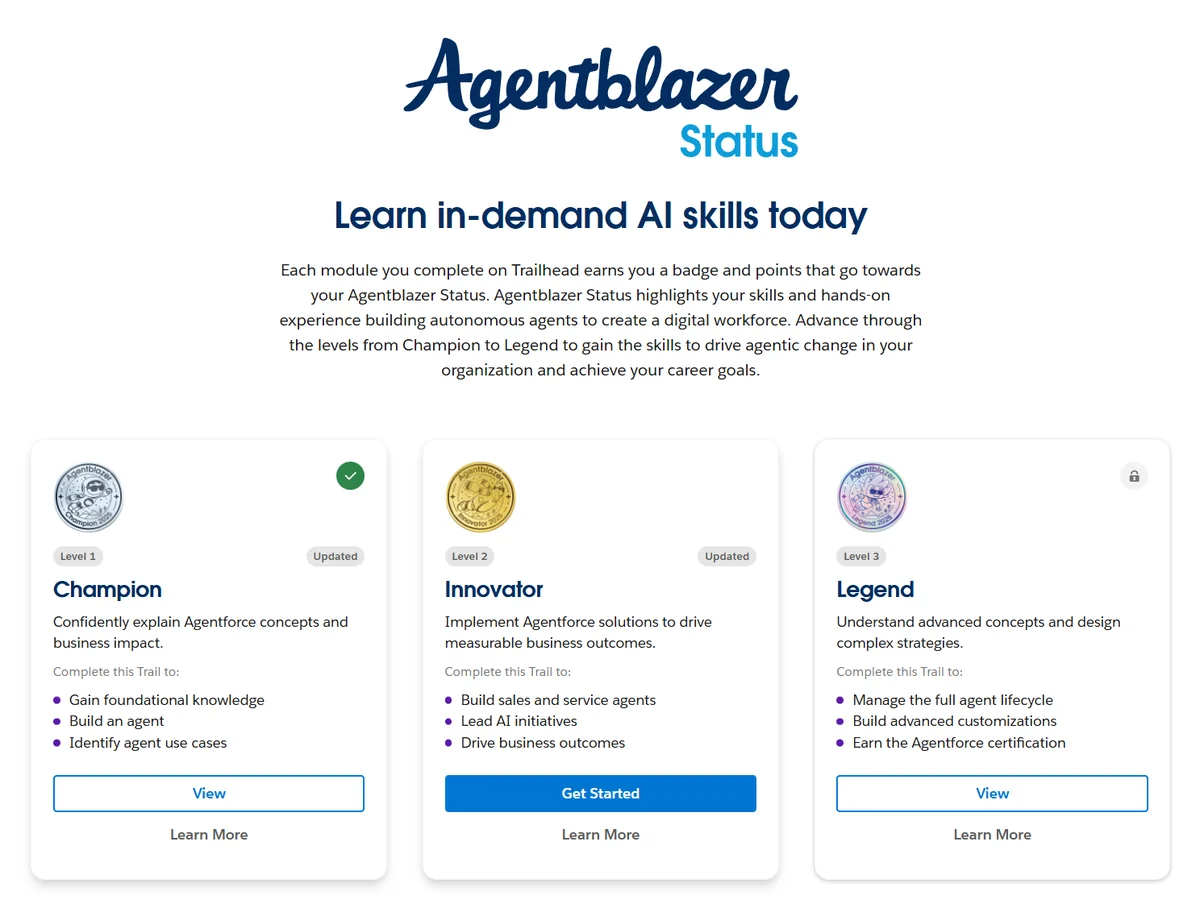
- Complete Trailhead concepts. Use Agentblazer learning paths to understand the vocabulary before you attempt an agentforce workshop.
- Build one agent end to end. Add topics, actions, instructions, test cases, and fallback handling.
- Practice exam scenarios. Use the official Salesforce Certified Agentforce Specialist page and exam guide as the source of truth for objectives.
Do not treat badges as a substitute for implementation. In enterprise orgs, the difference between training and readiness is usually the ability to explain why a topic, action, prompt, permission set, data source, or deployment path is safe for a given business process.
Agentforce workshop: when to use the hands-on path
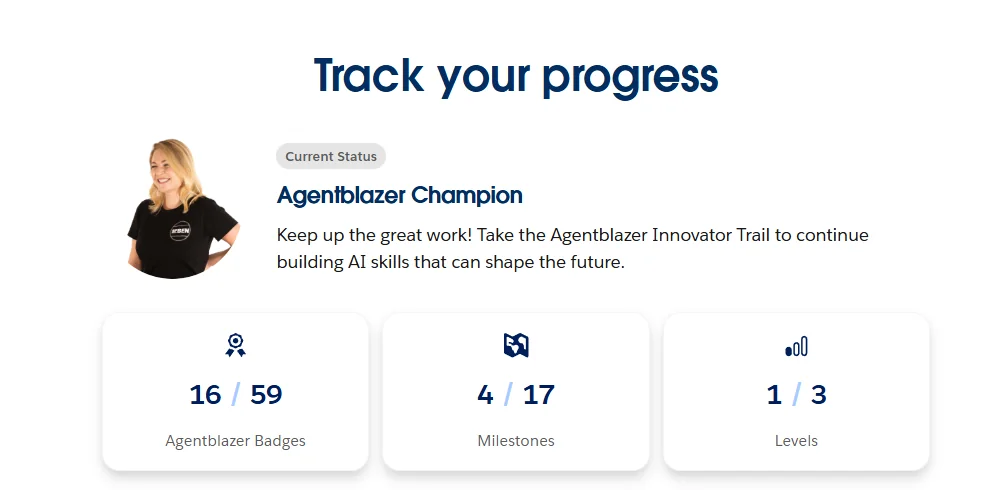
An agentforce workshop helps when you already know Salesforce setup basics and need to see how agent pieces fit together. The current Salesforce Developers workshop path includes setup, Agentforce Builder, Data 360, Prompt Builder, retrieval-augmented generation, and service agent work. Use the workshop as a build lab, not as a slide deck. Pause after each exercise and write down the metadata you changed, the data the agent could access, and the test prompt that proved the behavior.
For Admins, the agentforce workshop should produce a configuration checklist. For Developers, it should produce a backlog of extension points, such as Apex invocable actions or external services. For Architects, it should produce a risk view: data grounding, identity, auditability, sandbox-to-production movement, and support ownership.
Agentforce training: what to complete before certification prep
Agentforce training should cover more than terminology. Before you open an agentforce specialist practice exam, make sure you can describe agents, topics, actions, instructions, prompt templates, grounding, Data 360, trust controls, and testing. You should also know where low-code ends and pro-code begins. Salesforce documentation states that custom actions can be created with Apex, flows, or prompt templates, and Apex methods become available to Agentforce Builder through @InvocableMethod.
A good focusonforce study notebook has one page per feature: purpose, setup path, permission impact, test method, common error, and official Salesforce reference. This makes agentforce training easier to reuse for team onboarding and release reviews.
Agentforce for education: what changes in an institution
Agentforce for education adds institutional context. Salesforce Trailhead explains that Education Cloud is now called Agentforce Education, and Agentforce Education supports the learner lifecycle with CRM, data models, apps, agentic AI, and analytics. In practice, that means your use cases may involve recruitment, admissions, advising, student success, alumni engagement, faculty operations, and marketing communications.
Education teams should add data governance to the focusonforce plan from the start. Student data often comes from SIS, LMS, marketing, and support systems. A learner-facing agent must use the right identity context, avoid exposing restricted records, and hand off to staff when the request needs human judgment or policy interpretation.
Agentforce specialist practice exam: when to start
An agentforce specialist practice exam is useful after you have built at least one agent and reviewed the official exam objectives. Starting with practice questions too early can create false confidence because scenario questions often test product judgment, not memorized labels. The Trailhead credential page describes Certified Agentforce Specialists as people who manage and optimize Agentforce and understand both Salesforce platform configuration and Agentforce capabilities.
Use practice questions to find weak areas, then return to the org. If you miss questions about actions, build a new action. If you miss questions about grounding, test data-source access and retrieval behavior. If you miss questions about deployment, document how your team moves metadata, permissions, and agent configuration between environments.
Focusonforce checkpoints by role
A focusonforce plan should not look the same for every role. Admins need setup fluency, permission awareness, and testing habits. Developers need Apex, Flow, API, and deployment practice. Architects need lifecycle controls, data governance, support ownership, and risk signoff. Education teams need Agentforce for education use cases mapped to learner data and institutional policy.
| Role | Focusonforce checkpoint | Evidence to keep |
|---|---|---|
| Admin | Complete agentforce training for topics, actions, instructions, and testing | Configured agent, screenshots, permission notes |
| Developer | Extend an agentforce workshop with one Apex or Flow action | Source code, test class, action description, deployment notes |
| Architect | Review focusonforce outputs against security, data, and support requirements | Decision log, data access model, release checklist |
| Education team | Map Agentforce for education scenarios to recruitment, advising, and student support | Use-case matrix, escalation rules, privacy review |
These focusonforce checkpoints make study measurable. If you cannot produce the evidence, repeat the related Trailhead unit, Help article, or agentforce workshop exercise before you move to the agentforce specialist practice exam.
Best resources for a focusonforce Agentforce plan
The table below maps the main learning resources to the outcome you should expect. Use it to decide whether your next hour belongs in Trailhead, a developer workshop, a Help article, or the org itself.
| Resource | Best use | Output you should create | Official source |
|---|---|---|---|
| Developer Edition or trial org | Hands-on setup for Agentforce and Data 360 learning | Org notes, release version, enabled features, sample data map | Salesforce Developer Free Trials |
| Agentforce workshop | Build practice across Agentforce Builder, Data 360, Prompt Builder, RAG, and service agents | Configured agent, test prompts, screenshots, issue list | Salesforce Developers Agentforce Workshop |
| Trailhead Agentblazer paths | Concept learning and guided milestones | Completed modules and notes for terms you can explain | Trailhead Agentblazer |
| Agentforce Specialist credential page | Certification scope and preparation route | Exam objective checklist with hands-on proof for each area | Salesforce Certified Agentforce Specialist |
| Agentforce Education Trailhead | Education-specific learner lifecycle context | Institution use-case matrix with data and privacy notes | Agentforce Education Basics |
How to use an agentforce workshop in a real implementation
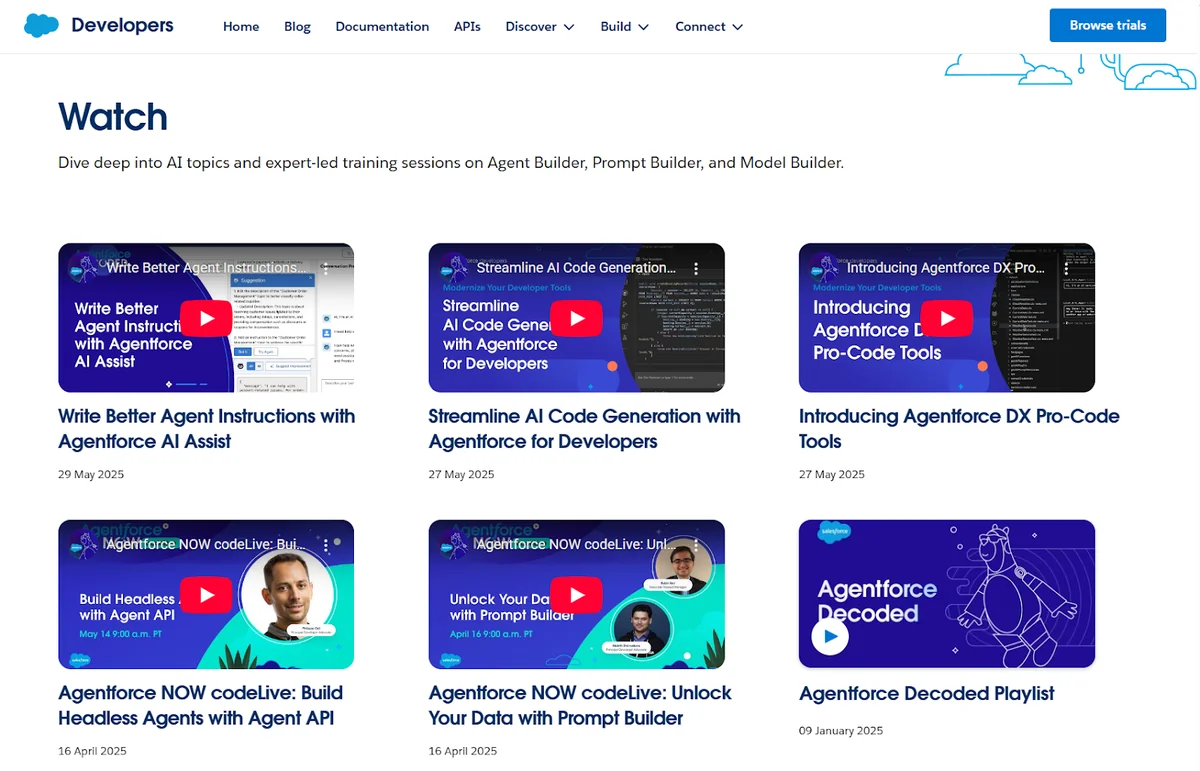
A workshop works best when you convert each exercise into an implementation artifact. Do not only click through the steps. Create a small delivery pack that a teammate could review: business requirement, user story, data access notes, agent instructions, action catalog, test prompts, expected responses, and known limitations.
For a service use case, your agentforce workshop checklist can look like this:
- Use case: answer a customer service question and summarize the related Case status.
- Data boundary: the agent can read only records available to the running user.
- Action boundary: the action returns safe fields and does not update the Case.
- Fallback: if no record is accessible, the agent asks the user to contact support.
- Test: run prompts for valid access, no access, missing record, and ambiguous user input.
This is also where focusonforce study becomes useful for teams. The same worksheet supports admin training, developer review, security signoff, and certification prep.
Code example for Agentforce training: Apex custom action
Developers preparing through focusonforce-style study should build at least one custom action. The example below shows a bulk-aware Apex invocable action that returns selected Case fields. It uses with sharing, checks object and field access before querying, handles null input, and returns one response per request. This pattern matters because an Agentforce action can later be reused from Flow, and Salesforce still requires passing Apex tests and at least 75% org code coverage for production deployment or packaging.
public with sharing class AgentforceCaseSummaryAction {
    public class Request {
        @InvocableVariable(required=true)
        public Id caseId;
    }

    public class Response {
        @InvocableVariable
        public String status;

        @InvocableVariable
        public String priority;

        @InvocableVariable
        public String message;
    }

    @InvocableMethod(
        label='Get Case Status Summary'
        description='Returns safe Case status fields for an Agentforce custom action.'
    )
    public static List<Response> getCaseStatus(List<Request> requests) {
        List<Response> results = new List<Response>();

        if (requests == null || requests.isEmpty()) {
            return results;
        }

        if (!Schema.sObjectType.Case.isAccessible()
            || !Schema.sObjectType.Case.fields.Status.isAccessible()
            || !Schema.sObjectType.Case.fields.Priority.isAccessible()
            || !Schema.sObjectType.Case.fields.Subject.isAccessible()) {

            for (Integer i = 0; i < requests.size(); i++) {
                Response denied = new Response();
                denied.message = 'The running user does not have access to the required Case fields.';
                results.add(denied);
            }
            return results;
        }

        Set<Id> caseIds = new Set<Id>();
        for (Request requestItem : requests) {
            if (requestItem != null && requestItem.caseId != null) {
                caseIds.add(requestItem.caseId);
            }
        }

        Map<Id, Case> casesById = new Map<Id, Case>();
        if (!caseIds.isEmpty()) {
            casesById = new Map<Id, Case>([
                SELECT Id, Status, Priority, Subject
                FROM Case
                WHERE Id IN :caseIds
            ]);
        }

        for (Request requestItem : requests) {
            Response responseItem = new Response();

            if (requestItem == null || requestItem.caseId == null) {
                responseItem.message = 'No Case Id was provided.';
            } else if (!casesById.containsKey(requestItem.caseId)) {
                responseItem.message = 'No accessible Case was found for the supplied Id.';
            } else {
                Case caseRecord = casesById.get(requestItem.caseId);
                responseItem.status = caseRecord.Status;
                responseItem.priority = caseRecord.Priority;
                responseItem.message = 'Case "' + caseRecord.Subject + '" is '
                    + caseRecord.Status + ' with priority ' + caseRecord.Priority + '.';
            }

            results.add(responseItem);
        }

        return results;
    }
}
Before using this pattern in a real agent, add unit tests for the null request path, valid Case path, and missing-record path. Then review user permissions, prompt instructions, action descriptions, and any data returned to the user. Agentforce action instructions should tell the agent what the action does and when to use it; vague instructions increase the chance that the agent calls the wrong action.
Best practices for focusonforce agentforce training in enterprise orgs
Enterprise Agentforce work needs more control than a personal study org. Use these practices while you follow a focusonforce plan:
- Separate learning from delivery. Use a Developer Edition or sandbox for training; use your release process for production metadata.
- Write action instructions like acceptance criteria. State when the action should run, what input it needs, and what it must not do.
- Test negative cases. Try missing records, restricted users, vague prompts, unsupported requests, and data the agent must not expose.
- Keep Apex bulk-aware. Even if an agent action often runs one request at a time, invocable methods can be reused by Flow and should handle lists safely.
- Document data grounding. Record which CRM records, Data 360 data, or unstructured content the agent can use.
- Align with security teams early. Review CRUD, FLS, sharing, prompt logging, data retention, and escalation paths before a pilot.
For related SalesforceTutorial references, review Salesforce Agentforce basics, Apex programming examples, Salesforce Flow automation, Salesforce Data Cloud concepts, and Salesforce certification preparation.
How to prepare with focusonforce for the agentforce specialist practice exam
The best agentforce specialist practice exam routine starts after you can complete a build without copying a tutorial. Use the official credential page to confirm the current scope, then create a two-column worksheet: objective and proof. Proof means a screenshot, configuration note, code sample, or test result from your org.
| Study area | Hands-on proof | Common weak spot |
|---|---|---|
| Agent setup and topics | Agent with at least two topics and tested instructions | Instructions are too broad or overlap between topics |
| Actions | Flow action and Apex invocable action connected to an agent | No CRUD/FLS review or unclear action descriptions |
| Prompt Builder and grounding | Prompt template tested with permitted and restricted data | Assuming grounding fixes poor data quality |
| Data 360 and RAG concepts | Notes showing which data source supports which answer type | Mixing CRM fields, unified profiles, and documents without governance |
| Deployment and lifecycle | Sandbox test plan and owner list for post-release monitoring | No rollback plan or support handoff |
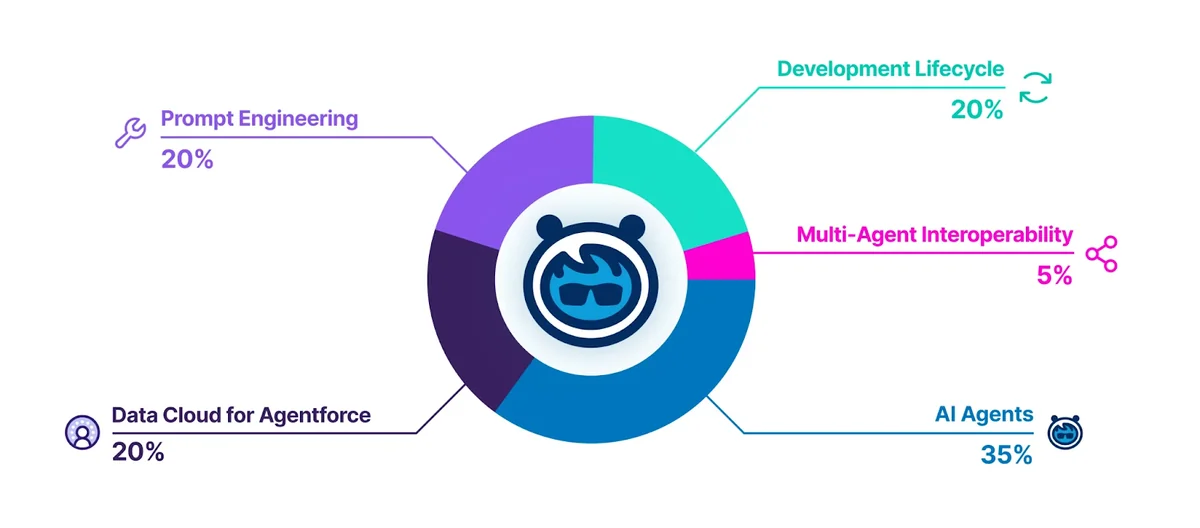
After every agentforce specialist practice exam attempt, group wrong answers by product area. A wrong answer about Agentforce for Education should send you back to the education data model and learner lifecycle modules. A wrong answer about custom actions should send you back to the Apex or Flow build. This keeps focusonforce preparation tied to skills rather than guessing patterns.
Common errors with focusonforce Agentforce preparation
The most common preparation error is studying Agentforce as a vocabulary list. Agentforce is configuration, data, security, testing, and operations. Avoid these mistakes:
- Skipping the org build. You cannot learn agent behavior only from notes.
- Ignoring permissions. Agents should not become a path around sharing, CRUD, FLS, or business approvals.
- Writing one-record Apex. Invocable Apex should accept lists and return predictable list responses.
- Using vague action names. Names and descriptions affect how clearly the action can be selected and reviewed.
- Taking practice exams too early. Practice questions work best after Trailhead, an agentforce workshop, and one complete build.
- Forgetting release checks. Recheck official Salesforce Help, Developer Docs, Trailhead, and release notes before publishing internal training.
Final focusonforce readiness check
Use this focusonforce checklist before you call your preparation complete: you can open the official Salesforce source for each claim, build the same feature in a non-production org, explain why an agent action is safe, and describe how the change moves through your release path. You can also connect agentforce training notes to at least one agentforce workshop artifact and one agentforce specialist practice exam weak area.
If your focusonforce notes only contain definitions, keep studying. If they contain a tested agent, a permissions review, a data grounding decision, and a support handoff plan, you are closer to real implementation readiness.
Frequently Asked Questions
Is focusonforce enough for Agentforce Specialist certification?
focusonforce-style preparation can organize your study, but it should not replace the official Salesforce Certified Agentforce Specialist credential page and exam guide. Use it as a study checklist, then confirm every objective through Trailhead, Salesforce Help, Developer Docs, and hands-on org work.
Where should I start with agentforce training?
Start with Trailhead Agentblazer learning, then use a Developer Edition or sandbox to complete an agentforce workshop. After that, build one small agent with topics, actions, instructions, and test prompts before moving to exam practice.
How does an agentforce workshop help admins and developers?
An agentforce workshop shows the build sequence. Admins learn the configuration path, testing approach, and handoff points. Developers learn where custom Apex, Flow, external services, APIs, and data grounding fit into the agent design.
What is different about agentforce for education?
Agentforce for education works in an institutional context where learner data, advising, admissions, alumni engagement, and staff workflows matter. The preparation plan should include the education data model, privacy review, user permissions, and escalation paths for student-facing requests.
When should I take an agentforce specialist practice exam?
Take an agentforce specialist practice exam after you can explain the official objectives and complete one hands-on agent build. Use wrong answers to choose the next lab: actions, grounding, prompts, Data 360, deployment, or Agentforce Education.