Hubspot Market Share: Salesforce View for 2026
Hubspot market share is best read as a set of signals, not one fixed percentage. Hubspot market share research is useful when you know which category the source is measuring. Customer count, revenue, review volume, installed-base data, search demand, and product-fit evidence all measure different parts of the CRM and marketing platform market.
For Salesforce teams, the practical question is not whether HubSpot has traction. It does. The question is where HubSpot wins, where Salesforce Marketing Cloud Growth and Marketing Cloud Next change the comparison, and how to make a defensible platform decision for sales, marketing, service, data, and compliance teams.
Hubspot Market Share: What the Numbers Mean in 2026
There is no single official Hubspot market share number that works for every buyer. Treat Hubspot market share as a category-specific benchmark, not as a universal buying score. A CRM market-share chart, a marketing automation market-share chart, a CMS adoption report, and a peer-review ranking can all be accurate while answering different questions.
HubSpot reported 288,706 customers as of December 31, 2025, and full-year 2025 revenue of $3.13 billion. Salesforce reported fiscal 2026 total revenue of $41.5 billion and disclosed $5.428 billion in fiscal 2026 subscription and support revenue for Agentforce Marketing and Agentforce Commerce. These figures do not prove product superiority by themselves, but they show scale, buying patterns, and product-line weight.
When an enterprise architecture team studies Hubspot market share, it should separate five data types:
| Signal | What it tells you | What it does not tell you | Useful source type |
|---|---|---|---|
| Revenue | Commercial scale and spend level | Feature fit for your process | Investor relations and SEC filings |
| Customer count | Adoption breadth | Number of active users or paid seats | Company financial releases |
| Installed-base tracking | Observed technology usage on domains or apps | Contract value or implementation depth | Technology intelligence providers |
| Review volume and ratings | User sentiment and recurring pain points | Architecture fit or data-governance maturity | Peer-review platforms such as G2 |
| Search demand | Buyer curiosity and comparison intent | Actual market adoption | SEO tools, GSC data, and trend reports |
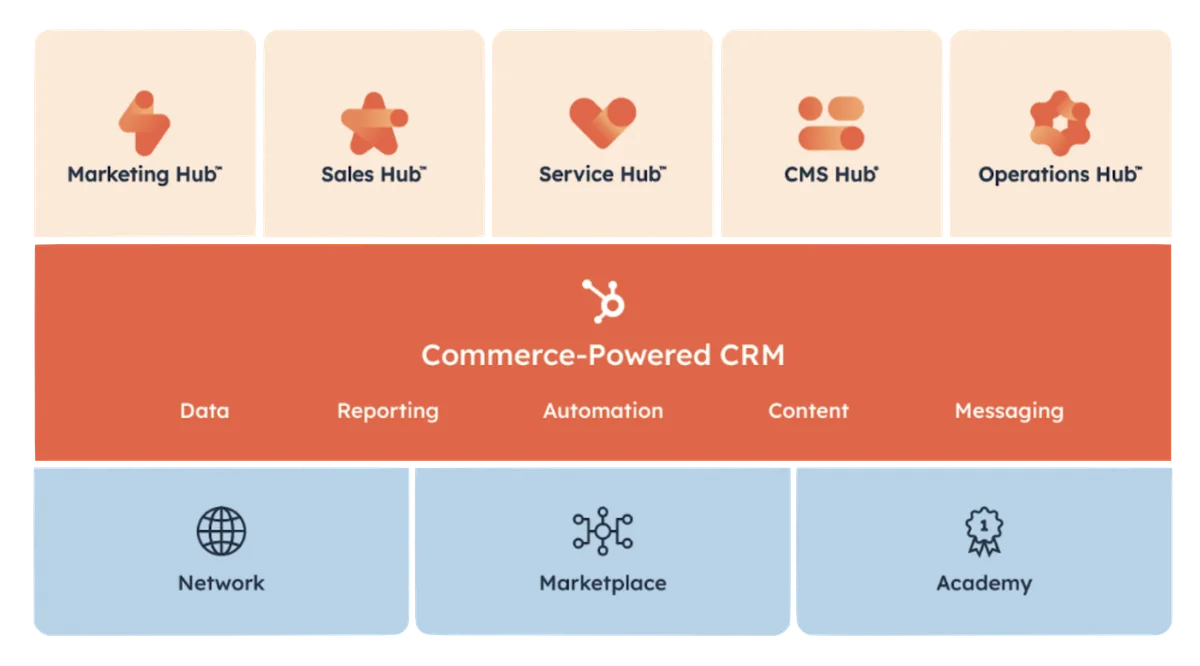
That is why Hubspot market share can look different depending on the category. A Hubspot market share figure from a CMS report should not be used to judge enterprise CRM depth, and a Hubspot market share figure from a CRM report should not be used to judge email-builder usability. HubSpot can appear strong in inbound marketing, marketing automation, SMB CRM, and CMS-led acquisition. Salesforce often appears stronger when the scope includes multi-cloud CRM, service operations, field service, custom data models, integration, identity, analytics, and regulated enterprise workloads.
How Salesforce Marketing Cloud Growth Changes the Hubspot Market Share Discussion
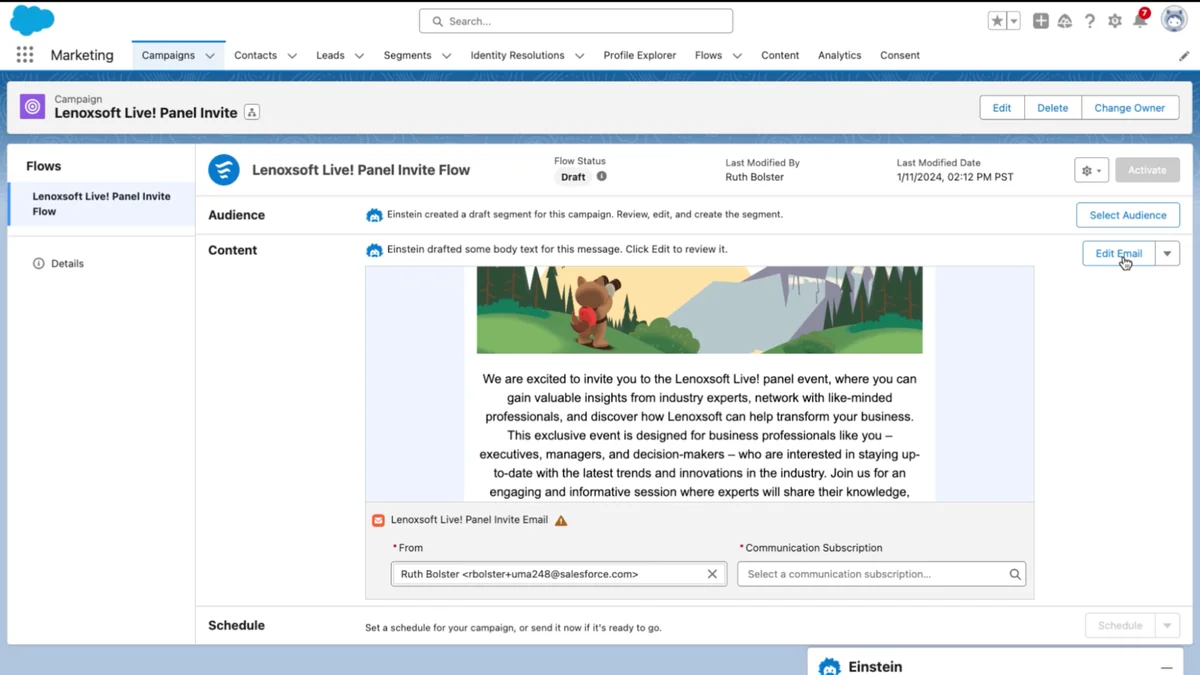
Salesforce Marketing Cloud Growth, now part of the broader Marketing Cloud Next direction, matters because it changes the old comparison. Historically, many teams compared HubSpot Marketing Hub with Salesforce Marketing Cloud Account Engagement for B2B marketing automation. In 2026, the comparison also includes Salesforce platform-native marketing capabilities, Salesforce CMS, Data 360, Flow, and Agentforce-related marketing features.
Salesforce describes Marketing Cloud Next as bringing Salesforce platform capabilities to marketing work, including data integration with Data 360, content building, audience work, and campaign execution. Salesforce pricing pages list Marketing Cloud Growth Edition at $1,500 USD per org per month when billed annually, and Salesforce allocation documentation lists annual message-credit and CMS storage limits. Always check the current contract, edition, and region before presenting costs to procurement.
This affects Hubspot market share because platform-native marketing reduces one reason buyers choose a separate SMB marketing suite: speed of launch. In Salesforce accounts, Hubspot market share becomes a question about overlap with existing CRM investment, not only a question about marketing tool adoption. Salesforce still requires admin discipline, release management, permission design, and data hygiene. But a Salesforce-first company can now evaluate whether the same platform can support CRM, campaign data, segmentation, content, reporting, AI-assisted work, and downstream service actions.
Salesforce marketing cloud growth and platform-native marketing
The phrase salesforce marketing cloud growth matters in buyer research because it signals Salesforce’s push toward marketers who need a simpler campaign workspace without leaving the Salesforce data model. In enterprise orgs, that is more than a UI change. It affects how campaigns, leads, contacts, accounts, consent, assets, segments, and reporting align with the CRM.
A Salesforce team should test salesforce marketing cloud growth against real scenarios: a webinar nurture, an account-based campaign, a partner campaign, a consent-driven regional campaign, and a sales handoff. The test should include setup effort, data model changes, permission sets, Data 360 dependencies, message-credit usage, sandbox strategy, and reporting ownership.
What Is the Right Way to Compare HubSpot and Salesforce?
The right comparison starts with operating model, not a feature checklist. If marketing owns the full funnel and needs fast landing pages, forms, email, simple automation, and CMS content without much platform engineering, HubSpot can be easier to operate. If sales, service, data, security, and industry processes depend on Salesforce records and automation, Salesforce Marketing Cloud Growth or Account Engagement may reduce integration debt.
Use Hubspot market share as a prompt for deeper evaluation. Hubspot market share is useful when it explains buyer behavior, but weak when it hides implementation trade-offs: why are buyers adopting HubSpot, what jobs are they hiring it to do, and where does that overlap with your Salesforce roadmap? In production programs, the answer often differs by segment. A startup team may prioritize time-to-campaign. A regulated financial-services team may prioritize data residency, role hierarchy, auditability, identity, and CRM-governed access.
Uk marketing cloud platform market checks for UK buyers
The uk marketing cloud platform market adds regional factors that do not always appear in global comparison pages. UK teams should review data processing terms, UK GDPR obligations, consent capture, cookie policy, email compliance, data residency requirements, support coverage, partner availability, and pricing in GBP. For Salesforce, also check whether the implementation uses Marketing Cloud Next, Marketing Cloud Engagement, Account Engagement, Data 360, or a combination.
In the uk marketing cloud platform market, procurement should ask each vendor for contract-level answers instead of relying on broad comparison claims. The useful questions are simple: where is customer data stored, which subprocessors are involved, how does the platform handle consent withdrawal, how are deleted contacts handled in connected systems, and how will marketing prove lawful basis for campaigns?
Hubspot cms hub vs salesforce marketing cloud g2 reviews: how to read review data
The search phrase hubspot cms hub vs salesforce marketing cloud g2 reviews mixes product categories, so read it carefully. HubSpot CMS Hub is a content management product. Salesforce Marketing Cloud is a marketing platform family, and current public listings may use names such as Agentforce Marketing or Salesforce Marketing Cloud. G2 reviews can help surface common user sentiment, but they should not replace a solution design workshop.
When using hubspot cms hub vs salesforce marketing cloud g2 reviews as a research path, filter by company size, industry, reviewer role, implementation age, and use case. A marketing manager’s comment about email builder speed is useful for adoption planning. An enterprise architect still needs to test identity, API limits, object model, data synchronization, release management, and reporting lineage.
Crm news today salesforce hubspot october 2025: treat news as context
The query crm news today salesforce hubspot october 2025 suggests that buyers track vendor momentum, product announcements, earnings, and AI positioning. That research is useful, but news should not drive a platform decision by itself. A headline from October 2025 may explain market direction; it does not prove that a feature works in your Salesforce org, region, edition, or compliance model.
Use crm news today salesforce hubspot october 2025 style searches for timing and context, then validate with release notes, official help pages, pricing pages, contract terms, and a proof of concept. Salesforce release behavior, product naming, and AI capabilities can change by release. HubSpot packaging can also change, so keep a dated decision log.
How to Build a Salesforce Evaluation Model for Hubspot Market Share Decisions
A Salesforce-centered evaluation should translate Hubspot market share into measurable fit. The best Hubspot market share discussion ends with testable requirements, not with a debate about brand preference. Do not ask, “Which product is bigger?” Ask, “Which platform can run our next three years of demand generation without creating data, security, or reporting gaps?”
Start with a scoring model that covers business capability, Salesforce architecture fit, cost drivers, implementation effort, and operational risk.
| Evaluation area | HubSpot question | Salesforce question | Decision evidence |
|---|---|---|---|
| Lead lifecycle | Can marketing define and qualify leads without custom engineering? | Do Lead, Contact, Account, Campaign, and Opportunity processes remain the system of record? | Lifecycle workshop and sample campaign |
| Data model | Can the standard model support account hierarchy, partner roles, and regional consent? | Can Salesforce objects and Data 360 support unification, segmentation, and activation? | Data dictionary and integration diagram |
| Content operations | Can CMS, landing pages, forms, and email be managed by marketers? | Can Salesforce CMS and Marketing Cloud builders support reusable assets and approvals? | Content build test |
| Automation | Can workflows handle nurture, scoring, sales alerts, and suppression? | Can Flow, Marketing Cloud automation, and CRM ownership rules work together? | Process test and exception handling |
| Reporting | Can marketing attribute campaigns without exports? | Can campaign influence, CRM dashboards, and Data 360 insights show the full journey? | Board-report mock-up |
| Security | Can roles, teams, and content access be controlled? | Can permission sets, sharing, field-level security, and audit requirements be enforced? | Security review |
| Scale and cost | Which contacts, seats, sends, domains, and add-ons drive cost? | Which message credits, Data 360 credits, storage, sandboxes, and licenses drive cost? | Three-year TCO model |
How to Use Salesforce Data to Validate Vendor Fit
Market statistics are external signals. Hubspot market share can explain what the broader market is doing, but your Salesforce org contains internal signals: campaign response, source quality, conversion speed, sales acceptance, email opt-out patterns, partner influence, and customer lifecycle events. A team that studies Hubspot market share should also study its own funnel data before changing platforms.
The Apex example below shows a safe pattern for exposing recent CampaignMember volume to an LWC dashboard. It uses aggregate SOQL, avoids SOQL in loops, and uses WITH USER_MODE so object permissions and field-level security are enforced. Salesforce made user-mode database operations generally available in Spring ’23, and Salesforce’s current secure Apex guidance recommends user-mode access for CRUD/FLS-aware data operations.
public with sharing class MarketSignalController {
    public class CampaignSignal {
        @AuraEnabled public Id campaignId;
        @AuraEnabled public String campaignName;
        @AuraEnabled public String campaignType;
        @AuraEnabled public Integer memberCount;

        public CampaignSignal(Id campaignId, String campaignName, String campaignType, Integer memberCount) {
            this.campaignId = campaignId;
            this.campaignName = campaignName;
            this.campaignType = campaignType;
            this.memberCount = memberCount;
        }
    }

    @AuraEnabled(cacheable=true)
    public static List<CampaignSignal> topCampaigns(Integer daysBack) {
        Integer safeDays = (daysBack == null || daysBack < 1 || daysBack > 365) ? 90 : daysBack;
        DateTime startDate = System.now().addDays(-safeDays);

        List<AggregateResult> groupedMembers = [
            SELECT CampaignId campaignId, COUNT(Id) memberCount
            FROM CampaignMember
            WHERE CreatedDate >= :startDate
            WITH USER_MODE
            GROUP BY CampaignId
            ORDER BY COUNT(Id) DESC
            LIMIT 20
        ];

        Set<Id> campaignIds = new Set<Id>();
        for (AggregateResult row : groupedMembers) {
            campaignIds.add((Id) row.get('campaignId'));
        }

        Map<Id, Campaign> campaignsById = new Map<Id, Campaign>([
            SELECT Id, Name, Type
            FROM Campaign
            WHERE Id IN :campaignIds
            WITH USER_MODE
        ]);

        List<CampaignSignal> results = new List<CampaignSignal>();
        for (AggregateResult row : groupedMembers) {
            Id campaignId = (Id) row.get('campaignId');
            Campaign campaignRecord = campaignsById.get(campaignId);
            results.add(new CampaignSignal(
                campaignId,
                campaignRecord == null ? null : campaignRecord.Name,
                campaignRecord == null ? null : campaignRecord.Type,
                (Integer) row.get('memberCount')
            ));
        }
        return results;
    }
}
This code does not decide whether HubSpot or Salesforce is the better platform. It gives architects a governed way to measure campaign activity from Salesforce records. Before deploying it, add tests, review object access for marketing users, and confirm that exposing Campaign and CampaignMember data matches your data-classification policy.
@IsTest
private class MarketSignalControllerTest {
    @IsTest
    static void returnsRecentCampaignSignals() {
        Campaign campaignRecord = new Campaign(
            Name = 'UK Demand Generation Webinar',
            IsActive = true,
            Type = 'Webinar'
        );
        insert campaignRecord;

        String defaultLeadStatus = [
            SELECT MasterLabel
            FROM LeadStatus
            WHERE IsDefault = true
            LIMIT 1
        ].MasterLabel;

        Lead leadRecord = new Lead(
            LastName = 'Evaluation',
            Company = 'SalesforceTutorial',
            Status = defaultLeadStatus
        );
        insert leadRecord;

        insert new CampaignMember(
            CampaignId = campaignRecord.Id,
            LeadId = leadRecord.Id,
            Status = 'Sent'
        );

        Test.startTest();
        List<MarketSignalController.CampaignSignal> results =
            MarketSignalController.topCampaigns(90);
        Test.stopTest();

        System.assertEquals(1, results.size(), 'One campaign should be returned.');
        System.assertEquals(campaignRecord.Id, results[0].campaignId);
        System.assertEquals(1, results[0].memberCount);
    }
}
Salesforce requires at least 75% Apex code coverage for deployment, and all tests must pass. Do not write tests only for percentage. Test empty data, old CampaignMember records, permission behavior, and bulk-like data volumes. For dashboards, wire the Apex method to an LWC only for read operations; use imperative Apex or Lightning Data Service patterns when the user changes data.
What Data Cloud and Data 360 Add to the Salesforce Side
Data 360, formerly Data Cloud in many Salesforce materials, is central to the Salesforce side of the comparison because marketing data rarely lives in one place. Web behavior, ERP records, commerce activity, email engagement, support cases, product usage, and offline events all affect segmentation and personalization.
For a Hubspot market share evaluation, this matters because a single marketing hub can be enough for a smaller team, but a larger Salesforce estate may need identity resolution, profile unification, calculated insights, segment activation, data actions, and governed data sharing. Salesforce documentation describes Data Cloud capabilities such as data streams, data model objects, calculated insights, activation, and integrations. Validate terminology in the current help pages because Salesforce naming moved toward Data 360 in 2025-2026 materials.
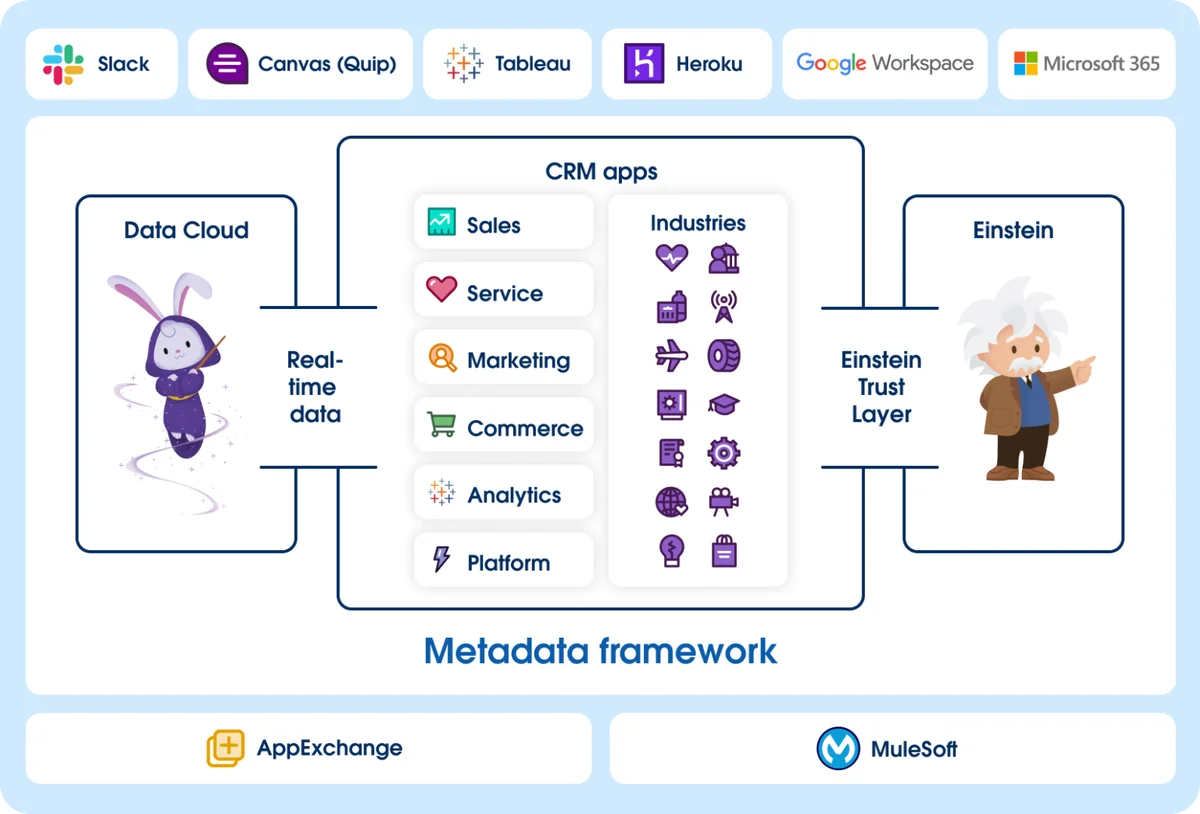
In enterprise orgs, the Salesforce advantage often appears when marketing activation depends on service, commerce, data warehouse, and industry records. The HubSpot advantage often appears when the team values a faster marketing-owned workspace and can accept the platform’s data model and integration patterns. Hubspot market share shows that many buyers value that simplicity, but it does not remove the need for architecture review.
Cost and Limit Questions Buyers Should Ask
Cost comparisons often fail because teams compare list prices instead of usage models. A Hubspot market share report rarely shows the cost of integration cleanup, consent rework, data migration, or reporting remediation. HubSpot plans can include contacts, marketing seats, add-ons, domains, and product hubs. Salesforce costs can include Marketing Cloud editions, Sales Cloud or Service Cloud licenses, message credits, Data 360 usage, sandboxes, implementation services, integrations, storage, and support plans.
For Salesforce Marketing Cloud Growth, review annual message credits, CMS storage, Data 360 consumption, permission set licenses, and regional pricing. For HubSpot, review marketing contacts, non-marketing contacts, additional seats, CMS requirements, operations tooling, and integration costs. This is where salesforce marketing cloud growth and Hubspot market share connect: a lower-friction launch can still become expensive if contact volume, data sync, or reporting requirements grow.
Build a three-year cost model with these rows:
- Licensed users by role: marketer, sales user, admin, analyst, integration user, agency user.
- Contact or message volume: total contacts, marketable contacts, email sends, SMS or push volume, suppression lists.
- Data operations: sync frequency, Data 360 credits, API calls, duplicate rules, identity resolution, warehouse exports.
- Environment strategy: sandboxes, developer environments, release path, backup and restore tooling.
- Services: implementation partner, migration, training, managed services, deliverability consulting, and consent review.
Best Practices for a Salesforce-HubSpot Platform Decision
A good vendor decision produces a reusable architecture record. Hubspot market share belongs in that record as market context, alongside proof-of-concept results and risk notes. It should explain why the team chose a platform, what evidence supported the choice, and which assumptions must be retested after each major release.
- Define the category first. State whether you are comparing CRM, B2B marketing automation, CMS, email marketing, CDP, customer platform, or a combined stack. Hubspot market share means different things across these categories.
- Map the source of truth. Identify whether Lead, Contact, Account, Opportunity, Campaign, consent, subscription, and customer profile data live in Salesforce, HubSpot, a warehouse, or Data 360.
- Run one production-like campaign. Build a real audience, content asset, form, email, suppression rule, handoff, and dashboard in each shortlisted platform.
- Check security early. In Salesforce, review permission sets, field-level security, sharing, connected app policies, and integration-user access. In HubSpot, review team permissions, content partitions, connected apps, and audit needs.
- Document limits. Capture message credits, API limits, automation limits, storage, contact tiers, sandbox support, and data retention.
- Use peer reviews as prompts. G2 comments can reveal adoption and usability themes, but they are not a substitute for testing your own data, users, and compliance requirements.
- Revisit the decision quarterly. Product packaging, AI capabilities, Data 360 features, and marketing operations needs can change. Keep the decision tied to release notes and contract terms.
Common Errors When Interpreting Hubspot Market Share
The most common error is treating Hubspot market share as a winner-takes-all score. Hubspot market share can show adoption, but it cannot tell you whether your org’s duplicate rules, lead assignment, campaign hierarchy, or consent objects will work after migration. A platform can win in SMB adoption and still be the wrong choice for a global Salesforce program with custom objects, data-residency constraints, private sharing rules, and multiple business units. The reverse is also true: Salesforce can be the right enterprise platform but too complex for a small marketing team that only needs simple email, landing pages, and lead capture.
Another error is comparing HubSpot CMS Hub directly with the full Salesforce Marketing Cloud family without defining scope. A CMS evaluation needs page building, content permissions, SEO controls, redirects, forms, analytics, and developer workflow. A Marketing Cloud evaluation needs segmentation, campaign orchestration, consent, personalization, deliverability, channel support, and CRM handoff.
A third error is ignoring implementation ownership. HubSpot projects often start inside marketing. Salesforce projects often require admin, developer, architect, data, security, and revenue operations participation. The better tool on paper can fail if the operating model does not match the team.
Recommended Decision Path for Salesforce Professionals
Use this path when a stakeholder asks whether Hubspot market share means your Salesforce org should change marketing platforms. The goal is to turn Hubspot market share into a controlled evaluation, not a rushed replacement project.
- Create a one-page scope statement: CRM, marketing automation, CMS, customer data, or all of them.
- Collect current-state metrics from Salesforce Campaigns, Leads, Opportunities, consent fields, and marketing attribution dashboards.
- Review official Salesforce documentation for Marketing Cloud Next, Marketing Cloud Growth limits, Data 360, Apex security, and LWC data access.
- Collect HubSpot financial and product packaging data from official HubSpot sources, then compare it with Salesforce pricing and contract terms.
- Run a campaign proof of concept using real segmentation, real content approval, and real reporting requirements.
- Score the result across adoption, data model, security, integration, reporting, cost, and release operations.
- Write an architecture decision record and review it with marketing, sales, service, IT, security, legal, and finance.
This keeps the Hubspot market share discussion grounded. A Hubspot market share number can start the conversation, but a Salesforce decision needs evidence from your own campaign, data, and security tests. Market momentum matters, but the final decision should come from verified fit, not a chart.
Frequently Asked Questions
What is Hubspot market share in 2026?
There is no single official Hubspot market share percentage that applies to every CRM, marketing automation, and CMS category. Hubspot market share changes with the dataset and category definition. Use HubSpot customer count, revenue, installed-base reports, review platforms, and category-specific analyst data together, then compare those signals with your Salesforce architecture needs.
Is Salesforce Marketing Cloud Growth a HubSpot replacement?
Salesforce Marketing Cloud Growth can replace some HubSpot-style marketing automation use cases for Salesforce-centered teams, especially where CRM data, Data 360, Salesforce CMS, and platform security are important. It is not an automatic replacement. Test your forms, landing pages, segmentation, email build process, consent handling, sales handoff, and reporting before deciding.
How should UK teams compare the uk marketing cloud platform market?
UK teams should compare the uk marketing cloud platform market using UK GDPR, consent capture, data processing terms, regional pricing, support coverage, partner availability, and integration requirements. Do not rely only on global market-share charts because regional compliance and procurement requirements can change the decision.
Do G2 reviews prove HubSpot is better than Salesforce Marketing Cloud?
No. G2 reviews show user sentiment and recurring product themes, but they do not prove architecture fit or override Hubspot market share context. Use hubspot cms hub vs salesforce marketing cloud g2 reviews to identify questions for your proof of concept, then validate data model, security, automation, reporting, and cost in your own environment.
What does salesforce marketing cloud growth mean for Salesforce customers?
salesforce marketing cloud growth points to a simpler, Salesforce-platform-based marketing experience for teams that want campaign execution closer to CRM data. Salesforce customers should review edition limits, message credits, Data 360 dependencies, user permissions, and current release documentation before adopting it.
Should crm news today salesforce hubspot october 2025 influence a buying decision?
crm news today salesforce hubspot october 2025 style searches can explain vendor direction and market timing, but they should not drive the buying decision alone. Use news as context, then verify features in official release notes, pricing pages, help documentation, and a production-like proof of concept.
Related SalesforceTutorial Resources
- Salesforce Marketing Cloud implementation guide
- Salesforce Data Cloud and Data 360 concepts
- Salesforce Marketing Cloud Account Engagement basics
- SOQL query syntax for Salesforce admins and developers
- Apex in Salesforce with security and testing patterns
Official Sources Used
- Salesforce Marketing Cloud editions pricing
- Salesforce Help: Marketing Cloud Next
- Salesforce Help: Marketing Cloud Next allocations and limits
- Salesforce Developer Docs: user-mode database operations
- Salesforce Developer Docs: SOQL SELECT syntax
- Salesforce Developer Docs: wire Apex methods to LWC
- Trailhead: Apex testing and code coverage
- HubSpot Investor Relations: full-year 2025 results
- Salesforce Investor Relations: fiscal 2026 results