A salesforce business analyst connects business needs with Salesforce delivery. The salesforce business analyst role turns goals, process gaps, and stakeholder feedback into requirements, user stories, acceptance criteria, UAT evidence, and release decisions that admins, developers, architects, and business owners can act on.
What is a Salesforce Business Analyst?
A salesforce business analyst is a project role, not just a job title. Salesforce describes business analysis as work that improves business processes and efficiency by eliciting, documenting, and analyzing requirements, then helping produce data-driven solutions. In implementation work, that means the BA keeps the team focused on the problem before anyone jumps to fields, flows, Apex, or licenses.
In enterprise orgs, the role often sits between sales operations, service operations, compliance, product owners, admins, developers, and architects. A good salesforce business analyst can hear “we need a button” and turn it into a clearer question: what decision, record update, approval, or customer outcome must happen?
Use Salesforce’s official role comparison on Trailhead for the admin-versus-BA distinction: Compare the Admin and Business Analyst Roles. For admin tasks that overlap with BA work, see our guide to Salesforce Admin responsibilities and setup tasks.
Salesforce Business Analyst responsibilities in real projects
Salesforce business analyst work changes by company size, delivery model, and Salesforce product, but a salesforce business analyst usually owns the clarity layer of a project. The BA does not need to configure every field, but must make sure the right feature is being built for the right user.
| Responsibility | Salesforce example | Output the team should see |
|---|---|---|
| Discovery | Interview sales managers about why Opportunity stages are skipped. | Problem statement, stakeholder list, current-state notes. |
| Process mapping | Document how a Case moves from web submission to closure. | Current-state and future-state process map. |
| Requirement analysis | Separate required approval controls from nice-to-have dashboard changes. | Prioritized requirements with assumptions and dependencies. |
| User stories | Write stories for sales reps, sales managers, and revenue operations. | User stories with testable acceptance criteria. |
| UAT coordination | Prepare scripts for quote approval, discount exception, and renewal scenarios. | UAT plan, test evidence, defect log, go/no-go recommendation. |
| Adoption support | Compare login, report, and feature usage before and after go-live. | Training notes, adoption dashboard, backlog items. |
Business analyst Salesforce discovery questions
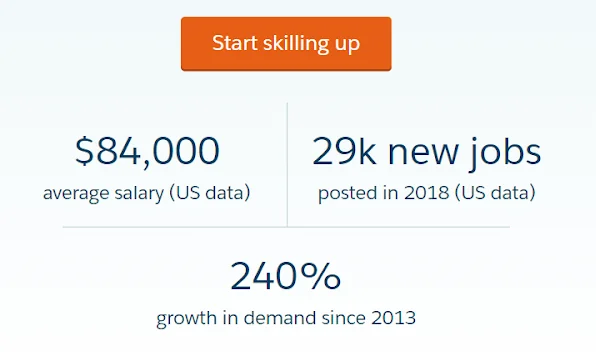
The search phrase business analyst salesforce usually points to people who need the role in practical terms. Start discovery with questions that expose value and risk: which users are affected, what happens if nothing changes, what records must be updated, what reports prove success, and what compliance or approval rules apply?
For example, “Create an auto-close flow for inactive Cases” is not a requirement yet. A BA should confirm the case types, inactivity definition, escalation rules, customer notification rules, audit needs, and exception handling. Only then should the delivery team decide whether the answer is Flow, Apex, Omni-Channel routing, a report, a validation rule, or no Salesforce change at all. See our Salesforce Flow design patterns for admins and BAs for automation tradeoffs.
SFDC analyst responsibilities in security reviews
An sfdc analyst should not approve a story that ignores access. Salesforce security is layered: org-wide defaults, roles, sharing rules, teams, profiles, permission sets, permission set groups, object permissions, field-level security, and record-level sharing all matter. For a project BA, the requirement should name who can view, create, edit, delete, approve, export, or report on the data.
When the solution includes Apex or LWC, the BA should ask developers how CRUD, FLS, and sharing are enforced. Salesforce developer guidance for secure Apex explains user-mode queries and related security controls in Apex controllers. For Summer ’26, Salesforce release notes also document a change in API v67.0 where database operations run in user mode by default; mixed-version orgs should still document the intended access mode so code reviews are clear.
What deliverables should a Salesforce BA create?
A salesforce ba does not create documents for decoration. Each deliverable should remove uncertainty for the next person in the delivery chain. If a document does not help scope, build, test, train, secure, or support the solution, shorten it or remove it.
- Problem statement: One or two paragraphs that define the business issue and expected outcome.
- Stakeholder map: Business owner, process owner, approver, impacted users, data owner, integration owner, security reviewer, and release approver.
- Current-state map: How the process works today, including spreadsheet, email, integration, and manual approval steps.
- Future-state map: The target process after Salesforce changes go live.
- User stories: Role, action, outcome, assumptions, dependencies, and acceptance criteria.
- UAT plan: Test users, test data, scripts, pass/fail rules, defect severity, retest owner, and sign-off path.
- Training notes: Short role-based instructions that match the deployed screen and permissions.
How to write user stories that developers can build
Salesforce Trailhead defines user stories as descriptions of features from the user’s point of view. A salesforce business analyst should write stories that describe intent, not a pre-selected implementation. The format can be simple: as a user role, I want to perform an action, so that I get a business outcome.
Example story for Sales Cloud: As a regional sales manager, I want to review discount requests above 20% before the quote is sent, so that margin exceptions are approved before customers receive pricing.
Good acceptance criteria make the story testable:
- If discount is 20% or less, the quote can move to Ready for Customer without manager approval.
- If discount is above 20%, the quote status changes to Pending Approval.
- Only users in the Regional Sales Manager permission set group can approve the exception.
- The approval decision, approver, and timestamp are visible on the quote record.
Trailhead’s User Story Creation module is a good official reference for story basics and acceptance criteria.
How does a Salesforce Business Analyst work with admins, developers, and architects?
A salesforce business analyst keeps design conversations grounded in requirements, while the admin, developer, and architect select the delivery pattern. This separation prevents a common mistake: writing requirements as solutions.
| Role | Main question | BA collaboration point |
|---|---|---|
| Admin | Can this be configured safely? | Clarify fields, page layouts, validation rules, Flow behavior, and permission sets. |
| Developer | Does this need Apex, LWC, or integration logic? | Define scenarios, edge cases, error messages, and test data. |
| Architect | Will this design scale across clouds, data volume, security, and releases? | Explain business priorities, compliance limits, system boundaries, and tradeoffs. |
| Product owner | What should be built first? | Prioritize backlog items using value, risk, dependency, and release timing. |
Technical handoff example for an SFDC analyst
An sfdc analyst should give developers enough detail to build securely without turning the story into pseudo-code. The handoff can include sample data, expected security behavior, and governor-limit notes.
public with sharing class SalesPipelineReadService {
    @AuraEnabled(cacheable=true)
    public static List<Opportunity> getOpenOpportunitiesForUat(Id accountId) {
        if (accountId == null) {
            throw new AuraHandledException('accountId is required.');
        }

        // One selective SOQL query. No query inside a loop.
        // WITH USER_MODE enforces object permissions, field-level security,
        // and sharing for the current user.
        return [
            SELECT Id, Name, StageName, Amount, CloseDate
            FROM Opportunity
            WHERE AccountId = :accountId
            AND IsClosed = false
            WITH USER_MODE
            ORDER BY CloseDate ASC
            LIMIT 50
        ];
    }
}
This sample is not a BA deliverable by itself. It shows the level of security and limit awareness that a salesforce ba should raise in refinement. The requirement should say which roles can see Amount, what happens when the user lacks access, and whether hidden records should appear in rollups or reports. For related access planning, read our guide to Salesforce sharing rules and record access basics.
Business analyst Salesforce tools and evidence
The best business analyst salesforce work is evidence-based. Avoid approving a change because a stakeholder likes a mockup. Use data from the org, support tickets, report usage, manual workarounds, release defects, and user interviews.
| Need | Useful Salesforce evidence | BA question |
|---|---|---|
| Low adoption | Login history, report usage, Lightning page feedback, training attendance. | Are users avoiding the feature because of access, layout, data quality, or unclear value? |
| Process delay | Stage duration, case age, approval elapsed time, task aging. | Where does work wait, and who can remove the blocker? |
| Security concern | Permission sets, role hierarchy, sharing rules, setup audit trail. | Who truly needs access, and is that access time-bound or permanent? |
| Data cleanup | Duplicate rules, required fields, validation failures, import errors. | Should the project fix data, process, ownership, or integration mapping? |
For data-heavy projects, pair BA discovery with a migration checklist. Our Salesforce data migration planning checklist explains source-to-target mapping, validation, and cutover controls.
How should a Salesforce BA run UAT?
A salesforce ba should treat UAT as business validation, not extra QA. Salesforce Trailhead describes user acceptance testing as end-user testing in a sandbox or test environment to confirm that the project or enhancement works as intended and delivers what was requested.
- Confirm scope: Link each script to a requirement or user story.
- Prepare data: Create realistic records for each profile, permission set, product, region, or case type.
- Use real roles: Test with users who match production access, not only System Administrators.
- Capture evidence: Record pass/fail status, screenshots, record IDs, tester, date, and defect reference.
- Separate defects from change requests: A failed acceptance criterion is a defect; a new idea belongs in the backlog.
- Make the go/no-go call visible: Show open severity, business impact, workaround, owner, and release risk.
For official learning, review Salesforce Trailhead’s User Acceptance Testing unit.
Common UAT errors a Salesforce business analyst should prevent
- Testing as admin only: This hides permission errors and field-level security gaps.
- No negative scenarios: Approval, validation, and integration stories need fail-path tests.
- Unclear defect severity: A typo and a blocked quote approval should not have the same release impact.
- Missing reports: If the business outcome depends on reporting, include dashboard and report checks in UAT.
- No rollback or workaround: The BA should know what users do if the release is delayed or partially deployed.
How to become a Salesforce Business Analyst in 2026
To become a salesforce business analyst, combine Salesforce platform knowledge with business analysis practice. Certification can help, but it does not replace project evidence. Build a small portfolio that shows discovery notes, process maps, user stories, UAT scripts, and release decision examples.

Salesforce BA learning path
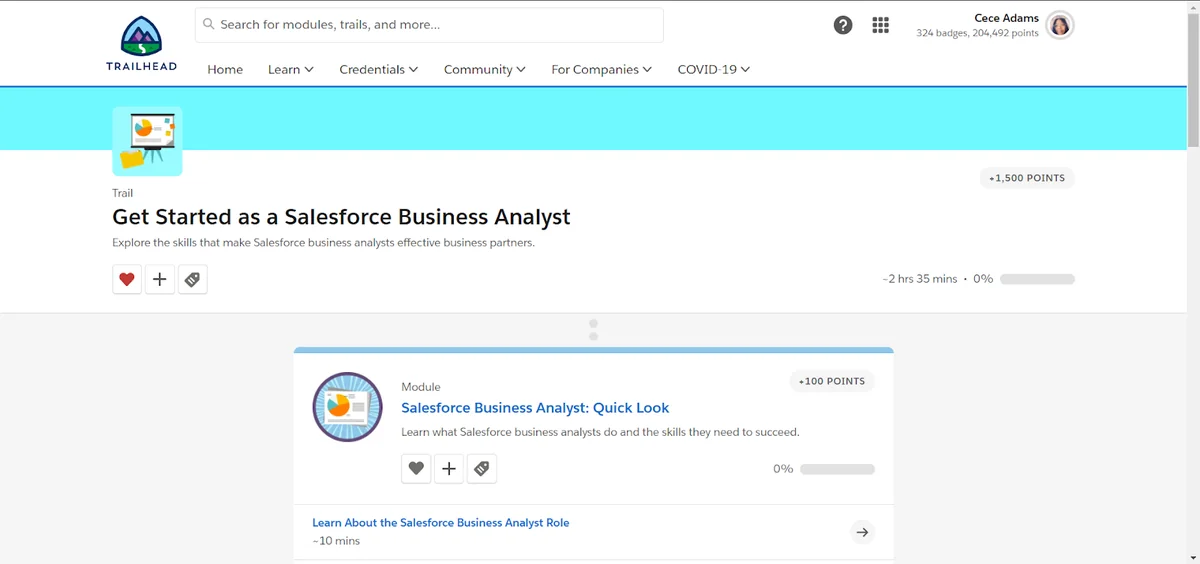
A practical salesforce ba path starts with Platform Administrator fundamentals, then moves into requirements, user stories, UAT, reporting, and security. Salesforce’s official Salesforce Certified Business Analyst page states that certified business analysts understand business needs, capture requirements, and collaborate with stakeholders to develop Salesforce solutions that drive business improvements.
The credential page lists a prepared learning path and certification prep module. As of July 2026, always check Trailhead for the current exam details, maintenance requirements, and any release-specific updates before scheduling the exam.
Business analyst Salesforce portfolio ideas
For a business analyst salesforce portfolio, avoid screenshots with fake claims. Use a Developer Edition org or Trailhead playground and describe the business problem, requirement decisions, assumptions, data model, automation choice, security model, UAT plan, and known limits. A portfolio can include:
- Lead assignment redesign with territory, product, and duplicate-handling assumptions.
- Case escalation process with Service Level Agreement rules and reporting needs.
- Opportunity approval process with discount thresholds and manager access.
- Data cleanup plan for Accounts, Contacts, and Opportunities before migration.
- Integration requirement summary for an external quoting or ERP system. For integration context, see our Salesforce API integration overview for project teams.
Common errors with Salesforce Business Analyst work
Many delivery problems look technical, but start as unclear analysis. A salesforce business analyst reduces rework by finding these issues before build starts.
| Error | Why it causes rework | Better BA action |
|---|---|---|
| Requirement names a feature too early. | The team may build Flow or Apex when a process or permission fix was enough. | Document the outcome first, then evaluate options. |
| Acceptance criteria are vague. | Developers and testers cannot prove completion. | Write pass/fail criteria for each story. |
| Security is left for the end. | UAT fails when real users cannot view or edit records. | Define roles, object access, FLS, and sharing during refinement. |
| Reports are not part of scope. | Business owners cannot measure whether the release worked. | Add reporting and adoption measures to success criteria. |
| Change requests enter UAT as defects. | Go-live decisions become political instead of evidence-based. | Classify each item as defect, change request, training issue, or data issue. |
Salesforce Business Analyst role names in job descriptions
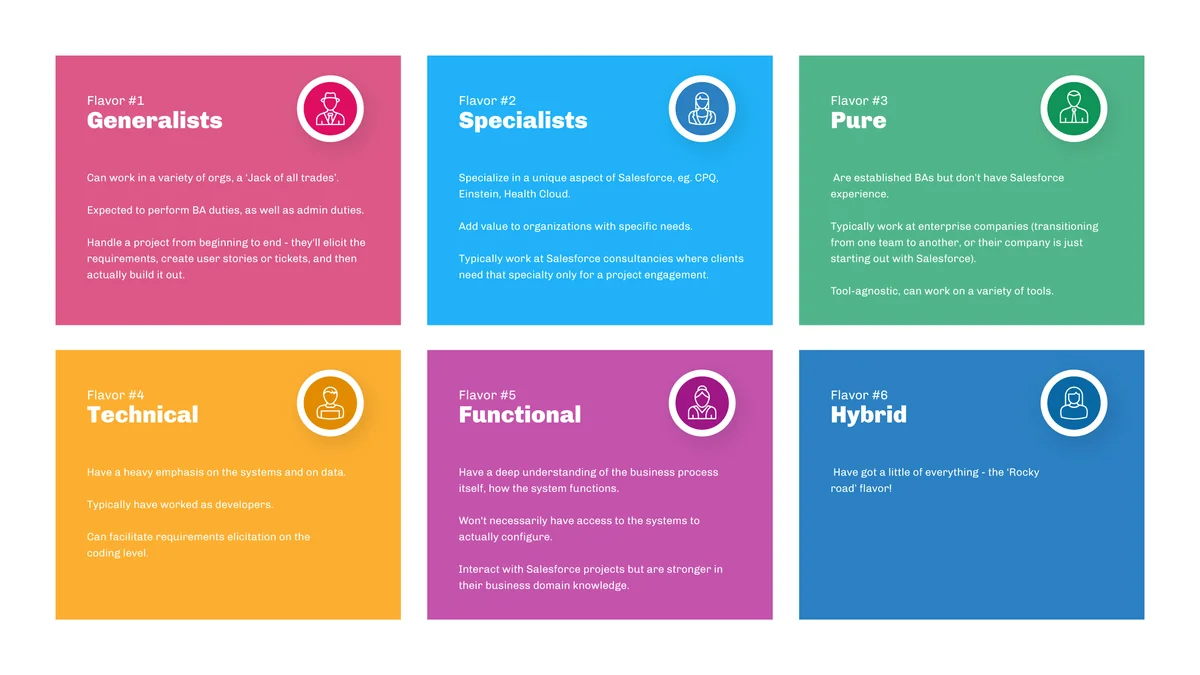
Job posts do not use one label. A salesforce business analyst may appear as Salesforce BA, CRM Business Analyst, Business Systems Analyst, SFDC analyst, Revenue Operations Analyst, or Product Analyst for Salesforce. Read the responsibilities before judging the title.
When a job post uses the phrase business analyst salesforce, check whether the employer expects hands-on configuration, functional analysis, technical analysis, product ownership, or a mix. A salesforce business analyst in a consulting project may run workshops and UAT for a fixed scope. A salesforce business analyst in internal IT may own intake, backlog refinement, release notes, adoption reporting, and support handoff.
How to read Salesforce BA and SFDC analyst job posts
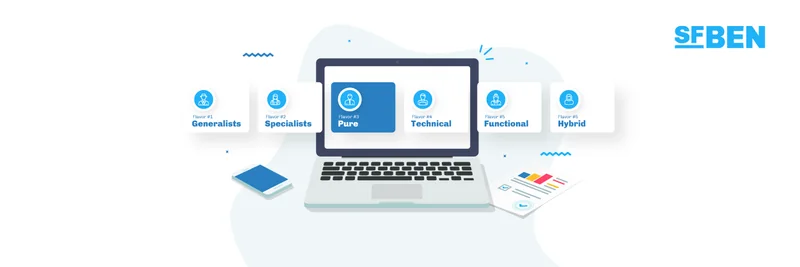
A salesforce ba job that lists Flow, reports, permission sets, and sandbox deployments is closer to an admin-analyst role. An sfdc analyst job that lists API mapping, data models, middleware, and defect triage is closer to a technical analyst role. A salesforce business analyst job that lists workshops, user stories, acceptance criteria, stakeholder sign-off, and UAT is closer to a pure BA role.
The safest way to compare roles is to ask what deliverables you own, what tools you can change, who approves scope, and whether you are accountable for production support after release. The answer tells you more than the title.
Frequently Asked Questions
What does a Salesforce business analyst do?
A Salesforce business analyst defines business problems, gathers requirements, documents user stories, maps processes, supports solution design, coordinates UAT, and helps stakeholders decide whether a Salesforce change is ready for release.
Is a Salesforce BA the same as a Salesforce Admin?
No. A Salesforce BA is usually project-focused and owns discovery, requirements, process analysis, and acceptance. A Salesforce Admin is usually operational and owns configuration, user setup, automation maintenance, reports, security settings, and day-to-day org health. In smaller orgs, one person may perform both roles.
How do I become a Salesforce business analyst in 2026?
Start with Salesforce platform fundamentals, learn discovery and stakeholder skills, practise writing user stories with acceptance criteria, learn UAT planning, and build a portfolio from sandbox projects. The Salesforce Certified Business Analyst credential is useful, and many candidates also earn the Platform Administrator credential first.
Does a Salesforce business analyst need to know Apex?
A Salesforce business analyst does not need to write production Apex in most roles, but should understand what makes a requirement expensive or risky for developers. That includes governor limits, record access, object permissions, field-level security, asynchronous processing, integrations, and test coverage requirements.
What should an SFDC analyst check before approving UAT?
An SFDC analyst should confirm that each acceptance criterion has a passing test result, defects have owners and severity, data setup matches the test scenario, user permissions match real roles, reports show expected values, and the business owner has signed off on the go-live decision.