Salesforce offers a comprehensive suite of cloud-based products designed to transform how organizations manage customer relationships, sales processes, and business operations. This guide covers all major Salesforce products available in 2026, their core features, and practical use cases for admins and developers.
Core Salesforce Products Overview
Salesforce.com provides multiple cloud solutions that integrate seamlessly to create a unified customer experience platform. Each product addresses specific business needs while maintaining data consistency across the entire ecosystem.
Primary Salesforce Cloud Products
- Sales Cloud – CRM and sales automation platform
- Service Cloud – Customer service and support management
- Marketing Cloud – Digital marketing automation and analytics
- Commerce Cloud – E-commerce and digital commerce solutions
- Experience Cloud – Community and portal development
- Analytics Cloud (Tableau CRM) – Business intelligence and data visualization
- Platform (Force.com) – Custom application development platform
- MuleSoft Anypoint Platform – Integration and API management
- Slack – Team collaboration and communication
- Data Cloud – Customer data platform and unification
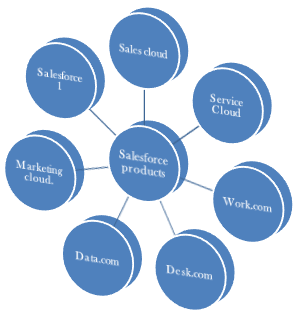
Detailed Salesforce Products Breakdown
Sales Cloud: CRM and Sales Automation
Sales Cloud automates the entire sales process from lead generation to deal closure. Key features include:
- Lead and opportunity management with customizable sales stages
- Account and contact relationship tracking
- Sales forecasting with AI-powered Einstein Analytics
- Quote and proposal generation
- Mobile access through Salesforce Mobile App
- Integration with email platforms and calendar systems
Sales Cloud supports complex B2B sales cycles with territory management, collaborative forecasting, and advanced workflow automation. Available in Essentials, Professional, Enterprise, and Unlimited editions.
Service Cloud: Customer Support Platform
Service Cloud provides comprehensive customer service management capabilities:
- Case management with automated routing and escalation
- Knowledge base creation and management
- Omnichannel support (email, phone, chat, social media)
- Field service management with mobile workforce tools
- Service analytics and performance dashboards
- Einstein Case Classification and Article Recommendations
Service Cloud integrates with telephony systems, live chat platforms, and social media channels to provide unified customer support experiences.
Marketing Cloud: Digital Marketing Automation
Marketing Cloud (formerly ExactTarget) enables sophisticated digital marketing campaigns:
- Email marketing with advanced segmentation and personalization
- Social media marketing and listening
- Mobile marketing including SMS and push notifications
- Web personalization and content management
- Customer journey mapping and automation
- Marketing analytics and attribution modeling
Marketing Cloud includes specialized studios: Email Studio, Mobile Studio, Social Studio, Advertising Studio, and Journey Builder for comprehensive campaign orchestration.
Experience Cloud: Community and Portal Development
Experience Cloud (formerly Community Cloud) enables organizations to build branded digital experiences:
- Customer portals with self-service capabilities
- Partner portals for channel management
- Employee communities and intranets
- Custom branded websites and microsites
- Mobile-responsive templates and themes
- Integration with Salesforce CRM data
Experience Cloud supports Lightning Web Components (LWC) for custom development and provides pre-built templates for common use cases.
Analytics Cloud (Tableau CRM): Business Intelligence
Analytics Cloud combines Salesforce’s Einstein Analytics with Tableau’s visualization capabilities:
- Interactive dashboards and reports
- Predictive analytics with Einstein Discovery
- Data preparation and transformation tools
- Mobile analytics with offline capabilities
- Embedded analytics within Salesforce applications
- Advanced statistical modeling and forecasting
Analytics Cloud connects to multiple data sources beyond Salesforce, enabling comprehensive business intelligence across the organization.
Platform and Development Products
Salesforce Platform (Force.com): Custom Application Development
Salesforce Platform provides the foundation for custom application development:
- Custom objects, fields, and relationships
- Apex programming language for server-side logic
- Lightning Web Components (LWC) for user interface development
- Process Builder and Flow for declarative automation
- Custom APIs and integration capabilities
- AppExchange marketplace for third-party applications
The platform supports both declarative (point-and-click) and programmatic development approaches, enabling rapid application development with enterprise-grade security and scalability.
MuleSoft Anypoint Platform: Integration Solutions
MuleSoft Anypoint Platform provides comprehensive integration capabilities:
- API design and development tools
- Pre-built connectors for popular systems
- Data transformation and mapping
- API management and security
- Runtime deployment options (cloud, on-premises, hybrid)
- Monitoring and analytics for integration performance
MuleSoft enables organizations to connect Salesforce with legacy systems, databases, and third-party applications using industry-standard integration patterns.
Collaboration and Productivity Products
Slack: Team Collaboration Platform
Slack (acquired by Salesforce in 2021) provides modern workplace collaboration:
- Channel-based messaging and file sharing
- Voice and video calling capabilities
- Workflow automation with Slack Workflow Builder
- Integration with Salesforce CRM data
- Third-party app integrations and custom bots
- Enterprise-grade security and compliance features
Slack integrates natively with Salesforce, enabling teams to collaborate on deals, cases, and projects directly within their communication workflows.
Data Cloud: Customer Data Platform
Data Cloud (formerly Customer 360 Data Manager) unifies customer data across systems:
- Real-time data ingestion from multiple sources
- Identity resolution and customer profile unification
- Data quality management and cleansing
- Audience segmentation and activation
- Privacy and consent management
- Integration with all Salesforce clouds
Data Cloud enables organizations to create a single source of truth for customer data, supporting personalized experiences across all touchpoints.
Industry-Specific Solutions
Salesforce provides specialized solutions for various industries:
- Financial Services Cloud – Banking, insurance, and wealth management
- Health Cloud – Healthcare providers and life sciences
- Education Cloud – Educational institutions and student management
- Nonprofit Cloud – Fundraising and program management
- Government Cloud – Public sector and compliance requirements
- Manufacturing Cloud – Account-based forecasting and partner management
These industry clouds extend core Salesforce functionality with specialized data models, processes, and compliance features.
Emerging Technologies and AI
Einstein AI Platform
Einstein AI capabilities are embedded across Salesforce products:
- Einstein Lead Scoring – Predictive lead qualification
- Einstein Opportunity Insights – Deal risk assessment
- Einstein Case Classification – Automated case routing
- Einstein Article Recommendations – Knowledge base suggestions
- Einstein Discovery – Automated insights and predictions
- Einstein Voice – Voice-activated CRM updates
Agentforce: AI Agent Platform
Agentforce (launched 2024) enables organizations to build and deploy AI agents:
- Autonomous customer service agents
- Sales development representatives (SDRs)
- Marketing campaign assistants
- Custom agent development with Agent Builder
- Integration with existing Salesforce workflows
- Multi-language support and conversation management
Agentforce agents can handle routine tasks, qualify leads, resolve customer issues, and escalate complex scenarios to human representatives.
Salesforce Products Comparison and Selection
| Product | Primary Use Case | Target Users | Key Features |
|---|---|---|---|
| Sales Cloud | Sales automation and CRM | Sales teams, managers | Lead/opportunity management, forecasting |
| Service Cloud | Customer support | Support agents, managers | Case management, knowledge base |
| Marketing Cloud | Digital marketing | Marketing teams | Email campaigns, journey automation |
| Commerce Cloud | E-commerce | Retailers, B2B sellers | Online storefronts, order management |
| Experience Cloud | Portals and communities | Customers, partners | Self-service portals, collaboration |
Integration Patterns and Architecture
Salesforce products integrate through several patterns:
- Native Integration – Built-in connections between Salesforce clouds
- API Integration – REST and SOAP APIs for custom connections
- MuleSoft Integration – Enterprise integration platform
- AppExchange Apps – Third-party applications and connectors
- Platform Events – Event-driven architecture for real-time integration
These integration patterns enable organizations to create unified customer experiences while maintaining data consistency and security across all systems.
Frequently Asked Questions
What is the difference between Salesforce Sales Cloud and Service Cloud?
Sales Cloud focuses on sales process automation, lead management, and opportunity tracking for sales teams. Service Cloud is designed for customer support operations, including case management, knowledge bases, and omnichannel support. While both share the same underlying platform, they have different data models and user interfaces optimized for their respective functions.
Which Salesforce products are included in the Customer 360 platform?
Customer 360 includes Sales Cloud, Service Cloud, Marketing Cloud, Commerce Cloud, Experience Cloud, Analytics Cloud, and the Salesforce Platform. Data Cloud serves as the foundation for unifying customer data across all these products. The platform also includes Einstein AI capabilities and integration tools like MuleSoft.
How do Salesforce integration patterns work across different products?
Salesforce products integrate through native APIs, platform events for real-time data sharing, and MuleSoft for complex enterprise integrations. Common patterns include point-to-point API connections, event-driven architectures using Platform Events, and hub-and-spoke models with MuleSoft as the integration layer. Data Cloud provides unified customer profiles across all connected systems.
What are the main Salesforce admin interview questions about products?
Common admin interview questions cover product capabilities, integration options, security models, and use cases. Key topics include understanding when to use each cloud, how products share data, license types and limitations, and configuration best practices. Admins should know the differences between declarative and programmatic customization options across products.
How do Salesforce security models apply across different products?
Salesforce security operates consistently across all products using organization-wide defaults, profiles, permission sets, and sharing rules. Each product may have specific security features (like Marketing Cloud’s sender authentication or Service Cloud’s case visibility rules), but the core security model remains the same. Single sign-on (SSO) and multi-factor authentication work across all Salesforce products.
What is quick deploy in Salesforce and which products support it?
Quick deploy allows administrators to deploy validated change sets without running all tests again, reducing deployment time from hours to minutes. It’s available across Sales Cloud, Service Cloud, and custom applications built on the Salesforce Platform. Quick deploy requires the change set to have been recently validated (within 4 days) with all tests passing successfully.