Salesforce products are the licensed applications, platform services, industry packages, AI tools, and data services that run on or connect to the Salesforce platform. The right product choice depends on the business process first: sales pipeline, service operations, marketing journeys, commerce, quote-to-cash, field work, analytics, integration, or AI automation.
This guide explains the current product map in plain terms for Salesforce Admins, Developers, Architects, and project teams. It also shows how clouds fit together, where security and data design matter, and what to validate before you buy or implement.
Salesforce Products: Current Map for 2026
Most Salesforce products fall into one of five groups: CRM applications, platform services, data and AI services, industry clouds, and add-on products. In enterprise orgs, a program rarely uses only one cloud. A common implementation might use Sales Cloud for opportunities, Service Cloud for cases, Data 360 for unified customer profiles, Experience Cloud for partner access, and Agentforce for guided or autonomous actions.
All Salesforce clouds grouped by business capability
The phrase all Salesforce clouds can be confusing because Salesforce uses “cloud” for both broad product families and industry packages. The practical way to group them is by the job they perform.
| Capability | Main products | Typical owner | Primary records or data |
|---|---|---|---|
| Sell | Sales Cloud, Revenue Cloud, Sales Performance Management | Sales operations | Lead, Account, Contact, Opportunity, Quote, Order, Product2, Pricebook2 |
| Serve | Service Cloud, Field Service, Digital Engagement | Support and operations | Case, Work Order, Service Appointment, Knowledge Article |
| Market | Marketing Cloud Engagement, Marketing Cloud Account Engagement, Marketing Cloud Growth, Marketing Cloud Advanced | Marketing operations | Subscriber, Prospect, Campaign, Segment, Journey, Contact Point |
| Commerce | Commerce Cloud, B2B Commerce, D2C storefront features | Digital commerce | Catalog, Cart, Order, Buyer Group, Price Adjustment |
| Build and integrate | Salesforce Platform, MuleSoft, Heroku, Slack, Experience Cloud | IT, developers, architects | Custom objects, APIs, flows, events, external services, channels |
| Unify data and automate with AI | Data 360, Agentforce, Einstein features, Tableau | Architecture, analytics, data teams | Data streams, data lake objects, unified profiles, calculated insights, agent actions |
Different clouds in Salesforce versus add-ons
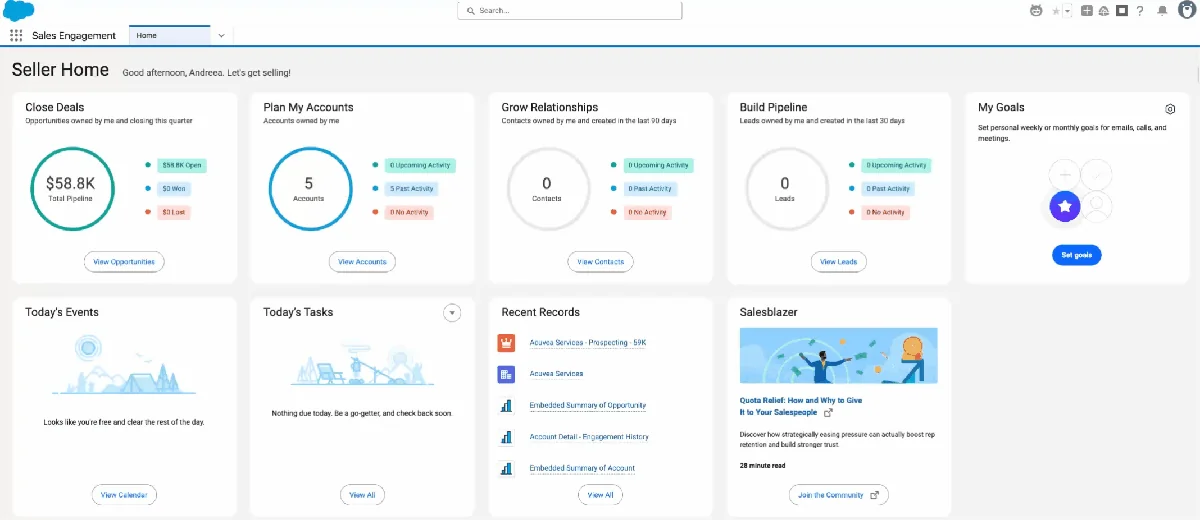
Different clouds in Salesforce usually mean licensed product families such as Sales Cloud, Service Cloud, Experience Cloud, and Marketing Cloud. Add-ons extend a cloud. For example, Digital Engagement extends service channels, Sales Engagement extends rep productivity, and Agentforce can connect to CRM data and actions. This distinction matters because edition, license, permission set, storage, and API access can differ by product.
Products Salesforce teams usually combine
For search terms like products Salesforce, treat the phrase as a request to compare product families. Salesforce teams usually combine products around a customer lifecycle: marketing creates demand, sales converts pipeline, revenue tools price and bill, service supports customers, and data and AI tools connect the experience.
Salesforce features and benefits by product layer
Salesforce features and benefits are easier to evaluate by layer. Applications provide objects and user interfaces. The platform provides automation, security, APIs, metadata, and DevOps patterns. Data 360 provides data unification and activation. Agentforce provides agent actions and conversational automation. The benefit is not the license by itself; it is the process outcome after data quality, permissions, adoption, and integration are handled.
How to choose among Salesforce products
Do not start with a product list. Start with the object model, user journey, integration points, and reporting requirement. Then map each requirement to the product that owns the capability.
| Question | Why it matters | Decision signal |
|---|---|---|
| What is the system of record? | Avoids duplicate customer, product, or order data. | Use Salesforce core objects where CRM users maintain records; use Data 360 when data must be unified from multiple systems. |
| Who needs access? | Licenses and sharing design depend on the user type. | Internal users may use Sales or Service licenses; partners or customers may require Experience Cloud; occasional users may need platform access. |
| Is the process synchronous? | Real-time actions and batch jobs use different patterns. | Use Flow or Apex for CRM transactions; use Platform Events, Batch Apex, MuleSoft, or Bulk API for volume and decoupling. |
| Does the process need AI? | AI needs governed data, safe actions, and clear escalation paths. | Use Agentforce when an agent must reason across topics and invoke actions; use simpler automation for deterministic rules. |
| What compliance controls apply? | Data residency, field security, audit, and consent can change the design. | Validate Shield, consent objects, Data 360 governance, and Hyperforce region requirements before build. |
What are the main Salesforce products?
The following sections explain the product families most teams evaluate first. Product packaging changes over time, so confirm edition, SKU, and add-on availability in your Salesforce contract and the current Salesforce Help documentation before implementation.
Sales Cloud
Sales Cloud supports lead management, account and contact management, opportunities, products, price books, quotes, forecasting, activities, and sales reporting. Salesforce Help describes Sales Cloud basics as a way to generate leads, manage opportunities through the pipeline, cultivate account relationships, forecast revenue, and set up products and price books.
In production, Sales Cloud design decisions usually center on lead conversion rules, account hierarchy, opportunity stages, forecast categories, product catalog ownership, and quoting boundaries. For a deeper walkthrough, read Salesforce Sales Cloud implementation basics.
Sales Performance Management
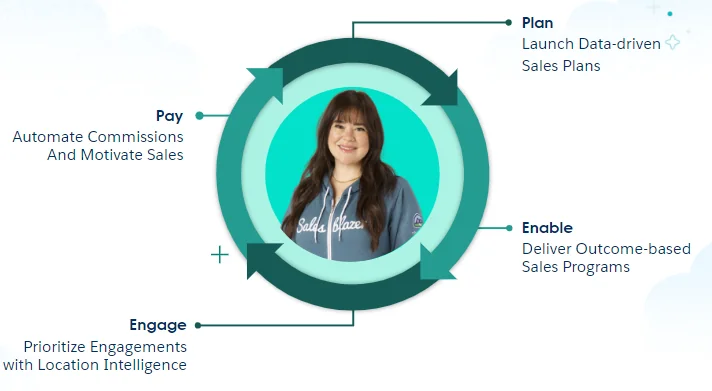
Sales Performance Management covers planning, territories, incentives, and field productivity. It is relevant when a company needs more than opportunity tracking. Typical questions include: who owns which territory, how quotas are assigned, how route planning works, and how compensation is calculated.
Revenue Cloud
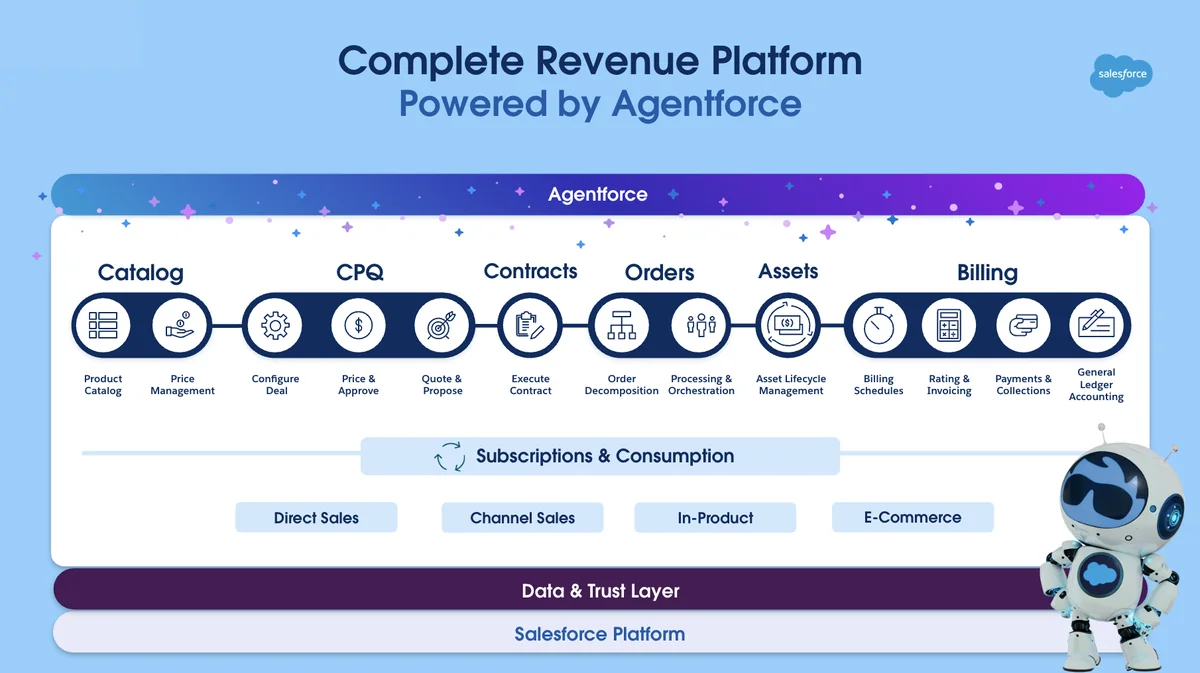
Revenue Cloud is used for product catalog, pricing, quote, order, contract, billing, and revenue operations. Salesforce documentation now includes Agentforce Revenue Management and Revenue Cloud release notes for advanced invoicing and billing scenarios. This product area matters when simple opportunity products and standard quotes cannot handle bundles, usage, amendments, renewals, invoicing, or integrations with ERP and tax systems.
Architects should document the quote-to-cash boundary before build. Decide whether Salesforce owns pricing, whether ERP owns fulfillment, whether billing happens in Salesforce, and how product master data moves between systems. See Salesforce Revenue Cloud architecture notes for related design patterns.
Service Cloud
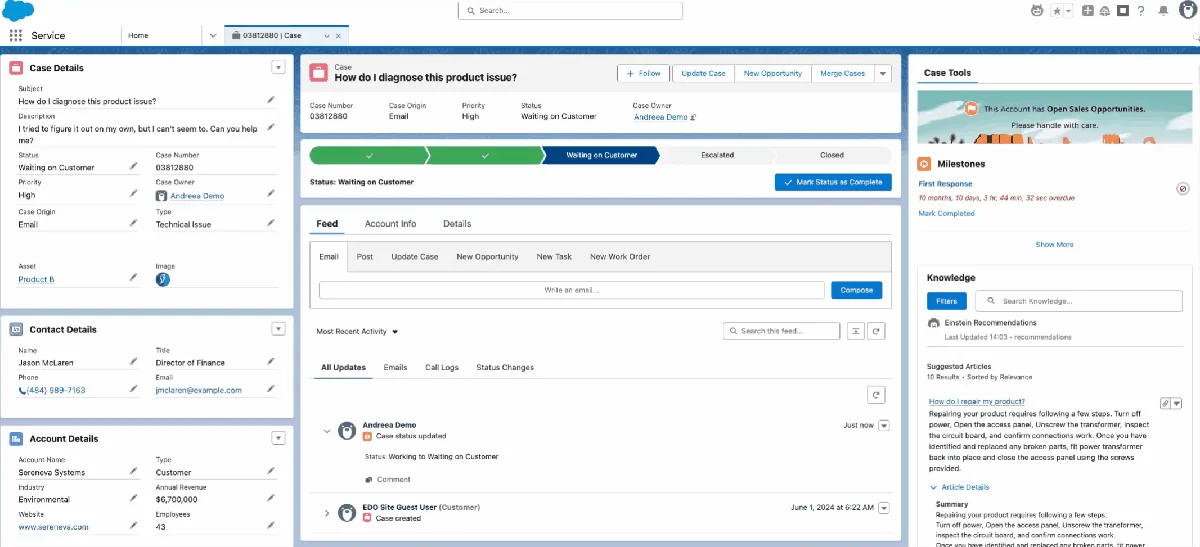
Service Cloud supports case management, service consoles, queues, routing, knowledge, entitlements, service channels, and support analytics. Official Omni-Channel documentation explains that work can be routed to reps through configured queues, routing configurations, presence, and the Omni-Channel component.
In enterprise orgs, Service Cloud succeeds when case intake, assignment, escalation, knowledge, and entitlement rules are designed together. Add-ons such as Digital Engagement, Service Cloud Voice, and Service Intelligence can extend the service model, but the base case lifecycle still needs clean statuses, ownership, and reporting. For setup details, use Salesforce Service Cloud setup guidance.
Agentforce
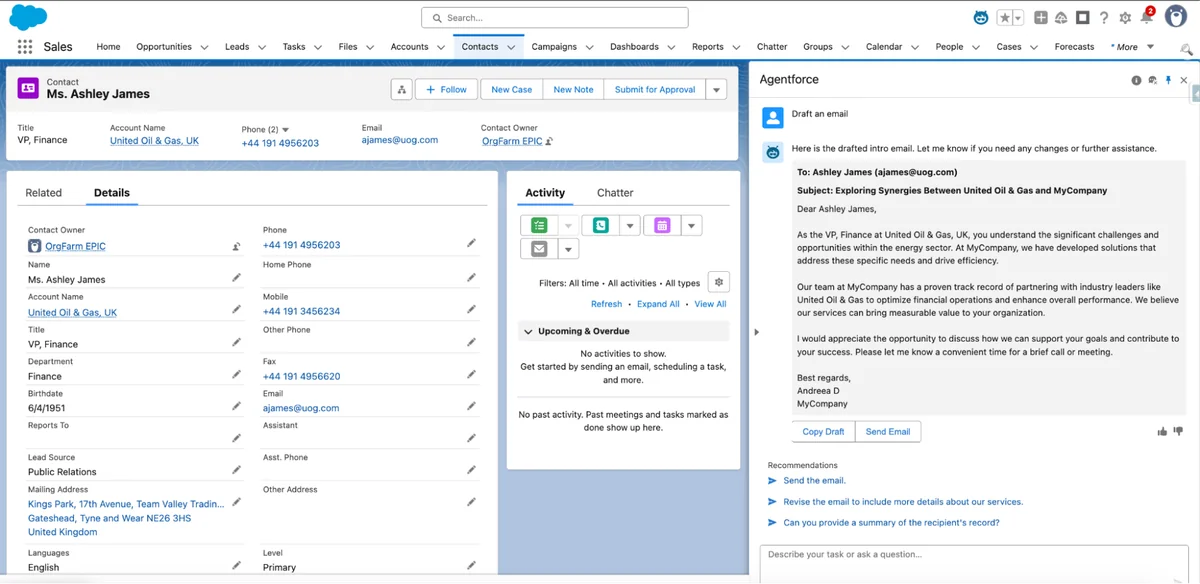
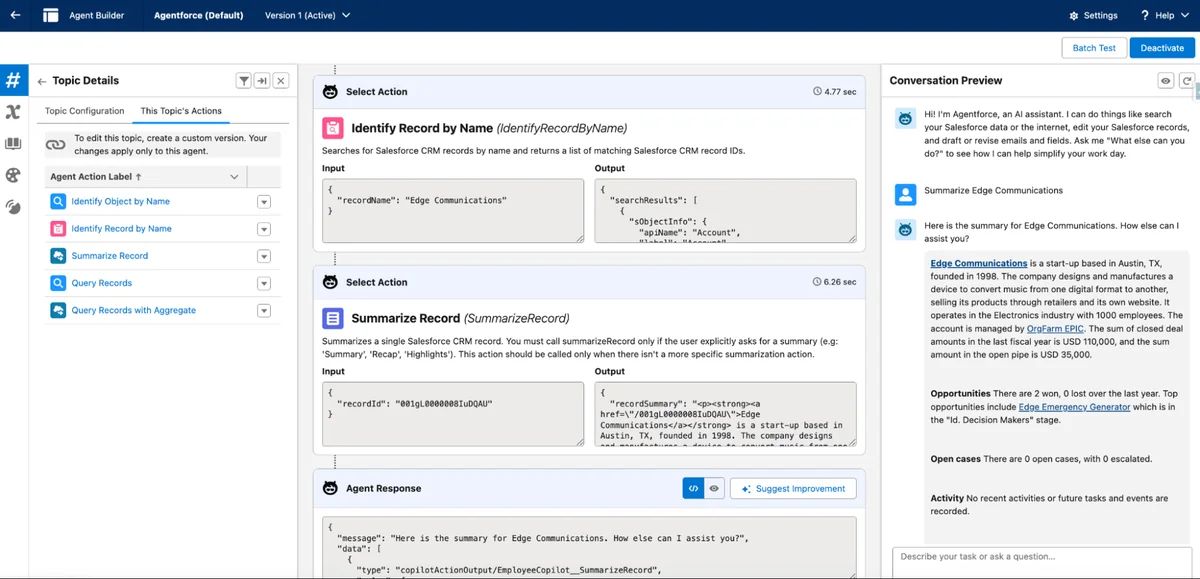
Agentforce is Salesforce’s agentic AI product family for building agents that can answer, reason, and take action through configured topics, actions, instructions, and trusted data access. Salesforce Help states that Agentforce actions are how agents get work done, and the trust documentation explains that agents integrate with the Einstein Trust Layer and respect Salesforce access controls.
Use Agentforce when the process needs natural-language interaction plus controlled action. Do not use it to replace deterministic validation rules, approval processes, or simple scheduled flows. Agent design must include topic scope, action permissions, grounding data, test conversations, fallback behavior, audit requirements, and human handoff. Read Salesforce Agentforce architecture guide for implementation notes.
Data 360, also still searched as Data Cloud
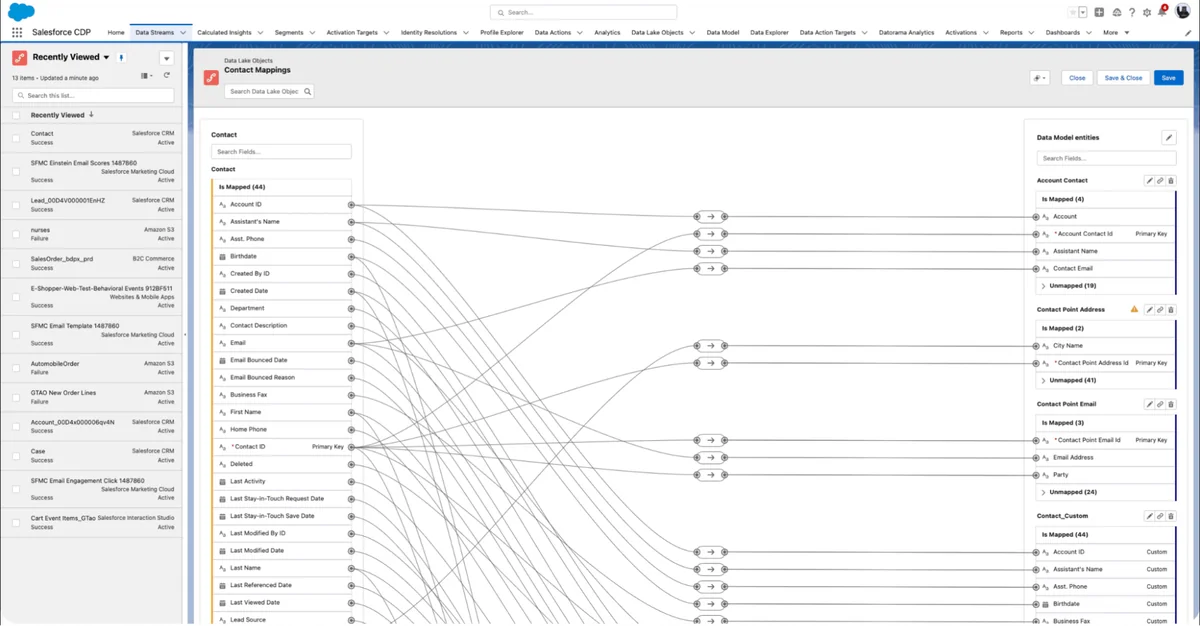
Salesforce documentation now uses Data 360 in many areas while many teams still search for Data Cloud. The product is used to ingest, harmonize, unify, segment, and activate data across Salesforce and external systems. Developer documentation identifies Data 360 Connect REST API as a common API for custom solutions on Data 360.
Use Data 360 when CRM objects alone cannot represent the customer view. Examples include combining web behavior, order history, service cases, loyalty data, and offline transactions into a governed profile. For hands-on data model planning, read Salesforce Data Cloud and Data 360 concepts.
Salesforce Foundations
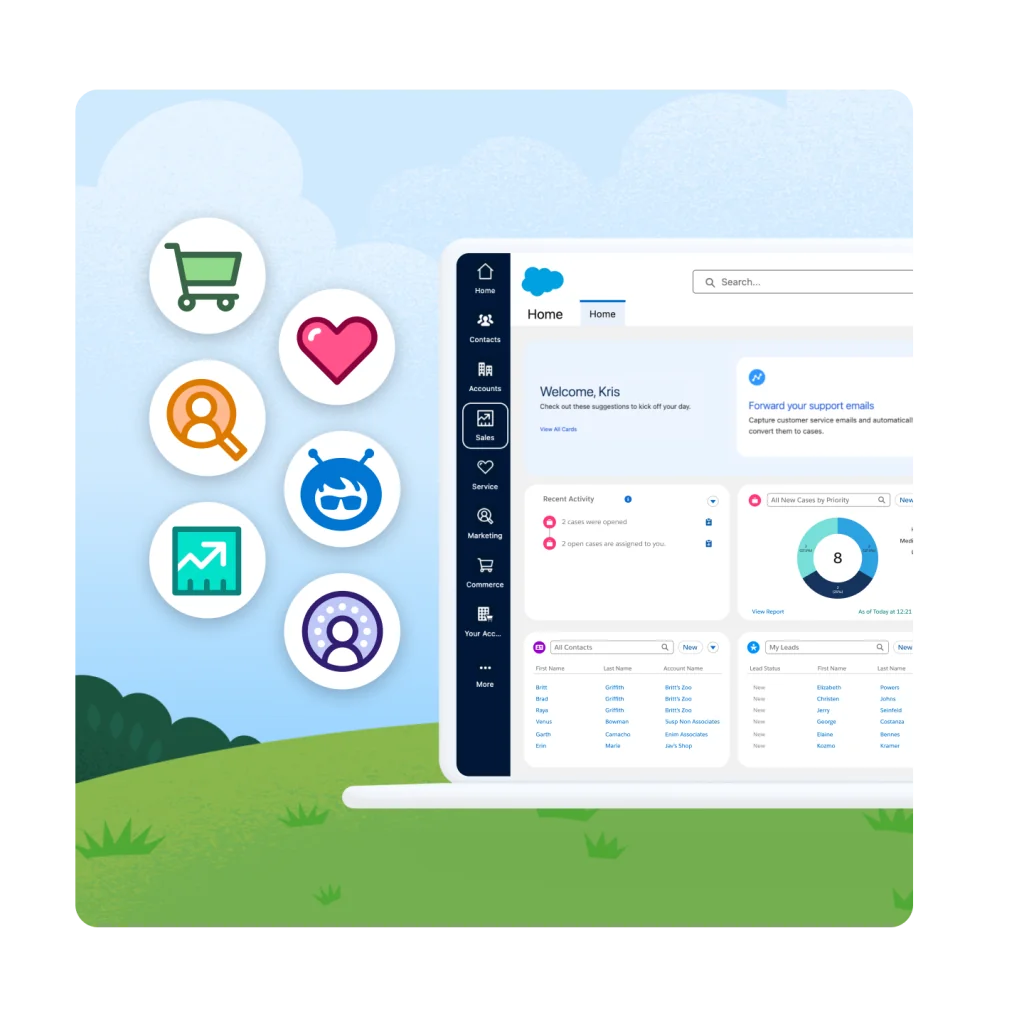
Salesforce Foundations provides a limited set of cross-cloud capabilities for eligible customers. Salesforce Help describes included features across sales, service, marketing, commerce, Data Cloud/Data 360, Agentforce, and platform access. Treat it as an adoption path for exploring connected capabilities, not as a replacement for full product licensing when scale, limits, or advanced features are required.
Field Service
Field Service supports work orders, service appointments, dispatching, scheduling, mobile execution, inventory-related processes, and technician workflows. Salesforce Help describes the Field Service mobile app as an offline-first app for iOS and Android that field workers use to complete tasks and sync with Salesforce.
Field Service needs a different design mindset than a case console. You must model operating hours, skills, territories, service resources, service crews, travel time, work types, mobile offline data, and dispatch exceptions.
Marketing Cloud products
Marketing Cloud is not one product. Marketing Cloud Engagement handles cross-channel B2C journeys and messaging. Marketing Cloud Account Engagement supports B2B lead nurturing, forms, scoring, grading, and campaign influence. Marketing Cloud Growth and Marketing Cloud Advanced are newer Salesforce-platform marketing products that connect closely with Data 360. Marketing teams should decide whether their main need is B2B demand generation, B2C journeys, content, segmentation, analytics, or platform-native campaign operations.
Commerce Cloud
Commerce Cloud supports storefront, catalog, cart, checkout, order, and buyer experiences. The main design question is whether the implementation is B2C, B2B, marketplace, or a Salesforce-native commerce use case. Commerce projects also need product information management, pricing, payment, tax, fulfillment, and identity decisions before configuration begins.
Experience Cloud
Experience Cloud provides external-facing sites and portals for customers, partners, employees, and other audiences. Use it when external users must interact with Salesforce data through authenticated or public experiences. The security model is different from internal user access, so architects must design sharing sets, external sharing models, profiles or permission sets, guest user access, and login flows carefully.
Salesforce Platform, MuleSoft, Slack, Tableau, and Heroku
The platform layer supports custom objects, Lightning apps, Flow, Apex, Lightning Web Components, APIs, events, metadata deployment, and security. MuleSoft supports integration and API-led connectivity. Slack supports collaboration and workflow surfaces. Tableau supports analytics and visual exploration. Heroku supports custom applications that need developer-managed runtime choices. These products often fill gaps around integration, analytics, collaboration, and custom user experiences.
Best practices for implementing Salesforce products
Implementation quality depends less on the number of licenses and more on architecture discipline. Use these checkpoints before configuration starts.
Confirm licenses, editions, limits, and release behavior
- Check the current Salesforce Help page for each product, because required editions and add-on rules can change.
- Confirm API access, storage, automation limits, feature allocations, and sandbox availability.
- Document whether a feature is generally available, beta, pilot, or controlled by Salesforce enablement.
- For release-specific work, test in a sandbox on the target release before production deployment.
Design the data model before the user interface
Salesforce products share platform capabilities, but they do not erase data modeling work. Define account strategy, person account needs, product catalog ownership, consent, identity, duplicate rules, reporting grains, and archival requirements early. Data 360 projects also need source mapping, identity resolution, calculated insights, activation targets, and data retention decisions.
Secure every object, field, record, and action
Use profiles and permission sets for object and field access, sharing rules and teams for record access, and named credentials or external credentials for integrations. In Apex, Salesforce recommends user-mode database operations for enforcing object and field permissions in many access scenarios. The example below uses WITH USER_MODE so a Lightning component receives only records and fields the running user can access.
public with sharing class ProductCatalogSelector {
    public class ProductOption {
        @AuraEnabled public Id pricebookEntryId;
        @AuraEnabled public Id productId;
        @AuraEnabled public String name;
        @AuraEnabled public String productCode;
        @AuraEnabled public String family;
        @AuraEnabled public Decimal unitPrice;

        public ProductOption(PricebookEntry entry) {
            pricebookEntryId = entry.Id;
            productId = entry.Product2Id;
            name = entry.Product2.Name;
            productCode = entry.Product2.ProductCode;
            family = entry.Product2.Family;
            unitPrice = entry.UnitPrice;
        }
    }

    @AuraEnabled(cacheable=true)
    public static List<ProductOption> listActiveProducts(Id pricebookId) {
        if (pricebookId == null) {
            throw new AuraHandledException('pricebookId is required.');
        }

        List<PricebookEntry> entries = [
            SELECT Id, UnitPrice,
                   Product2Id, Product2.Name, Product2.ProductCode, Product2.Family
            FROM PricebookEntry
            WHERE Pricebook2Id = :pricebookId
              AND IsActive = true
              AND Product2.IsActive = true
            WITH USER_MODE
            ORDER BY Product2.Name
            LIMIT 200
        ];

        List<ProductOption> results = new List<ProductOption>();
        for (PricebookEntry entry : entries) {
            results.add(new ProductOption(entry));
        }
        return results;
    }
}
Governor-limit notes: the method performs one SOQL query, does not query inside a loop, limits the result set, and uses a cacheable method for read-only LWC usage. In a large catalog, add filters for product family, search term, currency strategy, or active selling context rather than increasing the limit without a user need.
Plan integrations by transaction type
| Need | Common Salesforce pattern | Implementation note |
|---|---|---|
| Read or update CRM records from an external app | REST API, Composite API, External Services | Use named credentials, least-privilege integration users, and error handling for partial success. |
| Move large record volumes | Bulk API 2.0, Batch Apex | Design for retries, locking, and validation rule failures. |
| React to business events | Platform Events, Change Data Capture, Flow, Apex triggers | Keep subscribers idempotent because messages can be retried. |
| Orchestrate cross-system APIs | MuleSoft or middleware | Keep system APIs separate from process APIs when multiple channels reuse the integration. |
| Activate unified profile data | Data 360 APIs, segments, calculated insights, activations | Confirm identity rules, consent, and activation limits before connecting channels. |
Test product boundaries, not only happy paths
Test classes still need at least 75% Apex code coverage for production deployment, but coverage alone does not prove behavior. Build tests for missing permissions, inactive products, locked price books, queue routing gaps, duplicate customer records, failed callouts, bulk updates, and user profiles with restricted field access.
Common errors with Salesforce products
- Buying before mapping the process: Teams license a product and later discover that the data owner or integration boundary sits elsewhere.
- Treating all clouds as separate systems: Many clouds share platform objects, identity, automation, and security. Design shared governance.
- Ignoring product catalog ownership: Sales, revenue, commerce, ERP, and billing teams must agree on product IDs, prices, bundles, and lifecycle.
- Skipping permission design for AI: Agentforce actions must respect access control, but teams still need to review what an action can do.
- Underestimating data cleanup: Data 360 and AI projects expose duplicate accounts, weak consent data, and inconsistent identifiers quickly.
Recommended learning path for Salesforce products
- Start with Sales Cloud and Service Cloud objects because they appear in many CRM implementations.
- Learn Salesforce Platform basics: objects, fields, automation, security, APIs, metadata, and deployment.
- Add Data 360 concepts if your org needs unified profiles, segmentation, activation, or AI grounding.
- Study Agentforce only after you understand data access, Flow, Apex actions, and trust controls.
- For specialization, choose Revenue Cloud, Marketing Cloud, Field Service, Commerce Cloud, or an industry cloud based on your project work.
Official Salesforce references used
Use Salesforce Help and Salesforce Developer documentation as the source of truth for edition availability, limits, and setup paths. Key references for this article include Sales Cloud basics, Omni-Channel routing, Agentforce trust, Data 360 Connect REST API, and Apex user-mode database operations.
Frequently Asked Questions
What are Salesforce products?
Salesforce products are applications and platform services used to manage sales, service, marketing, commerce, analytics, integration, data, and AI processes. Examples include Sales Cloud, Service Cloud, Data 360, Agentforce, Revenue Cloud, Field Service, Experience Cloud, MuleSoft, Tableau, Slack, and Marketing Cloud products.
What are all Salesforce clouds used for?
All Salesforce clouds are not used for the same job. Sales Cloud manages pipeline, Service Cloud manages support, Marketing Cloud manages campaigns and journeys, Commerce Cloud manages storefronts, Experience Cloud manages portals, Data 360 unifies data, and Agentforce adds agentic AI actions over trusted Salesforce data.
Which Salesforce product should an admin learn first?
An admin should usually learn Sales Cloud, Service Cloud, and Salesforce Platform basics first. These areas teach objects, fields, page layouts, Lightning apps, flows, permissions, sharing, reports, dashboards, and record lifecycle concepts that appear across many Salesforce products.
Is Data Cloud the same as Data 360?
Salesforce documentation now uses Data 360 in many current developer and help areas, while many customers and search queries still use Data Cloud. In implementation work, confirm the label, license, and setup menu in the target org because naming can vary during transition periods.
How is Agentforce different from Flow or Apex?
Agentforce is used when a conversational or agentic experience must reason across topics and invoke approved actions. Flow and Apex are better for deterministic business rules, validations, record updates, integrations, and scheduled automation. Many Agentforce implementations still use Flow or Apex behind the action layer.
Do Salesforce products share the same security model?
Many Salesforce products use the core platform security model, including object permissions, field-level security, record sharing, roles, permission sets, and profiles. Some products also add their own permissions, managed package settings, external user rules, data governance settings, or channel-specific controls. Always validate security in the specific product documentation and test with real permission sets.