SFDC certification opens doors to lucrative Salesforce careers, but navigating the certification landscape can feel overwhelming. With over 40 active certifications across multiple career tracks, choosing the right path requires understanding prerequisites, experience requirements, and career outcomes. This guide provides a comprehensive roadmap for your Salesforce certification journey.
Understanding SFDC Certification Structure
Salesforce organizes certifications into distinct career pathways, each designed for specific roles and skill levels. The certification framework follows a hierarchical structure where foundational certifications serve as prerequisites for advanced specializations.
The current SFDC cert structure includes eight primary pathways:
- Associate Level – Entry-point certifications requiring minimal experience
- Administrator – Core platform management and configuration skills
- Developer – Custom application development and programming
- Consultant – Implementation and solution design expertise
- Architect – Enterprise-level system design and strategy
- Marketer – Marketing Cloud and customer engagement tools
- Designer – User experience and interface design
- Artificial Intelligence – Einstein and AI-powered solutions
Salesforce Certification Pyramid: Career Progression Framework
The salesforce certification pyramid illustrates how certifications build upon each other, creating clear advancement paths. At the foundation, Associate certifications provide entry points for newcomers. The middle tier includes specialized Administrator, Developer, and Consultant tracks. The apex features Architect-level certifications requiring extensive experience and multiple prerequisites.
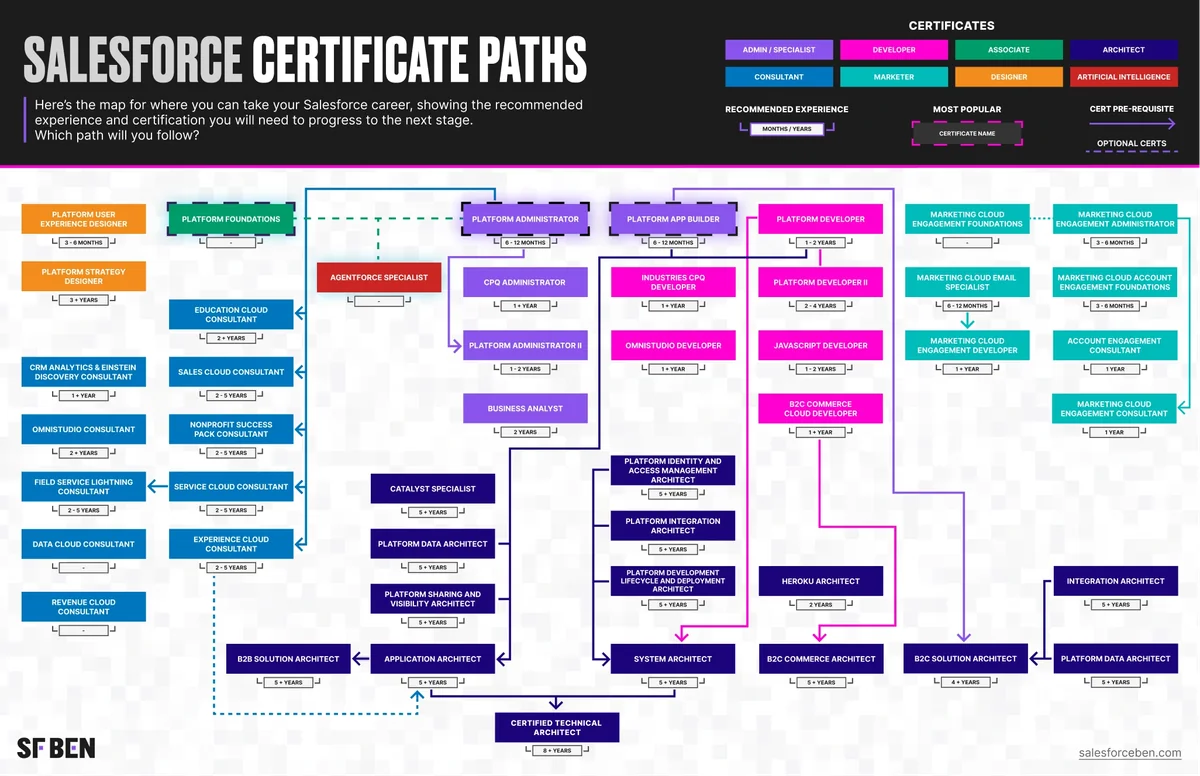
This pyramid structure ensures professionals develop comprehensive skills before advancing to complex certifications. Each level builds technical depth while expanding scope of responsibility.
Core SFDC Certification Pathways
Administrator Track
The Administrator pathway begins with Salesforce Certified Administrator, requiring 6+ months of hands-on experience. This certification covers:
- User management and security model configuration
- Data management and workflow automation
- Reports, dashboards, and analytics
- AppExchange and basic customization
Advanced Administrator follows as the next step, requiring the base Administrator certification plus 12+ months of experience. It covers advanced automation, complex security models, and enterprise-scale deployments.
Developer Track
Platform Developer I serves as the entry point for custom development, requiring 6+ months of Apex and Visualforce experience. Key topics include:
- Apex programming fundamentals and best practices
- SOQL/SOSL query optimization
- Trigger design patterns and governor limits
- Lightning Web Components (LWC) development
Platform Developer II requires Platform Developer I certification plus 2+ years of development experience, covering advanced Apex patterns, integration architecture, and performance optimization.
Consultant Specializations
Consultant certifications require foundational Administrator or Developer credentials plus domain expertise:
- Sales Cloud Consultant – Sales process automation and CRM optimization
- Service Cloud Consultant – Customer service and support solutions
- Experience Cloud Consultant – Portal and community implementations
- Field Service Consultant – Mobile workforce and scheduling solutions
Salesforce Roadmap: Planning Your Certification Journey
Creating an effective salesforce roadmap requires aligning certifications with career goals and current experience level. Consider these factors when planning your path:
Experience Assessment
Salesforce recommends specific experience levels for each certification. Attempting certifications without adequate hands-on experience typically results in failure, as exams test practical application rather than theoretical knowledge.
| Certification Level | Recommended Experience | Prerequisites |
|---|---|---|
| Associate | 0-6 months | None |
| Administrator | 6+ months | None (Associate recommended) |
| Developer I | 6+ months coding | None (Associate recommended) |
| Consultant | 12+ months implementation | Admin or Developer certification |
| Architect | 3+ years enterprise experience | Multiple prerequisite certifications |
Career-Focused Planning
Different roles require different certification combinations. System Administrators benefit from the Administrator track plus relevant consultant specializations. Developers should pursue the Platform Developer pathway alongside integration-focused certifications. Solution Architects need broad certification coverage across multiple domains.
Application Architect Salesforce Certification Path
The application architect salesforce certification represents the pinnacle of technical expertise, requiring extensive prerequisites and experience. This track includes:
Technical Architect Prerequisites
- Platform Developer II certification
- System Architect or Application Architect certification
- Sharing and Visibility Architect certification
- Integration Architect certification
- Identity and Access Management Architect certification
Review Board Process
Technical Architect candidates must pass a comprehensive review board evaluation, including:
- Scenario-based architecture presentations
- Technical deep-dive discussions
- Real-world implementation case studies
- Peer review and recommendation process
Certification Maintenance and Renewal
All Salesforce certifications require ongoing maintenance through Trailhead modules and release-specific updates. Maintenance requirements include:
- Annual release update modules (3 per year)
- Continuing education credits through Trailhead
- Hands-on challenges and superbadges
- Community participation and knowledge sharing
Failing to maintain certifications results in credential suspension and requires retaking the full exam to regain active status.
Study Resources and Preparation Strategies
Effective SFDC cert preparation combines multiple learning approaches:
Official Resources
- Trailhead – Free, comprehensive learning paths aligned with exam objectives
- Exam Guides – Detailed topic breakdowns and weighting from Salesforce
- Practice Exams – Official practice tests available through Webassessor
- Documentation – Help articles and developer guides for in-depth technical reference
Hands-On Experience
Developer Edition orgs provide free environments for practicing configurations and development. Trailhead Playground orgs offer guided exercises with pre-configured scenarios. Production experience remains the most valuable preparation method.
Cost Considerations and ROI
Salesforce certification costs vary by level and region:
- Associate certifications: $75 USD
- Administrator/Developer certifications: $200 USD
- Consultant/Architect certifications: $400 USD
- Technical Architect review board: $6,000 USD
Certification ROI typically justifies costs through salary increases, career advancement opportunities, and enhanced job security in the Salesforce ecosystem.
Common Certification Pitfalls
Avoid these frequent mistakes during your certification journey:
- Insufficient hands-on experience – Theoretical knowledge alone rarely passes practical exams
- Ignoring prerequisites – Attempting advanced certifications without foundational knowledge
- Outdated study materials – Using resources from previous Salesforce releases
- Neglecting maintenance – Allowing certifications to lapse due to missed renewal requirements
- Single-track focus – Limiting career options by pursuing only one certification pathway
Frequently Asked Questions
How long does it take to complete SFDC certification?
Timeline varies by certification level and experience. Associate certifications can be completed in 2-3 months with dedicated study. Administrator and Developer certifications typically require 3-6 months of preparation plus hands-on experience. Consultant and Architect certifications may take 6-12 months or longer due to prerequisite requirements and experience expectations.
Which SFDC cert should I start with as a beginner?
Start with Salesforce Associate certification if you’re completely new to the platform. For those with some Salesforce exposure, Administrator certification provides the broadest foundation. Avoid jumping directly to Developer or Consultant certifications without platform fundamentals.
Do Salesforce certifications expire?
Salesforce certifications require annual maintenance through Trailhead modules but do not technically expire. However, failing to complete maintenance requirements results in credential suspension. Suspended certifications require retaking the full exam to regain active status.
How much do certified Salesforce professionals earn?
Salaries vary by role, location, and experience level. Entry-level certified administrators typically earn $50,000-$70,000 annually. Experienced developers and consultants earn $80,000-$120,000. Certified architects can command $130,000-$200,000+ depending on specialization and market demand.
Can I take multiple Salesforce certifications simultaneously?
Yes, you can schedule and take multiple certifications, but this approach is not recommended. Each certification requires focused study and hands-on experience. Attempting multiple exams simultaneously often results in lower pass rates and superficial knowledge retention.