Salesforce workflow task creation enables automated task assignment when workflow rules or approval processes trigger. This guide covers configuring workflow tasks for both standard and custom objects, including required fields, assignment options, and notification settings.
What is Workflow in Salesforce
Salesforce workflow is an automated process that evaluates records against defined criteria and executes actions like task creation, email alerts, field updates, or outbound messages. Workflow rules run when records are created or edited, making them essential for Salesforce workflow automation.
Workflow tasks are one of four workflow actions available in Salesforce. When a workflow rule triggers, it can automatically create tasks and assign them to users, roles, or record owners.
Salesforce Workflow Task Configuration
To configure workflow tasks, navigate to Setup → Process Automation → Workflow Actions → Tasks → New Task.
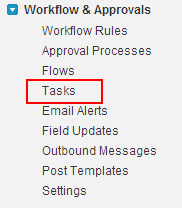
Note: The screenshot shows Classic UI. In Lightning Experience, navigate to Setup → Process Automation → Workflow Actions.
Step 1: Select Object for Workflow Task
Choose the object type from the picklist. Tasks can be created for both standard and custom objects, though custom objects require Activities to be enabled in their settings.
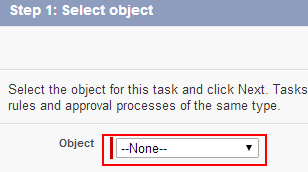
Activities must be enabled for custom objects before workflow tasks can be created. Standard objects have Activities enabled by default.
Step 2: Configure Task Settings
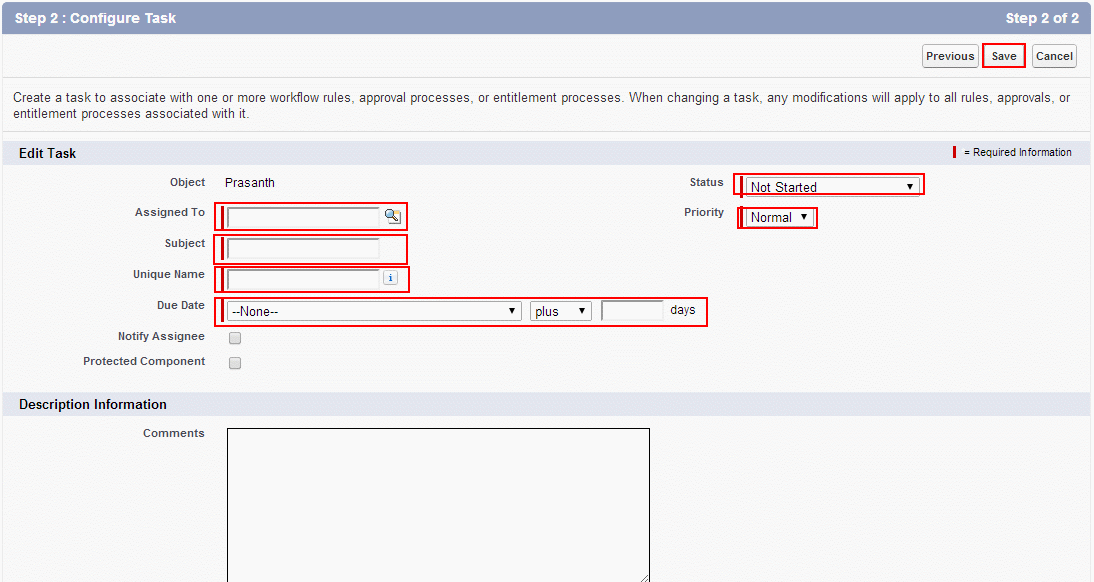
Required Fields for Salesforce Workflow Tasks
When configuring workflow tasks, these fields are mandatory:
Assigned To (Required)
Select the task assignee using the lookup dialog. Options include:
- Users: Assign to specific users by name
- Roles: Assign to users in specific roles
- Record Owner: Assign to the owner of the triggering record
- Creator: Assign to the user who created the record
Limitation: Tasks cannot be assigned to multiple users simultaneously. For multiple assignments, create separate workflow tasks.
Subject (Required)
Enter a unique, descriptive subject for the task. This field is used by the API and managed packages. Use merge fields to include record data:
Follow up on {!Account.Name} - {!Case.CaseNumber}
Due Date (Required)
Set the task due date using:
- Rule Trigger Date: Due immediately when workflow fires
- Created Date: Based on record creation date
- Days from trigger: Specify number of days after workflow execution
Status and Priority (Required)
Select appropriate status (Not Started, In Progress, Completed) and priority (High, Normal, Low) values from picklists.
Optional Workflow Task Settings
Notify Assignee
Check this box to send an email notification to the assigned user when the task is created. The email includes task details and a link to the record.
Comments
Add additional context or instructions for the task assignee. Merge fields can be used to include record-specific information.
Protected Component
Enable this setting for managed packages to prevent modification by subscribers. This is primarily used by ISV developers.
Salesforce Workflow Automation Best Practices
Task Assignment Strategy
- Use record owner assignment for account management tasks
- Assign to roles for department-specific workflows
- Create user-specific assignments for specialized processes
Subject Line Optimization
- Include record identifiers using merge fields
- Keep subjects concise but descriptive
- Use consistent naming conventions across workflow tasks
Due Date Planning
- Set realistic timeframes based on business processes
- Consider business hours and holidays
- Use rule trigger date for immediate action items
Workflow vs Process Builder vs Flow
While workflow rules handle basic automation, consider these alternatives for complex scenarios:
| Feature | Workflow Rules | Process Builder | Flow |
|---|---|---|---|
| Task Creation | Yes | Yes | Yes |
| Multiple Actions | Limited | Yes | Yes |
| Cross-Object Updates | No | Yes | Yes |
| User Interface | No | No | Yes |
Note: Salesforce recommends using Flow for new automation as of Winter ’23. Workflow rules remain supported but are not actively enhanced.
Common Workflow Task Errors
Assignment Failures
- Inactive Users: Tasks fail if assigned to inactive users
- Role Hierarchy: Role-based assignments require proper hierarchy setup
- Permission Issues: Assignees need task creation permissions
Merge Field Errors
- Invalid field references cause workflow failures
- Cross-object merge fields have limitations
- Null values can break subject line formatting
Monitoring Workflow Task Creation
Track workflow task performance using:
- Setup Audit Trail: Monitor workflow rule changes
- Debug Logs: Troubleshoot workflow execution
- Task Reports: Analyze task creation patterns
- Workflow Queue: View pending time-based actions
Frequently Asked Questions
What is workflow in Salesforce interview questions typically cover?
Salesforce workflow interview questions focus on automation concepts, workflow rule criteria, actions (tasks, emails, field updates, outbound messages), time-based workflows, and the differences between workflow rules, Process Builder, and Flow. Candidates should understand when to use each tool and their limitations.
Can workflow tasks be assigned to multiple users?
No, each workflow task can only be assigned to one user, role, or record owner. To assign tasks to multiple users, create separate workflow tasks or use Process Builder with multiple task actions.
What happens when a workflow task is assigned to an inactive user?
The workflow rule will fail to execute if a task is assigned to an inactive user. Always ensure assigned users are active, or use role-based assignment to avoid this issue.
How do time-based workflow tasks work?
Time-based workflow tasks are created when the workflow rule criteria is met, but the task creation is delayed until the specified time trigger occurs. These tasks appear in the Time-Based Workflow queue until execution.
Can workflow tasks include merge fields in the subject?
Yes, workflow task subjects support merge fields from the triggering object. Use syntax like {!Account.Name} or {!Case.CaseNumber} to include record-specific data in task subjects.
What’s the difference between workflow rules and Process Builder for task creation?
Workflow rules can create one task per rule, while Process Builder can create multiple tasks and perform cross-object updates. Process Builder offers more flexibility but workflow rules are simpler for basic task automation.