Dynamic dashboards in Salesforce provide security-aware data visualization that adapts to each user’s permissions and role. Unlike static dashboards that show the same data to everyone, dynamic dashboards display information based on the logged-in user’s access level, ensuring data security while maintaining organizational visibility.
Salesforce dashboards are visual representations of report data using components like charts, graphs, gauges, tables, and metrics. Each dashboard supports up to 20 components and can be configured to run with different security contexts depending on your organization’s requirements.
What Are Dynamic Dashboards in Salesforce?
Dynamic dashboards differ from standard dashboards in how they handle data visibility and user permissions. When you create a standard dashboard, it runs with a fixed user context – meaning everyone sees the same data regardless of their individual permissions. Dynamic dashboards solve this limitation by running with the context of whoever is viewing the dashboard.
This security model ensures that users only see data they have permission to access, making dynamic dashboards essential for organizations with complex sharing rules, role hierarchies, and field-level security requirements.
Dashboard Security Settings: Run As Options
Salesforce provides two security options for dashboard execution:
- Run as Specified User: The dashboard displays data based on a single designated user’s permissions. All viewers see the same data regardless of their individual access levels.
- Run as Logged-in User: The dashboard displays data based on each viewer’s individual permissions. This creates a dynamic experience where the same dashboard shows different data to different users.
When you select “Run as Logged-in User,” the dashboard becomes dynamic. Each user sees only the records they have permission to view, filtered by their sharing rules, role hierarchy position, and field-level security settings.
Setting Up Dynamic Dashboards in Salesforce
Dynamic dashboards display metrics across organizational levels while respecting data security boundaries. Enterprise Edition orgs can create up to 5 dynamic dashboards, while Unlimited Edition supports up to 10 dynamic dashboards.
Creating Dynamic Dashboards: Step-by-Step Process
Follow these steps to convert an existing dashboard to dynamic mode or create a new dynamic dashboard:
Step 1: Access Dashboard Settings
- Navigate to the Dashboards tab and go to the dashboards list

Step 2: Edit Dashboard Properties
- Select your target dashboard and navigate to Actions → Edit

Step 3: Configure Dynamic Settings
- Click on the “View dashboard as” field option located on the right side of the interface
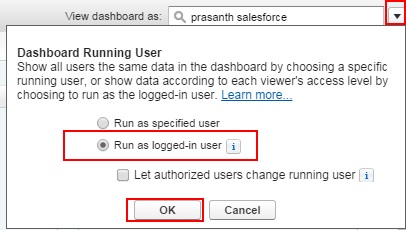
Step 4: Enable Dynamic Mode
- Select “Run as logged-in user” to enable dynamic functionality
- Check “Let authorized users change running user” if you want to allow users with appropriate permissions to temporarily view the dashboard from another user’s perspective
- Click OK to save your configuration
After completing these steps, your dashboard will function as a dynamic dashboard, showing personalized data to each user based on their individual Salesforce permissions.
Dynamic Dashboard Best Practices
Performance Considerations
Dynamic dashboards require more processing power than static dashboards because Salesforce must evaluate each user’s permissions in real-time. Consider these optimization strategies:
- Use selective report filters to reduce data volume
- Limit the number of components per dashboard
- Schedule dashboard refreshes during off-peak hours
- Monitor dashboard load times and user feedback
Security and Governance
Dynamic dashboards inherit Salesforce’s security model, but administrators should verify:
- Field-level security settings are properly configured
- Sharing rules align with business requirements
- Role hierarchy reflects organizational structure
- Users understand why they see different data than colleagues
User Training and Communication
Since dynamic dashboards show different data to different users, provide clear communication about:
- Why dashboard data varies between users
- How permissions affect dashboard visibility
- Who to contact for access-related questions
- Expected refresh schedules and data freshness
Troubleshooting Dynamic Dashboard Issues
Common Problems and Solutions
Empty or Missing Data: Users may see blank dashboards if they lack access to underlying report data. Verify sharing settings on source reports and ensure users have appropriate object and field permissions.
Performance Issues: Dynamic dashboards may load slowly during peak usage. Consider reducing component count, optimizing report filters, or scheduling refreshes during low-traffic periods.
Inconsistent Results: If users report unexpected data variations, review role hierarchy settings, sharing rules, and field-level security configurations that might affect data visibility.
Dynamic Dashboard Limitations
Understanding dynamic dashboard constraints helps set appropriate expectations:
- Limited quantity: Enterprise Edition (5 dashboards), Unlimited Edition (10 dashboards)
- Performance impact: Higher server load compared to static dashboards
- Complexity: More difficult to troubleshoot permission-related issues
- Refresh timing: May take longer to refresh due to permission calculations
Frequently Asked Questions
What is the difference between static and dynamic dashboards in Salesforce?
Static dashboards run with a fixed user context, showing the same data to all viewers. Dynamic dashboards run with each logged-in user’s permissions, displaying personalized data based on individual access levels, sharing rules, and field-level security settings.
How many dynamic dashboards can I create in Salesforce?
Enterprise Edition allows up to 5 dynamic dashboards, while Unlimited Edition supports up to 10 dynamic dashboards. These limits are separate from your total dashboard allocation.
Why is my dynamic dashboard showing no data?
Empty dynamic dashboards typically indicate permission issues. Check that you have access to the underlying reports, verify object-level permissions, confirm field-level security settings, and review sharing rules that might restrict data visibility.
Can I convert an existing dashboard to dynamic?
Yes, you can convert existing dashboards to dynamic by editing the dashboard properties and changing the “View dashboard as” setting from “Run as specified user” to “Run as logged-in user.”
Do dynamic dashboards affect Salesforce performance?
Dynamic dashboards require more processing power because Salesforce must evaluate each user’s permissions in real-time. This can impact load times, especially with complex permission structures or during peak usage periods.