This Salesforce automation example demonstrates how to derive year and month values from Opportunity close dates using formula fields. Formula fields are a core automation tool that calculate values dynamically without requiring Apex code or workflow rules.
What is Salesforce Automation
Salesforce automation refers to using platform features to automatically calculate, update, or trigger actions based on data changes. Formula fields, workflow rules, Process Builder, and Flow are common automation tools. This example focuses on formula fields — calculated fields that derive values from other fields on the same record or related records.
Salesforce Automation Example: Date Formula Field
Deriving year and month values from Opportunity close dates is a practical automation example. This creates a text representation of dates for reports and dashboards. The standard CloseDate field contains the full date, but reports often need just “2024-03” format for grouping.
Formula fields automatically recalculate when the source field changes, making this approach more reliable than manual data entry or batch updates.
Creating the Formula Field: Step-by-Step
Follow these steps to create a formula field that extracts year and month from the Opportunity close date.
Step 1: Navigate to Opportunity Fields
Go to Setup → Object Manager → Opportunity → Fields & Relationships.
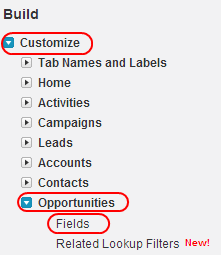
In Lightning Experience, the path is Setup → Object Manager → Opportunity → Fields & Relationships. In Salesforce Classic, use Setup → Customize → Opportunities → Fields.
Step 2: Create New Custom Field
Click New in the Opportunity Custom Fields and Relationships section.

Step 3: Select Formula Data Type
Select Formula as the data type and click Next.
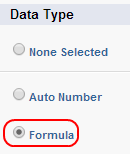
Formula fields calculate values based on other fields, functions, or expressions. They’re read-only and update automatically when source data changes.
Step 4: Configure Field Properties
Enter the field details:
- Field Label: Close Date Year Month
- Field Name: Close_Date_Year_Month (auto-populated)
- Formula Return Type: Text
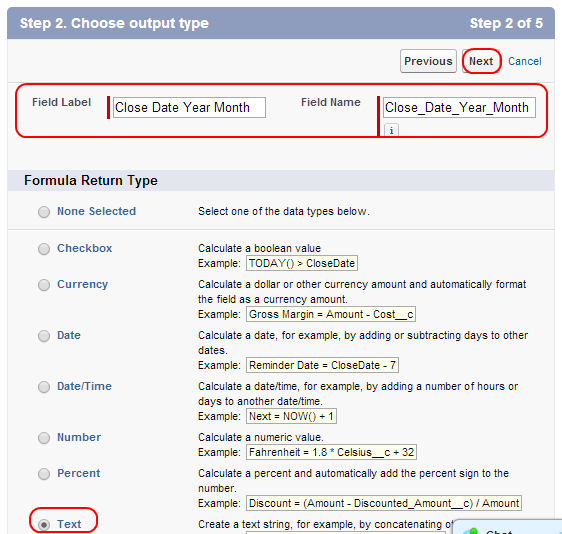
Choose Text as the return type because we want a formatted string like “2024-03” rather than a date value.
Step 5: Enter the Formula Code
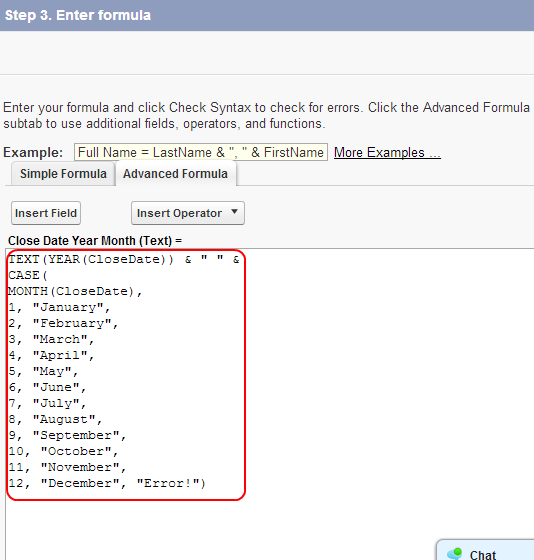
Enter this formula in the editor:
TEXT(YEAR(CloseDate)) + "-" +
IF(MONTH(CloseDate) < 10,
   "0" + TEXT(MONTH(CloseDate)),
   TEXT(MONTH(CloseDate))
)
Formula Breakdown
YEAR(CloseDate)– Extracts the 4-digit yearTEXT()– Converts numbers to text for concatenationMONTH(CloseDate)– Extracts the month number (1-12)IF(MONTH(CloseDate) < 10, "0" + TEXT(MONTH(CloseDate)), TEXT(MONTH(CloseDate)))– Adds leading zero for single-digit months
This formula handles null dates gracefully — if CloseDate is blank, the formula returns blank.
Step 6: Configure Blank Field Handling
Select Treat blank fields as blanks and click Next.
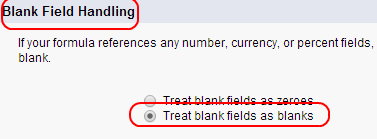
This setting determines how the formula handles null values in referenced fields. “Treat blank fields as blanks” means if CloseDate is null, the formula returns null rather than throwing an error.
Step 7: Set Field-Level Security
Configure field visibility for profiles and permission sets. Select Visible for relevant profiles and click Save.
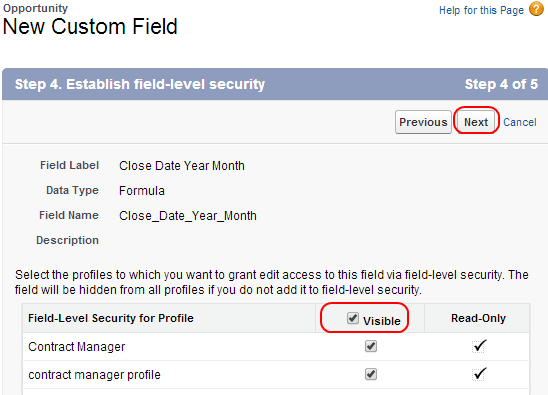
Field-level security controls which users can view or edit fields. Formula fields are always read-only, so you only set visibility permissions.
Testing the Formula Field
Navigate to any Opportunity record to verify the formula works correctly.

The formula field displays the year and month in YYYY-MM format. If the close date is March 15, 2024, the formula shows “2024-03”.
Advanced Formula Examples for Salesforce Automation
This date extraction example demonstrates basic formula syntax. Here are additional automation patterns using formula fields:
Business Days Calculation
// Calculate business days between created date and close date
WEEKDAY(CreatedDate) - WEEKDAY(CloseDate) +
(WEEKDAY(CloseDate) - WEEKDAY(CreatedDate)) / 7 * 5
Conditional Text Based on Amount
// Categorize opportunities by size
IF(Amount >= 100000, "Enterprise",
   IF(Amount >= 25000, "Mid-Market", "SMB")
)
Cross-Object Formula (Account Industry)
// Reference parent account industry
Account.Industry
Best Practices for Formula Field Automation
- Handle null values: Use ISNULL() or ISBLANK() functions to prevent errors
- Consider performance: Complex formulas with many IF statements can slow page loads
- Test edge cases: Verify behavior with blank dates, future dates, and leap years
- Document formulas: Add comments in the description field explaining the business logic
- Use appropriate return types: Text for formatted output, Number for calculations, Date for date arithmetic
Alternative Automation Approaches
While formula fields work well for simple calculations, consider these alternatives for complex automation:
- Workflow Rules: Update fields based on criteria (being phased out)
- Process Builder: More complex logic with multiple actions (being phased out)
- Flow: Current recommended approach for complex automation
- Apex Triggers: Custom code for advanced scenarios requiring governor limit considerations
Common Formula Field Errors
When creating formula fields, watch for these common issues:
- Data type mismatches: Ensure consistent data types in calculations
- Null reference errors: Always handle potential null values
- Circular references: Formula fields cannot reference themselves directly or indirectly
- Character limits: Formula text is limited to 3,900 characters
- Function limits: Some functions have specific limitations (e.g., REGEX limited to 100 characters)
What are the most common Salesforce automation examples for beginners?
Common Salesforce automation examples include formula fields for calculations, workflow rules for field updates, validation rules for data quality, and auto-response rules for case management. Formula fields like date extraction, percentage calculations, and conditional text are good starting points.
How do Salesforce apex code examples differ from formula field automation?
Salesforce Apex code examples involve custom programming with triggers, classes, and batch jobs that can perform complex logic, DML operations, and callouts. Formula fields are declarative automation limited to calculations and cannot modify data or perform external integrations. Apex requires development skills while formulas use point-and-click configuration.
Can formula fields reference Salesforce role hierarchy examples?
Formula fields cannot directly reference role hierarchy relationships. However, you can create formula fields that reference user fields like Role.Name or Role.DeveloperName to display role information. For complex role-based automation, use Apex triggers or Flow instead.
What are SOQL relationship query examples in formula fields?
Formula fields support cross-object references using dot notation, similar to SOQL relationship queries. Examples include Account.Industry, Owner.Email, or Parent.Name. You can traverse up to 10 relationship levels, but each reference counts toward formula complexity limits.
How do workflow rules in Salesforce examples compare to modern automation?
Workflow rules in Salesforce examples are legacy automation tools being replaced by Flow. Workflow rules can send emails, create tasks, update fields, and send outbound messages based on criteria. Flow provides the same functionality with better user interface, debugging capabilities, and more complex logic options.