Creating help pages for Salesforce custom objects improves user adoption by providing context-sensitive documentation directly within your org. This guide shows you how to generate help pages for custom objects using Visualforce pages and PDF documents as static resources.
In our previous Salesforce training tutorials we learned about how to convert 15 digit opportunity ID into 18 digit ID. This tutorial covers generating help pages for custom objects using Visualforce and PDF documents.
What Are Help Pages for Salesforce Objects?
Help pages for Salesforce objects provide users with contextual documentation and guidance. When users click the “Help for this page” link on standard objects in Salesforce or custom objects, they can access relevant documentation. For custom objects, you must create these help pages manually using Visualforce pages that reference PDF documents stored as static resources.
Prerequisites for Creating Custom Object Help Pages
Before creating help pages for your Salesforce custom objects, ensure you have:
- System Administrator or equivalent permissions
- Access to Setup menu
- A PDF document with your help content
- Basic understanding of Visualforce pages
- Custom objects already created in your org
Step-by-Step Process Overview
Creating help pages for custom objects involves four main steps:
- Upload PDF document as a static resource
- Create a Visualforce page to display the PDF
- Link the Visualforce page to your custom object
- Test the help page functionality
Step 1: Upload PDF Document as Static Resource
Static resources in Salesforce store files like PDFs, images, and JavaScript that you can reference in Visualforce pages. Here’s how to upload your help document:
Go to Setup.

Navigate to Develop → Static Resources → New
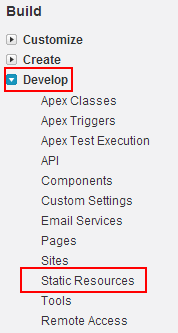
Click the New button to create a new static resource.

Enter the name for the static resource in the Name field as CustomObjectHelpText.
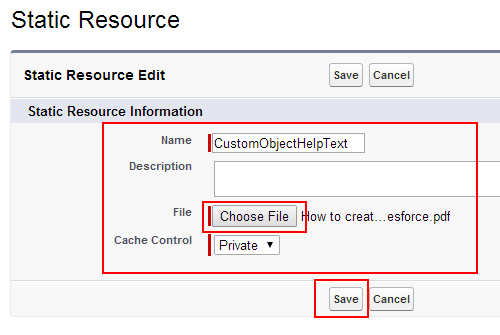
In the file section, click Choose File and upload your PDF document. Leave Cache Control as Private for security.
Click Save to complete the static resource creation.
Step 2: Create Visualforce Page for PDF Display
The PDF document is now stored in Salesforce as a static resource. Next, create a Visualforce page that references this PDF document.
Go to Setup → Develop → Pages.
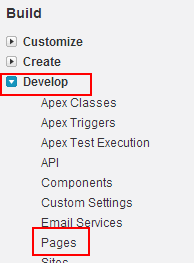
Click New to create a new Visualforce page.

Enter the Label and Name fields as shown below:
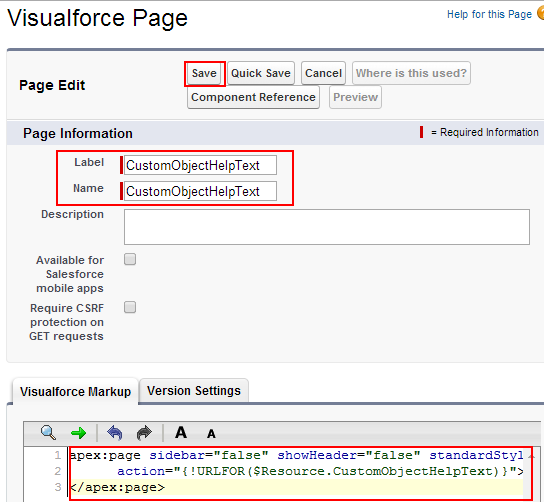
The Visualforce page code should reference your static resource:
<apex:page>
  <apex:iframe src="{!URLFOR($Resource.CustomObjectHelpText)}" width="100%" height="600px"/>
</apex:page>
Click the Save button to save your Visualforce page.
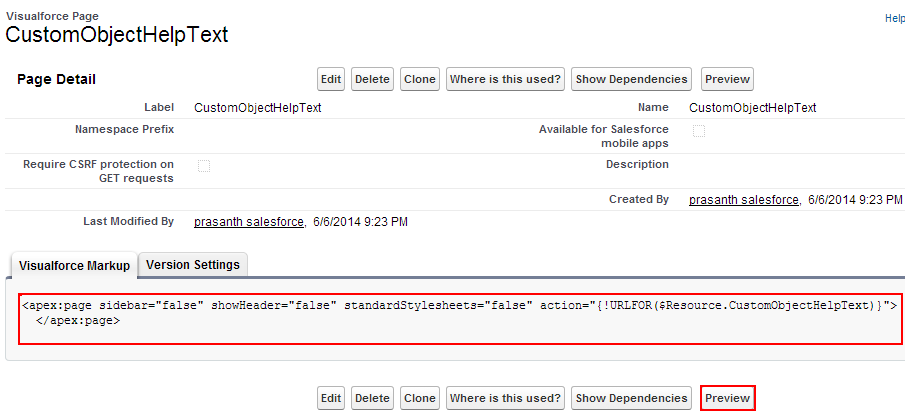
Configure Visualforce Page Security
After creating the Visualforce page, configure security settings to control which profiles can access it.
Go to Setup → Develop → Pages and find your CustomObjectHelpText Visualforce page. Click the Security link.

Set security permissions for the required profiles. Enable access for profiles that need to view the help pages.
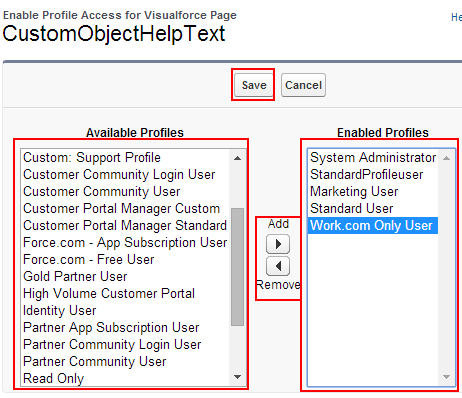
Click Save to apply the security settings.
Step 3: Link Visualforce Page to Custom Object
Now connect your Visualforce page to the custom object so users can access the help content.
Navigate to Setup → Create → Objects → [Your Custom Object] → Edit
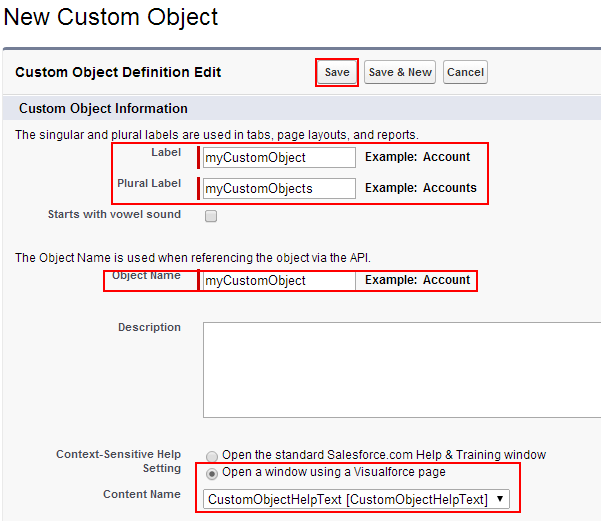
In the Context-Sensitive Help Settings section:
- Select Open a window using a Visualforce page
- Choose CustomObjectHelpText from the Content Name dropdown
- Configure other help settings as needed
Click Save to apply the changes to your custom object.
Step 4: Test the Help Page
Test your help page implementation by navigating to a record of your custom object.
Go to the detail view of any custom object record and click Help for this page on the right side of the page.
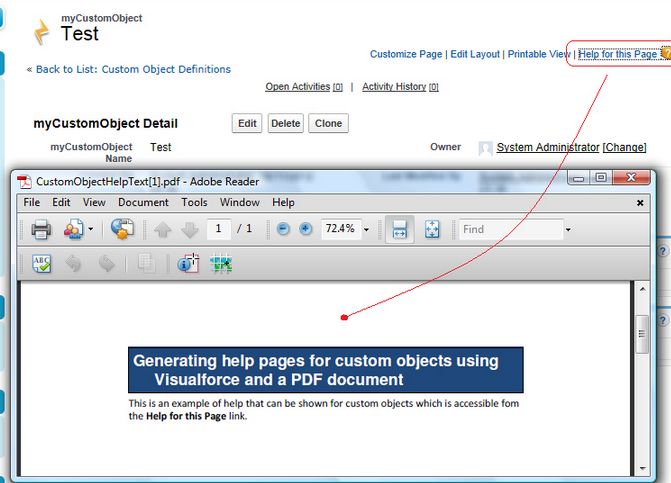
After clicking the link, your PDF document should open in a new window, displaying the help content for your custom object.
Best Practices for Custom Object Help Pages
When creating help pages for Salesforce custom objects, follow these best practices:
- Keep PDFs under 5MB to ensure fast loading times
- Use descriptive static resource names for easy identification
- Test across different browsers to ensure compatibility
- Update help content regularly as your custom objects evolve
- Consider mobile users when designing PDF layouts
- Use consistent branding across all help documents
Alternative Approaches for Object Help
While PDF documents work well for comprehensive help content, consider these alternatives:
- HTML-based Visualforce pages for more interactive help content
- Lightning Web Components for modern, responsive help interfaces
- External documentation links to wikis or knowledge bases
- Embedded videos for visual learners
Troubleshooting Common Issues
If your help pages aren’t working correctly, check these common issues:
- Static resource not found: Verify the resource name matches exactly in your Visualforce page
- Permission errors: Ensure the Visualforce page has proper profile access
- PDF not displaying: Check browser PDF plugin settings
- Help link not appearing: Verify the custom object help settings are configured correctly
Frequently Asked Questions
What file types can I use for Salesforce custom object help pages?
You can use PDF files, HTML files, images, and other static content. PDF files are most common for comprehensive help documentation, while HTML files offer more interactive possibilities.
Can I create help pages for standard objects in Salesforce?
Standard objects in Salesforce already have built-in help content from Salesforce. You cannot override the help for standard objects like Account, Contact, or Opportunity with custom help pages.
How do I update the help content after creating the help page?
To update help content, upload a new version of your PDF to the same static resource name. The Visualforce page will automatically reference the updated content without requiring code changes.
What happens if users don’t have access to the Visualforce page?
Users without proper profile permissions will see an access denied error when clicking the help link. Ensure all relevant user profiles have access to the Visualforce page through the security settings.
Can I track usage of custom object help pages?
Yes, you can add custom tracking to your Visualforce page using Google Analytics or create custom objects to log help page views. This helps measure user engagement with your help content.